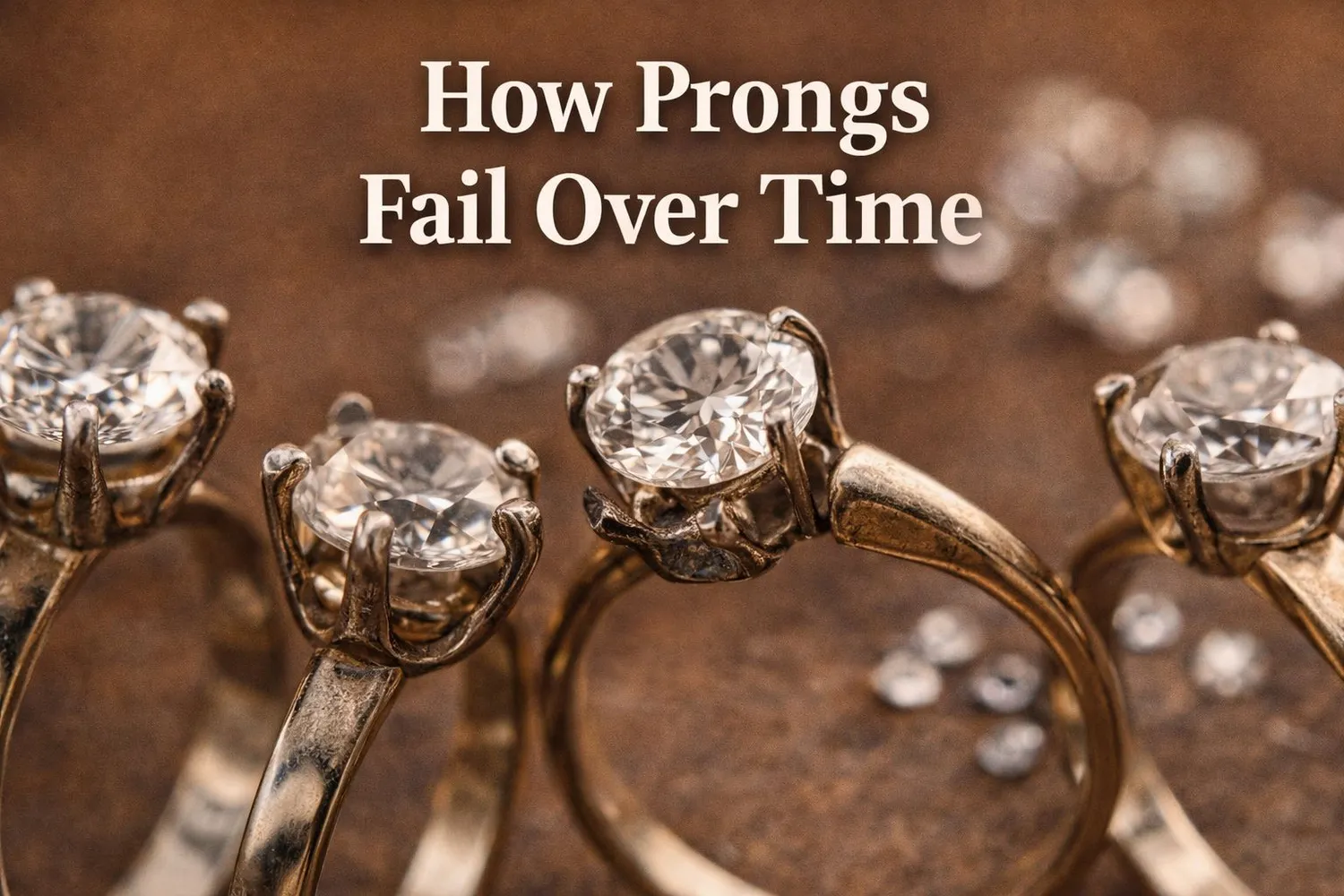
Walk into almost any jewelry store and you’ll see a familiar design choice: extremely thin prongs holding a gemstone as lightly as possible. The goal is clear. Thin prongs make the stone look larger, brighter, and less obstructed by metal.
From a visual standpoint, the effect works. The gemstone appears to float. Light reaches more of the stone’s surface. The setting looks delicate and refined.
But thin prongs come with a trade-off that many buyers don’t fully understand. The same design that improves appearance also reduces the structural margin that keeps the stone secure over time.
Prongs are small metal supports that hold a gemstone in place by gripping its edge. When those supports become extremely thin, they have less metal to absorb wear, resist bending, and survive years of daily contact with the environment.
Understanding the balance between elegance and durability helps buyers make more informed choices—and helps owners know what kind of maintenance delicate settings require.
The Aesthetic Trend Toward Ultra-Fine Settings
Modern jewelry design often favors minimal metal. Over the last two decades, many engagement rings and gemstone settings have moved toward slimmer bands and finer prongs.
There are several reasons for this shift.
First, thinner prongs reveal more of the gemstone. When less metal covers the edges of the stone, light can enter from more directions, which enhances sparkle. Even small changes in metal coverage can noticeably change how a stone looks.
Second, delicate settings emphasize the gemstone visually. A large stone held by thin prongs appears more prominent than the same stone held by thick metal claws.
Third, fashion trends have leaned toward lighter, more minimalist jewelry. Slim bands and refined prongs match that aesthetic.
From a design standpoint, thin prongs can be beautiful. They make the gemstone the focal point of the piece.
However, jewelry design doesn’t operate only in the visual realm. Every design choice interacts with physics and material limits.
Structural Limits of Thin Metal Prongs
A prong works like a tiny cantilevered beam: a small metal arm anchored at the base of the setting and extending upward to grip the gemstone. That structure carries stress whenever the ring contacts another surface.
When the prong becomes thinner, two structural changes happen immediately.
First, the prong loses bending strength.
The resistance of a metal piece to bending depends heavily on its thickness. Even small reductions in thickness can significantly reduce stiffness.
Second, the prong loses wear reserve.
Every prong slowly loses metal through abrasion over time. When the original prong is thin, there is simply less metal available before the structure becomes too weak.
This doesn’t mean thin prongs are automatically unsafe. But the margin for long-term wear becomes smaller.
A thicker prong might lose some metal and still remain structurally sound. An ultra-thin prong may reach its failure point much sooner.
Minimum Practical Thickness Considerations
Jewelers rarely publish universal minimum dimensions for prongs, because appropriate thickness depends on several variables:
- gemstone size
- gemstone shape
- metal type
- setting height
- overall ring design
However, practical limits do exist. A prong must contain enough metal to do three things reliably:
- Grip the stone securely
- Resist bending during everyday contact
- Maintain enough metal for future repairs
If a prong starts extremely thin, there may not be enough metal to reshape or rebuild later.
Many jewelers address this by tapering the prong. The base is thicker for strength, while the visible tip remains thin for aesthetics. This approach keeps the stone visually open without sacrificing as much structural support.
Buyers rarely see the base of the prong clearly, but that hidden thickness often determines how well the setting survives long-term wear.
Wear Rate vs. Prong Mass
All prongs experience wear. The difference between thick and thin prongs is how quickly that wear becomes a problem.
Everyday interactions—brushing against desks, countertops, door handles, and clothing—remove tiny amounts of metal from the prong tips. The process is extremely slow, but it accumulates over time.
The concept to understand is wear reserve.
Imagine two prongs:
- one relatively thick
- one extremely thin
Both experience the same environment and the same wear rate. The thicker prong simply has more material available before the tip becomes too small to hold the stone.
The thinner prong reaches that threshold much sooner.
Because prongs are already small components, the difference between safe and unsafe metal thickness may be measured in fractions of a millimeter.
That’s why routine inspection matters more with delicate settings.
The Trade-Off Between Sparkle and Durability
Thin prongs improve the appearance of many gemstones. Less metal around the stone allows more light to enter and exit.
This visual benefit is real, but it must be balanced with durability.
Thicker prongs block a small portion of light at the edges of the gemstone. In most cases, the difference in sparkle is modest, especially when the stone is viewed from normal distances.
However, the durability difference between thick and ultra-thin prongs can be substantial over years of wear.
Designers often try to balance these factors in several ways:
- using slightly thicker bases with fine tips
- increasing the number of prongs
- lowering the height of the setting
- shaping prongs to minimize visual bulk
The best designs achieve a balance rather than pushing one extreme.
How Jewelers Reinforce Delicate Settings
When a design calls for delicate prongs, jewelers often reinforce other parts of the structure to compensate.
Thicker prong bases
The base of the prong—where it connects to the ring head—can be made thicker than the visible tip. This improves resistance to bending while keeping the upper portion visually fine.
Additional prongs
A six-prong setting distributes stress across more supports than a four-prong setting. If one prong weakens, the others still help hold the stone.
Lower gemstone height
High-profile settings expose prongs to more leverage during impacts. Lowering the stone reduces the bending force applied when the ring contacts hard surfaces.
Protective gallery structures
Some rings include a gallery rail beneath the stone that connects the prongs. This structure helps stabilize them and limits how far they can bend outward.
These reinforcements allow designers to maintain delicate aesthetics while improving durability.
Situations Where Thin Prongs Are Acceptable
Thin prongs are not automatically a bad choice. In certain situations, they perform well.
Jewelry worn occasionally
Rings or pendants worn only during special events experience far less wear than daily jewelry. Delicate prongs can last a long time under light use.
Protective settings
Some settings shield the prongs from direct impact. For example, designs where the stone sits slightly recessed may reduce exposure.
Smaller gemstones
Small stones create less leverage on the prongs. When the stone is light and the setting sits close to the band, thin prongs may remain stable longer.
Owners willing to maintain the setting
Delicate prongs often require more frequent inspections and occasional repairs. Owners who understand this and schedule regular checks can safely enjoy thinner designs.
The key factor is matching the design to how the jewelry will actually be worn.
Situations Where Thin Prongs May Be Risky
Certain combinations increase the likelihood that thin prongs will wear or fail more quickly.
Large gemstones
Larger stones create more leverage during impacts. If the stone sits high above the band, that leverage increases further.
Daily wear rings
Engagement rings and wedding rings are often worn constantly. Over years of use, thin prongs may experience thousands of minor contacts.
Active lifestyles
People who frequently work with their hands expose rings to more mechanical stress.
Very high settings
A tall setting increases the distance between the gemstone and the band, which increases bending force when the ring hits something.
In these situations, slightly thicker prongs often provide better long-term reliability.
Practical Buying Guidelines
Choosing a ring or gemstone setting involves balancing aesthetics with durability. Buyers don’t need to avoid thin prongs entirely, but a few practical guidelines help reduce risk.
Examine prong bases
If possible, look at the base of the prongs rather than only the tips. A well-designed prong usually widens slightly where it meets the setting.
Consider prong count
Six prongs offer additional security compared to four. This doesn’t eliminate wear, but it provides redundancy.
Evaluate setting height
A lower setting reduces the leverage applied to prongs during impacts.
Ask about maintenance
Delicate prongs often require periodic inspection and occasional rebuilding. Understanding this before purchasing helps set realistic expectations.
Think about lifestyle
Someone who frequently lifts heavy objects or works with tools may benefit from slightly sturdier prongs.
A ring designed for long-term daily wear often prioritizes durability over extreme delicacy.
Common Misunderstandings About Thin Prongs
Several misconceptions affect how people evaluate prong designs.
One is the belief that thicker prongs always look bulky. Skilled jewelers can shape prongs so they appear refined while still maintaining structural strength.
Another misconception is that prongs only fail after large impacts. In reality, most wear comes from thousands of small interactions with surfaces and fabrics.
Some buyers also assume that prong failure is rare. While catastrophic failures are uncommon, prong wear requiring repair is a routine part of jewelry maintenance.
Understanding these realities helps buyers approach delicate settings with realistic expectations.
Maintenance Expectations for Delicate Prongs
Thin prongs generally benefit from more frequent inspection.
A practical schedule often includes:
- visual checks every few months
- professional inspection about once a year
- prompt repair if snagging or uneven prongs appear
Early repairs are usually simple. Jewelers can tighten prongs or rebuild worn tips before the gemstone becomes loose.
Waiting until a stone shifts or rattles often requires more extensive work.
Maintenance isn’t a sign that a ring is poorly made. Even well-designed prongs gradually wear over time.
Frequently Asked Questions
Do thin prongs always fail quickly?
Not necessarily. Thin prongs can last many years if the jewelry is worn gently and inspected regularly. However, they usually have less tolerance for wear and impact compared to thicker prongs.
Are platinum prongs better for delicate designs?
Platinum behaves differently from gold alloys and often deforms rather than losing metal quickly. Some jewelers prefer it for prongs because it can resist abrasion well. The best choice still depends on the design and alloy used.
Can worn thin prongs be repaired?
Often they can. Jewelers commonly rebuild worn prong tips by adding metal, a process called re-tipping. However, if the prong becomes extremely thin or cracked, replacement may be necessary.
Do six thin prongs last longer than four thicker ones?
It depends on the design. More prongs distribute stress across multiple supports, but each prong still needs enough metal to function properly.
How can I tell if my prongs are too thin?
Signs include visible thinning at the tip, snagging on clothing, uneven prongs, or small gaps between the prong and the gemstone. A jeweler can evaluate whether the remaining metal is sufficient.
Is it safe to resize a ring with delicate prongs?
Resizing itself usually affects the band rather than the prongs. However, jewelers often inspect prongs during resizing because weakened prongs may require reinforcement during the process.
Thin prongs are a classic example of jewelry design balancing beauty with physics. The visual effect—more light, less metal, a floating gemstone—is undeniably appealing.
But thin metal has limits. When prongs become extremely delicate, the margin between elegance and structural weakness becomes smaller.
The best approach isn’t avoiding delicate designs altogether. It’s understanding the trade-offs. With thoughtful design, realistic expectations, and regular inspection, even refined settings can remain secure for many years.