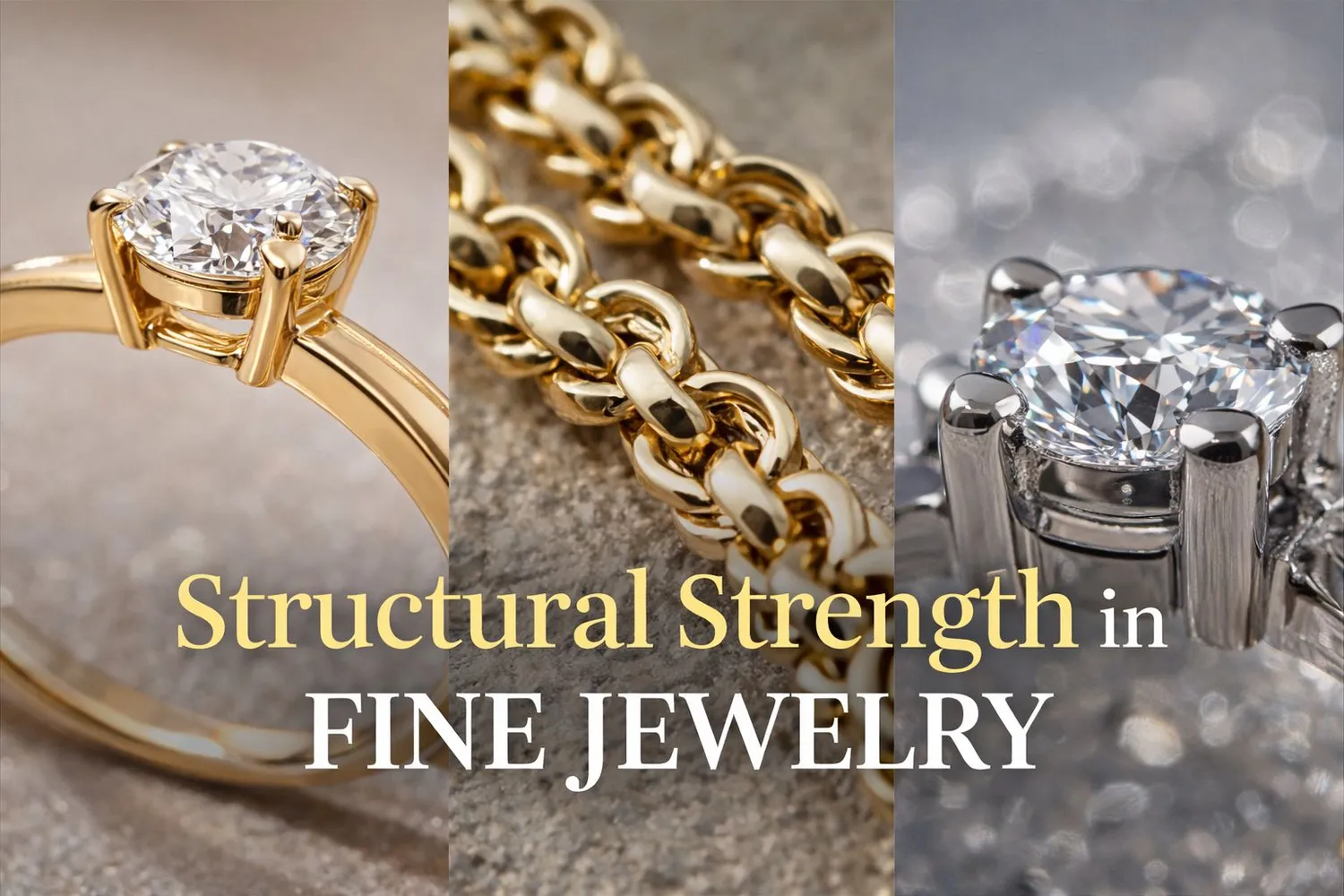
A necklace chain may look simple—just a sequence of small metal links connected together. But behind that simplicity lies a surprising amount of engineering. Every chain must balance flexibility, strength, weight, and comfort. If those elements are poorly balanced, the chain may twist, kink, stretch, or break.
Most chain failures do not occur randomly. They happen where the design concentrates stress: a thin link, a poorly soldered connection, or a link shape that bends too easily under tension.
Understanding the engineering behind chain links helps explain why some chains last for decades while others break within a few years. The key factors include link geometry, metal thickness, construction style, and how stress travels through the chain structure.
Basic Chain Mechanics
At its core, a chain is a flexible structure designed to transmit force through a series of connected links. When you pull on a necklace chain, the force travels from one link to the next until it reaches the clasp.
Unlike a solid bar of metal, a chain must bend and move freely while still carrying tension. Each link plays two roles:
1. Structural support – carrying the pulling force from adjacent links
2. Mechanical articulation – allowing the chain to bend and conform to the body
The balance between these roles determines how well a chain performs.
When a chain is under tension—such as when it supports a pendant—each link experiences several forces:
· Tension from the links on either side
· Bending where links rotate against each other
· Friction from repeated contact between links
The chain’s design must distribute these forces across many links. If the load concentrates on one weak link, that link becomes the failure point.
Link Shapes and Their Structural Effects
One of the most overlooked aspects of chain strength is link shape. The geometry of each link determines how stress flows through the chain.
Round Links
Round links are among the most common forms used in chain design.
Because the curvature is continuous, stress tends to distribute evenly across the metal. When a round link is pulled, the force spreads along the entire arc rather than concentrating in one corner.
Advantages of round links include:
· Even stress distribution
· Smooth movement between links
· Reduced likelihood of sharp stress points
However, round links can still fail if the wire forming the link is too thin.
Oval Links
Oval links are slightly elongated compared with round links.
This shape allows chains to lie flatter and sometimes improves flexibility. However, the longer sides of an oval link can experience greater bending stress when the chain is pulled.
The orientation of the oval matters as well. In some chains, links alternate directions to distribute tension more evenly.
Oval links are common in many chain styles, including classic cable chains.
Square or Rectangular Links
Square or rectangular links introduce sharper corners into the design.
Sharp corners can act as stress concentration points. When the chain is pulled, force may accumulate near the corners instead of spreading evenly along a curved surface.
Some square-link chains compensate for this by increasing metal thickness.
When properly reinforced, square links can still perform well, but they require careful design to avoid weak points.
Link Thickness vs Flexibility
Metal thickness is one of the most important factors in chain durability. Yet thickness also affects flexibility and comfort.
Thin Links
Thin links create lightweight, delicate chains that move easily and feel comfortable on the neck.
However, thin metal has limited resistance to tension and bending. If the chain catches on clothing or experiences a sudden pull, thin links may open or break.
Thin chains are often suitable for:
· Light pendants
· Occasional wear
· Minimalist jewelry designs
But they are more vulnerable to accidental stress.
Thick Links
Thicker links contain more metal and therefore resist bending and stretching more effectively.
Chains with thicker links tend to:
· Support heavier pendants
· Resist deformation under tension
· Last longer under daily wear
The trade-off is weight. Thick chains feel heavier and may appear more substantial than some people prefer.
Designers often aim for a middle ground—links thick enough to resist stress but still comfortable to wear.
Wire Gauge and Strength
Many chains are constructed from metal wire that is bent into links. The thickness of that wire—often described by gauge or millimeter diameter—strongly influences durability.
For example, a chain made from extremely fine wire may look elegant but break easily if pulled.
A slightly thicker wire dramatically increases the cross-sectional area of the metal, which improves resistance to bending and tension.
Even small changes in wire diameter can significantly increase strength.
Strong Chain Styles
Certain chain styles have earned reputations for durability because their structures distribute stress effectively.
Cable Chains
Cable chains consist of simple oval or round links connected in alternating directions.
The simplicity of this design is one reason it performs well structurally. Each link shares tension with its neighbors, and the chain remains flexible without concentrating stress in one location.
Cable chains can vary widely in strength depending on link thickness, but the underlying structure is reliable.
Curb Chains
Curb chains use flattened, interlocking links that lie closely together.
Flattening the links allows the chain to sit smoothly against the skin while maintaining structural strength.
Because the links interlock tightly, tension spreads across multiple contact points rather than relying on a single link.
This makes curb chains relatively durable for their weight.
Wheat Chains
Wheat chains are built from four strands of oval links woven together in a symmetrical pattern.
This structure creates a dense, rope-like chain where multiple links share the load simultaneously.
The woven design distributes stress across the entire chain rather than focusing it on individual links.
As a result, wheat chains often resist kinking and breaking better than simpler designs.
Chain Designs That Are More Vulnerable
Not all chain styles prioritize structural strength. Some emphasize appearance or lightness instead.
Extremely Fine Chains
Very thin chains are prone to breaking simply because the metal cross-section is small.
Even moderate pulling force can exceed the metal’s resistance when the links are extremely thin.
These chains are best paired with lightweight pendants or worn alone.
Chains With Long, Thin Links
Chains that use elongated links may experience bending stress along the longer sides.
If the metal thickness is not increased accordingly, the links can deform under tension.
This is especially true if the chain supports a pendant that pulls downward consistently.
Decorative Chains With Structural Weakness
Some decorative chains include thin connecting rings hidden between larger decorative elements.
Although the decorative pieces may appear solid, the small connecting rings carry most of the stress.
If those rings are thin or unsoldered, they may become the first point of failure.
Stress Distribution in Chain Structures
Chain durability depends not only on individual link strength but also on how stress spreads through the entire structure.
Load Sharing
In a well-designed chain, multiple links share the load when tension is applied.
Instead of one link absorbing the entire force, several links distribute the stress across the structure.
This principle is similar to structural engineering in larger systems such as bridges or cables.
Link Orientation
The orientation of links affects how force travels through the chain.
Chains with alternating link directions often distribute stress more evenly because the load shifts across multiple axes.
If all links align in the same direction, certain parts of the chain may experience more concentrated stress.
Resistance to Twisting
Chains that twist easily can develop localized stress points.
Twisting causes links to bend in directions they were not designed to handle.
Some chain styles naturally resist twisting because of their interwoven structures.
Redundancy
Chains with multiple strands or interwoven links have a form of redundancy.
If one link weakens slightly, the surrounding links continue to support the structure.
Single-link chains rely more heavily on the strength of each individual component.
Common Causes of Chain Failure
Several real-world situations cause chains to break even when the design itself is strong.
Snagging
Chains frequently break when they catch on objects such as clothing, bags, or door handles.
The sudden pull applies force far beyond normal wear conditions.
Weak Attachment Rings
The ring connecting the clasp to the chain is often thinner than the chain links themselves.
If this ring opens or breaks, the chain separates even though the rest of the structure remains intact.
Poor Solder Joints
Each chain link may contain a tiny solder joint where the wire ends meet.
If that joint is poorly executed, the link may open under tension.
Metal Fatigue
Repeated bending and movement can gradually weaken metal.
Over time, this fatigue may cause links to crack, particularly in chains worn daily.
Choosing a Structurally Strong Chain
Buyers can often identify stronger chains by focusing on several practical features.
Examine Link Thickness
Links should not appear extremely thin relative to their size.
Thicker wire generally indicates better resistance to bending and tension.
Check for Soldered Links
Some chains use open links that are simply bent closed.
Chains with soldered links provide greater security because the joint cannot easily open.
Inspect the Clasp Attachment
The ring attaching the clasp should appear sturdy and fully closed.
A thin or open ring may become the chain’s weakest point.
Match Chain Strength to Pendant Weight
A heavy pendant requires a stronger chain structure.
Placing a heavy pendant on a very thin chain significantly increases the risk of breakage.
Frequently Asked Questions
Why do thin chains break so easily?
Thin chains contain less metal in each link. This reduces their ability to resist tension, bending, and accidental pulling.
Are thicker chains always stronger?
Generally yes, but design also matters. A poorly constructed thick chain can still fail if the links are weak or poorly soldered.
What part of a chain breaks most often?
The weakest point is often the clasp attachment ring or a link with a weak solder joint.
Are woven chains stronger than simple chains?
Woven chains often distribute stress across multiple links, which can improve durability.
However, the exact strength depends on metal thickness and construction quality.
Can a broken chain be repaired?
Most broken chains can be repaired by re-soldering the link or replacing a damaged section.
However, repeated breakage in the same location may indicate a design limitation.
Final Thoughts
Chain strength depends on more than metal type or overall weight. The engineering of each link—its shape, thickness, and connection—determines how well the chain handles tension and movement.
Designs that distribute stress across multiple links, avoid sharp corners, and use adequate metal thickness tend to last longer under daily wear. Chains that rely on extremely thin links or weak connection points are more likely to break when exposed to sudden stress.
By understanding the basic mechanics of chain structures, buyers can evaluate jewelry more effectively. Instead of focusing only on appearance, they can recognize the design features that keep a chain intact through years of everyday use.