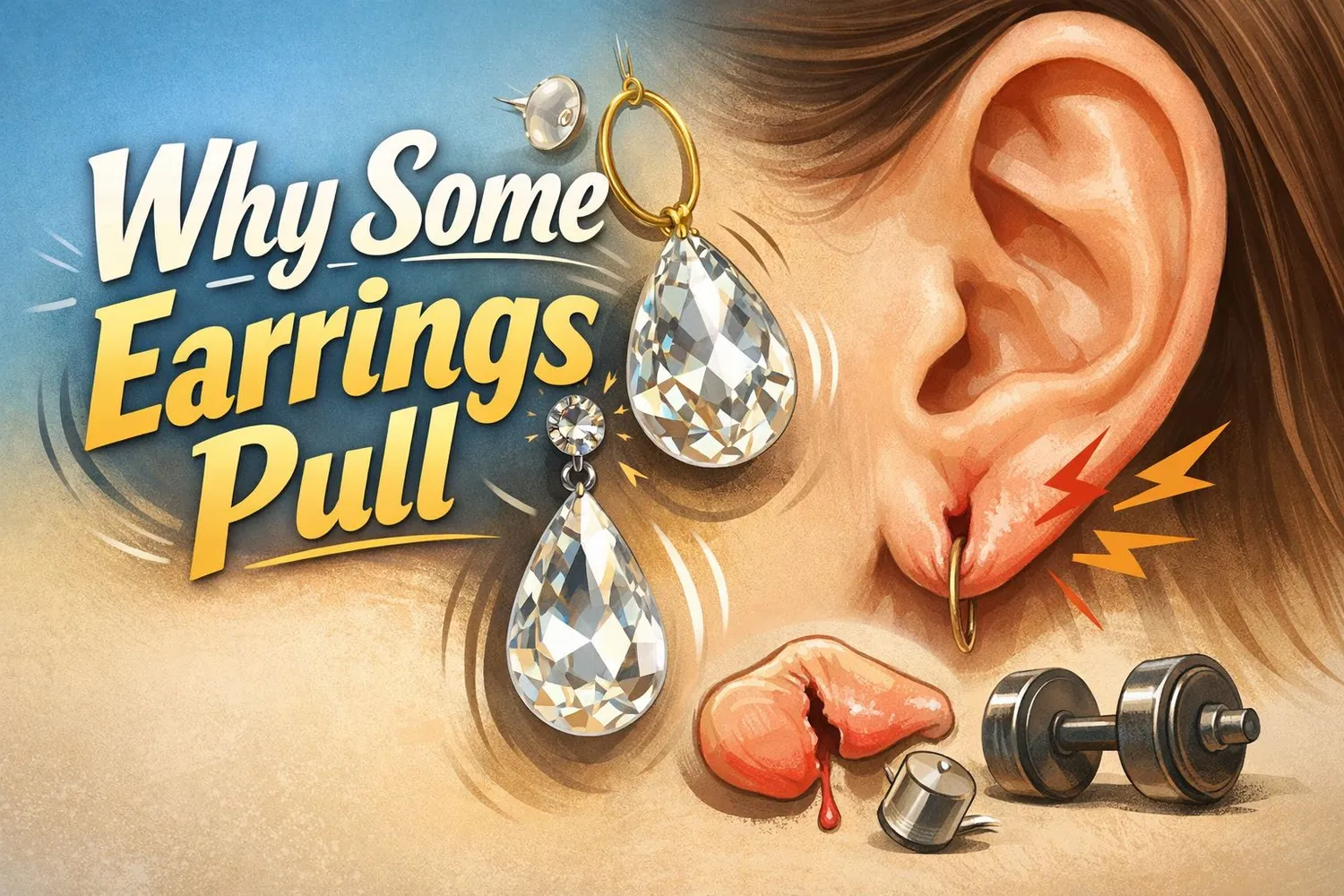
Most people assume earrings pull downward simply because they’re heavy. Weight certainly matters, but it’s rarely the only reason. In many cases, earrings that look lightweight still tug on the earlobe because of subtle design flaws.
These flaws are easy to miss. The jewelry may appear balanced at first glance, yet once it’s worn for a few hours the earring tilts forward, the piercing starts to ache, or the lobe feels stretched.
The cause is usually structural. Small design decisions—where weight sits, how the post is positioned, how stones are mounted, or how the components connect—can change how gravity acts on the piece.
A well-designed earring spreads its weight and keeps the center of mass close to the piercing. A poorly designed one concentrates force in ways that increase downward pull.
Understanding these hidden design problems makes it easier to recognize why some earrings feel comfortable while others quickly become irritating.
Jewelry Design Mistakes That Lead to Pulling
Earrings must balance several competing priorities: visual appearance, structural stability, and comfort. When design decisions focus mostly on appearance, the mechanical behavior of the jewelry can suffer.
One common mistake is placing decorative elements without considering how they affect balance. For example, a designer might add a large metal plate or gemstone cluster to the front of an earring to create visual impact. If that weight sits too far forward, gravity pulls the piece outward from the ear.
The earring then rotates around the piercing hole, concentrating pressure on a small area of tissue.
Another frequent issue involves the attachment point. If the post or hook sits too high relative to the decorative portion of the earring, the weight below the piercing becomes the dominant force. The piece behaves like a pendulum, pulling downward continuously.
Some earrings also include multiple moving sections connected by small joints. While these joints allow attractive movement, they can increase strain if too much weight sits at the bottom of the design.
These mistakes are rarely obvious until the earrings are worn. At that point the physics becomes clear: gravity finds the heaviest part of the piece and pulls it downward.
Poor Weight Distribution
Weight distribution is one of the most important factors in comfortable jewelry design.
Two earrings may weigh exactly the same but feel completely different depending on where their mass sits relative to the piercing.
When most of the weight sits close to the ear, the downward force remains relatively stable. Stud earrings illustrate this principle well. Their mass is concentrated near the piercing, so gravity pulls almost directly downward.
Problems begin when weight shifts away from the piercing.
Imagine a long earring with a decorative stone at the bottom. Even if the stone is not extremely heavy, the distance between the stone and the piercing increases the torque acting on the ear.
This rotational force causes the earring to tilt and pull.
Designs with uneven mass distribution often show several warning signs:
· The earring tilts forward while worn
· The decorative portion points downward rather than hanging straight
· The piercing hole feels sore after a short period of wear
Another issue appears when earrings include decorative elements on only one side of the design. Asymmetrical mass can cause sideways pulling that irritates the piercing.
Good jewelry design attempts to keep the center of gravity close to the ear. This may involve distributing decorative elements along the length of the earring rather than concentrating them in a single heavy component.
Thin Hooks vs Reinforced Posts
The part of the earring that passes through the ear—the hook or post—plays a major role in how comfortable the jewelry feels.
Thin hooks are common in dangling earrings because they’re easy to manufacture and allow the earring to swing freely. However, they also concentrate pressure on a very small section of the piercing.
When the contact area is small, the force from the earring becomes more noticeable.
The situation becomes worse when a thin hook supports a relatively large decorative piece. The entire weight of the earring transfers through the narrow curve of metal resting in the piercing.
Over time, that concentrated pressure can create soreness or a feeling of pulling.
Reinforced posts distribute weight differently. Posts pass straight through the piercing and typically use a backing piece to hold the earring in place. This design stabilizes the jewelry and reduces swinging motion.
Posts also allow designers to position the decorative portion of the earring closer to the ear, which reduces leverage.
However, posts are not automatically comfortable. If the decorative element attached to the post is too large or heavy, the earring may still tilt forward.
The most comfortable designs combine a stable post with balanced weight distribution.
Unbalanced Gemstone Settings
Gemstones can add beauty and value to earrings, but they also introduce design challenges.
Stones are often denser than the surrounding metal, which means they contribute a significant portion of the earring’s total weight.
If the stone sits at the bottom of the design, the entire piece becomes bottom-heavy.
This creates a strong downward pull on the piercing hole. The heavier the stone and the farther it sits from the ear, the greater the torque acting on the earlobe.
Another problem appears when gemstones project forward from the ear. Some settings place stones in raised mounts so they catch more light. While this can improve visual sparkle, it shifts the center of mass forward.
The result is a forward-tilting earring that presses against the front edge of the piercing hole.
Cluster settings can also create imbalance if the stones are grouped unevenly. For example, a cluster arranged in a triangular shape with most of the mass at the bottom can cause the earring to rotate downward.
Well-balanced gemstone earrings usually position the stones so their combined weight sits close to the piercing.
In some designs, multiple smaller stones are used instead of one large stone. This spreads the weight more evenly and reduces pulling.
Manufacturing Shortcuts
Not all design problems come from the original concept. Some appear during manufacturing.
Jewelry production often involves balancing cost, durability, and appearance. When manufacturers cut corners, small structural weaknesses can develop.
One common shortcut involves using thinner metal components to reduce material costs. While thinner metal lowers weight, it can also reduce structural stability. Flexible parts may bend slightly under the weight of decorative elements, allowing the earring to tilt forward.
Another issue arises when attachment points are not reinforced. A decorative plate connected by a small loop may gradually shift position as it moves during wear. Over time, the weight distribution changes and the earring begins pulling downward.
Mass-produced jewelry sometimes skips detailed balance testing as well. In carefully designed pieces, jewelers often evaluate how the earring hangs before finalizing the design. Without that step, subtle imbalances may go unnoticed until the jewelry reaches the customer.
Even small alignment errors can matter. If the post is soldered slightly off-center, the earring may hang unevenly.
These issues don’t always affect durability, but they can significantly affect comfort.
Design Improvements That Prevent Pulling
Many of the problems described above can be avoided with thoughtful design.
One of the most effective strategies is balanced mass placement. Decorative elements should distribute along the earring rather than concentrate at the bottom.
For example, instead of a single heavy stone hanging from a thin chain, designers might use several smaller stones spaced evenly along the length of the earring.
Another improvement involves keeping the center of gravity close to the piercing. Shorter drop lengths and lighter lower sections reduce torque.
Structural support also matters. Reinforced posts and wider backs help stabilize the earring and distribute pressure across more of the earlobe.
Large statement earrings often benefit from hollow construction. Thin metal shells maintain visual size while reducing overall weight.
Some designers also add hidden structural supports. For example, a decorative plate may include a secondary attachment point that prevents forward tilting.
These adjustments don’t change the visual style dramatically, but they can transform how the earring feels when worn.
Safety Note
If earrings consistently cause pain, redness, swelling, or stretching of the piercing hole, it may be best to stop wearing them until the ear recovers. Persistent discomfort or signs of tearing should be evaluated by a qualified healthcare professional or experienced professional piercer.
This article discusses mechanical causes of earring pulling and does not replace medical advice.
FAQ
Why do some earrings tilt forward when I wear them?
Forward tilting usually happens when the center of mass sits in front of the piercing hole. Gravity pulls the decorative portion downward and outward, causing the earring to rotate.
Can lightweight earrings still pull on the ear?
Yes. If weight sits far below the piercing or is distributed unevenly, the leverage effect can create noticeable pulling even when the total weight is moderate.
Are hooks less comfortable than posts?
Hooks can feel less stable because they concentrate pressure on a small part of the piercing and allow more movement. Posts typically provide more stability, though design balance still matters.
Why do gemstone earrings sometimes feel heavier than metal ones?
Gemstones are often dense relative to their size. A single stone positioned far below the piercing can create significant torque on the ear.
How can I tell if an earring has poor balance?
Signs include forward tilting, the decorative portion pointing downward, or soreness around the piercing after short wear.
Do larger earring backs help reduce pulling?
They can help distribute pressure across the back of the earlobe, which may improve stability for heavier designs.
Can design flaws cause long-term damage to the ear?
Repeated strain from poorly balanced earrings can stretch the piercing hole or thin the tissue over time.
Earrings that pull downward often reveal hidden design flaws rather than simply excessive weight. Poor weight distribution, unstable hooks, bottom-heavy gemstones, and manufacturing shortcuts can all shift the center of mass away from the ear.
When designers address these structural issues—by balancing weight, reinforcing support points, and controlling the center of gravity—earrings become far more comfortable to wear.
Understanding these details makes it easier to recognize jewelry that looks beautiful but is also engineered to respect the limits of the earlobe.