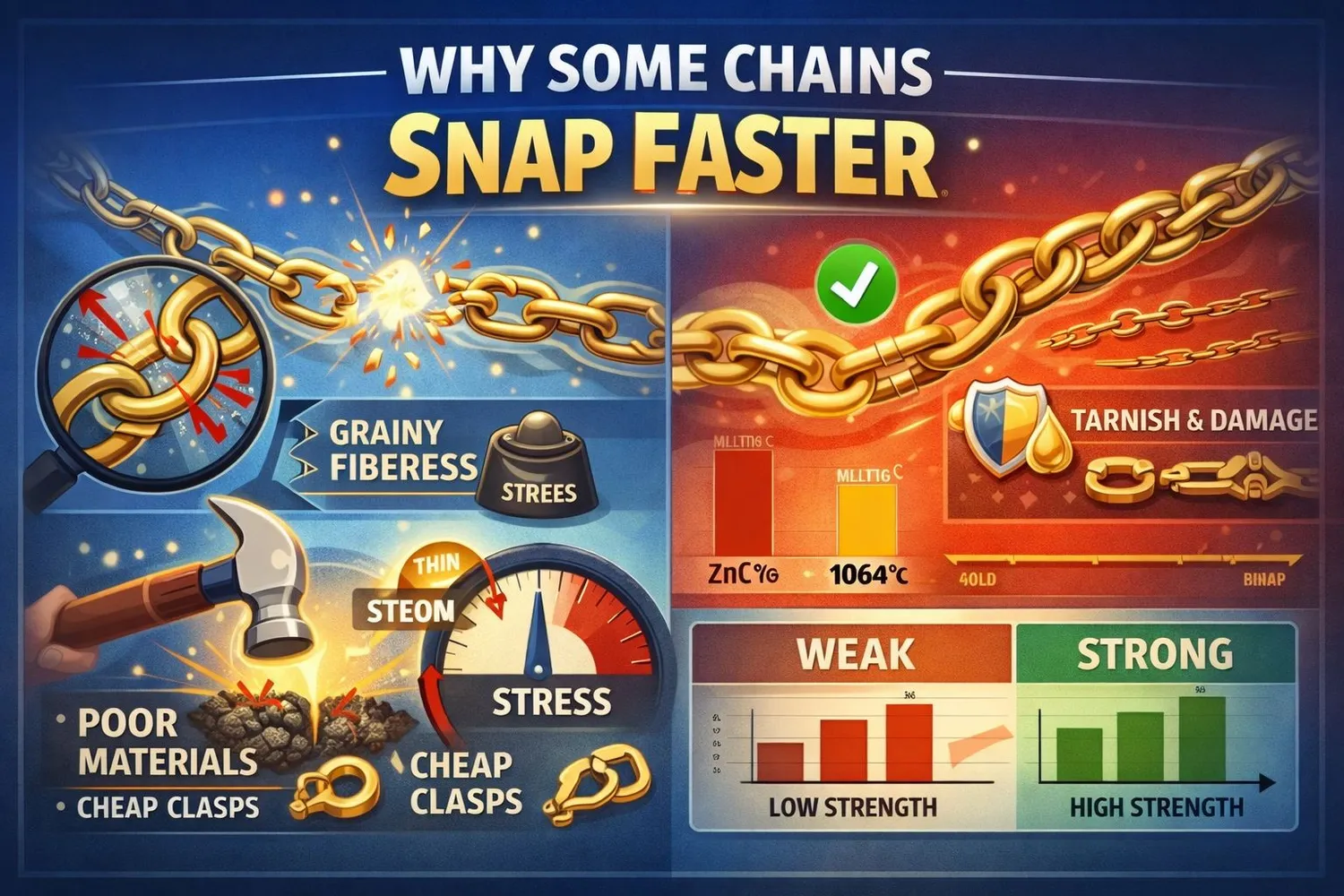
Most jewelry chains look deceptively simple. From a distance, they appear to be repeating patterns of identical links that should share weight evenly. Yet certain chains break more often than others—even when they’re made from the same metal and thickness.
The reason usually comes down to stress distribution. Different chain styles transfer force through their links in different ways. Some designs spread tension evenly across the structure, while others concentrate stress in specific areas.
Those concentrated areas become hidden stress points. Over time, repeated bending, friction, and small pulling forces weaken those spots until a link fails.
Understanding where these stress points occur helps explain why some chains last for years while others break more easily. It also helps buyers choose a chain style that matches how the jewelry will actually be worn.
Structural Differences in Chain Styles
Every chain style is built from a repeating structure of links, but the geometry of those links determines how stress moves through the chain.
Two chains with the same metal thickness can behave very differently because of their structure.
Several structural characteristics influence durability:
Link orientation
Some chains have links aligned in a straight sequence. Others twist or rotate as part of the design. Twisting structures often create more internal friction between links.
Number of contact points
Links may connect to one or multiple neighboring links. More contact points can distribute stress more evenly.
Link shape
Round links, square links, and flattened links respond differently to tension. Sharp corners or thin edges may become stress concentration points.
Movement flexibility
Chains designed to move freely can absorb motion without concentrating force. Chains that resist twisting may instead transfer stress to individual links.
These design differences explain why two chains of equal thickness can have very different lifespans.
Box Chain Weak Points
Box chains are known for their clean, geometric appearance. Each link forms a square shape that connects tightly to neighboring links, creating a smooth and uniform pattern.
This design gives box chains several advantages.
The square structure distributes tension fairly evenly across the chain, and the interlocking links create a consistent visual line that resists twisting.
However, box chains also have specific structural weaknesses.
Corner stress concentration
Each link in a box chain has four corners. These corners experience higher stress than the flat sides of the link.
When the chain bends, those corners absorb the bending force. Over time, repeated movement may weaken them.
This is particularly noticeable in thinner box chains used for pendants.
Link collapse
If a box chain link bends sharply—such as when the chain is pulled suddenly—the square structure can deform.
Once one link collapses, the geometry of the chain becomes misaligned. This misalignment causes neighboring links to twist or jam.
Repairing collapsed box chains can be difficult because the structure relies on precise alignment.
Kinking
Box chains can develop kinks when a link bends inward. The kink prevents the chain from moving smoothly and concentrates stress at that location.
If the kink is not corrected early, the affected link may eventually break.
Despite these weaknesses, box chains remain popular because their structure distributes normal tension well when the chain is used properly.
Cable Chain Stress Patterns
Cable chains are one of the most common chain styles in jewelry. They consist of simple round or oval links connected one after another.
This straightforward design gives cable chains excellent flexibility. They move easily and adapt to body movement without resisting motion.
However, cable chains also have clear stress patterns.
Individual link load
In a cable chain, each link typically connects to two neighbors.
This means every link must carry part of the load directly. If one link weakens, it becomes the chain’s primary failure point.
Unlike more complex chain structures, cable chains do not distribute stress across multiple overlapping links.
Solder seam vulnerability
Most cable chain links are formed by bending wire into a loop and soldering the ends together.
The solder seam can become a stress concentration point because the metal structure at that joint may differ slightly from the rest of the wire.
Repeated bending often causes fatigue cracks to begin near the seam.
Center-link stress from pendants
Cable chains used with pendants often experience the most stress at the center of the chain.
The pendant concentrates weight on a small section of links, which increases fatigue in those specific links.
This is why breaks frequently occur near the middle of cable chains rather than at the ends.
Despite these limitations, cable chains are widely used because they balance flexibility, affordability, and simplicity.
Rope Chain Durability Issues
Rope chains are visually distinctive. They consist of multiple small links twisted together in a spiral pattern that resembles a rope.
This twisting structure creates a strong visual texture and reflective surface, which is why rope chains are popular in both casual and formal jewelry.
However, the same twisting structure that gives rope chains their appearance also introduces several durability challenges.
Internal friction
Rope chains contain many tightly interwoven links. As the chain moves, those links rub against each other.
This friction can gradually wear down small areas of metal inside the chain structure.
Because much of the contact occurs inside the chain, wear may develop before it becomes visible externally.
Limited flexibility under compression
Rope chains bend easily when hanging freely, but they resist certain types of twisting motion.
If a rope chain becomes kinked, the twisted structure can lock into place. Straightening the chain may require careful manipulation to avoid damaging links.
Complex repair
When a rope chain breaks, the repair process can be complicated because the links are interwoven in multiple directions.
Replacing or repairing a single damaged link may require partially reconstructing the surrounding structure.
Despite these issues, well-made rope chains can still be durable when the links are sufficiently thick and the chain is worn without excessive pulling forces.
Figaro and Curb Chain Characteristics
Figaro and curb chains share a similar structural principle: flattened links that lie in the same plane.
The difference is mostly aesthetic.
A curb chain uses identical flattened links throughout the chain. A Figaro chain alternates between short links and a longer link in a repeating pattern.
Both styles have structural characteristics that affect stress distribution.
Load distribution across flattened links
Because the links lie flat, these chains distribute tension across a wider surface area.
This design reduces stress concentration compared with chains that rely on thin round wire.
Resistance to twisting
Flattened links resist twisting and tend to remain aligned when worn.
This stability helps prevent the chain from developing tight knots or kinks.
Edge wear
One downside of flattened links is that the outer edges may experience more friction against clothing or pendants.
Over time, repeated rubbing can gradually thin the edges of the links.
If a link becomes significantly worn, it may weaken and eventually break.
Overall, curb and Figaro chains are often considered durable styles when made with adequate metal thickness.
Stress Points Near Clasps and Connectors
Regardless of chain style, certain areas of any chain tend to experience higher stress.
One of the most common locations is the connection between the chain and the clasp.
Several factors contribute to this.
First, clasps are usually heavier than individual links. This weight creates a small imbalance where the clasp attaches to the chain.
Second, the jump ring connecting the clasp to the chain may be thinner than surrounding links.
Third, twisting motion occurs frequently at the clasp during fastening and removal.
These combined stresses often cause fatigue damage near the clasp before other parts of the chain show wear.
Another stress point occurs where pendants attach to the chain. The pendant adds weight and movement that concentrate force on a few central links.
Choosing Styles for Strength
When durability is the priority, chain style should be considered alongside metal type and thickness.
Certain structural characteristics generally improve strength.
Even stress distribution
Chains that distribute load across multiple contact points tend to resist breakage better.
Designs with overlapping links or wider contact areas help spread force more evenly.
Adequate metal thickness
Regardless of style, thicker links resist bending and fatigue better than extremely thin ones.
Very delicate chains may prioritize appearance over strength.
Link symmetry
Chains with consistent link shapes usually distribute tension more predictably than chains with complex alternating structures.
Flexibility without excessive twisting
Chains that move smoothly without resisting motion are less likely to concentrate stress at specific links.
Selecting a chain with these characteristics can improve long-term durability.
Matching Chain Style to How It Will Be Worn
Durability also depends on how the chain will be used.
Chains supporting pendants benefit from styles that distribute weight across several links rather than concentrating it at a single point.
For example, thicker box chains or curb chains often handle pendant weight more effectively than very thin cable chains.
Chains worn daily should also tolerate frequent movement and occasional pulling forces.
In contrast, decorative chains worn occasionally may prioritize appearance over structural strength.
Choosing a chain style that matches the intended use helps prevent unnecessary wear.
Common Mistakes When Choosing Chain Styles
Several common misunderstandings can lead to premature chain failure.
Assuming thicker appearance means stronger structure
Some chains appear thick but use hollow construction or thin links. Visual thickness does not always reflect structural strength.
Ignoring link thickness
Even durable styles like curb chains can fail if the links are extremely thin.
Using delicate chains for heavy pendants
The pendant’s weight may exceed what the chain’s structure was designed to handle.
Overlooking repair difficulty
Certain chain styles—particularly those with complex link patterns—are harder to repair when damaged.
Considering these factors before purchasing can prevent frustration later.
Practical Takeaway
Every chain style has strengths and weaknesses rooted in its structure.
Box chains distribute tension evenly but can kink if links collapse. Cable chains offer flexibility but concentrate stress on individual links. Rope chains provide visual richness yet experience internal friction. Curb and Figaro chains distribute load well but may wear along their edges.
The most durable chain is not determined by style alone. Metal thickness, link construction, and intended use all play important roles.
Understanding where hidden stress points occur allows buyers to choose chains that balance appearance with long-term reliability.
FAQ
Which chain style is strongest?
No single style is universally strongest. Chains with thicker links and good load distribution—such as well-made curb or box chains—often perform well in everyday wear.
Why do chains often break near the clasp?
The clasp area experiences twisting forces and often uses small jump rings that carry concentrated stress.
Are rope chains fragile?
Rope chains can be durable if the links are thick enough. However, their twisted structure can make repairs more complex if damage occurs.
Do box chains hold pendants well?
Box chains are commonly used with pendants because they distribute tension evenly. Thin box chains, however, can kink if bent sharply.
Are cable chains weaker than other styles?
Cable chains rely on individual links carrying the load, which can make them more vulnerable to fatigue if a single link weakens.
Does chain thickness matter more than style?
In many cases, yes. A thicker chain in a simple style may be stronger than a very thin chain in a more complex style.
Can chain style affect repairability?
Yes. Chains with simple link patterns are often easier to repair than highly interwoven designs like rope chains.