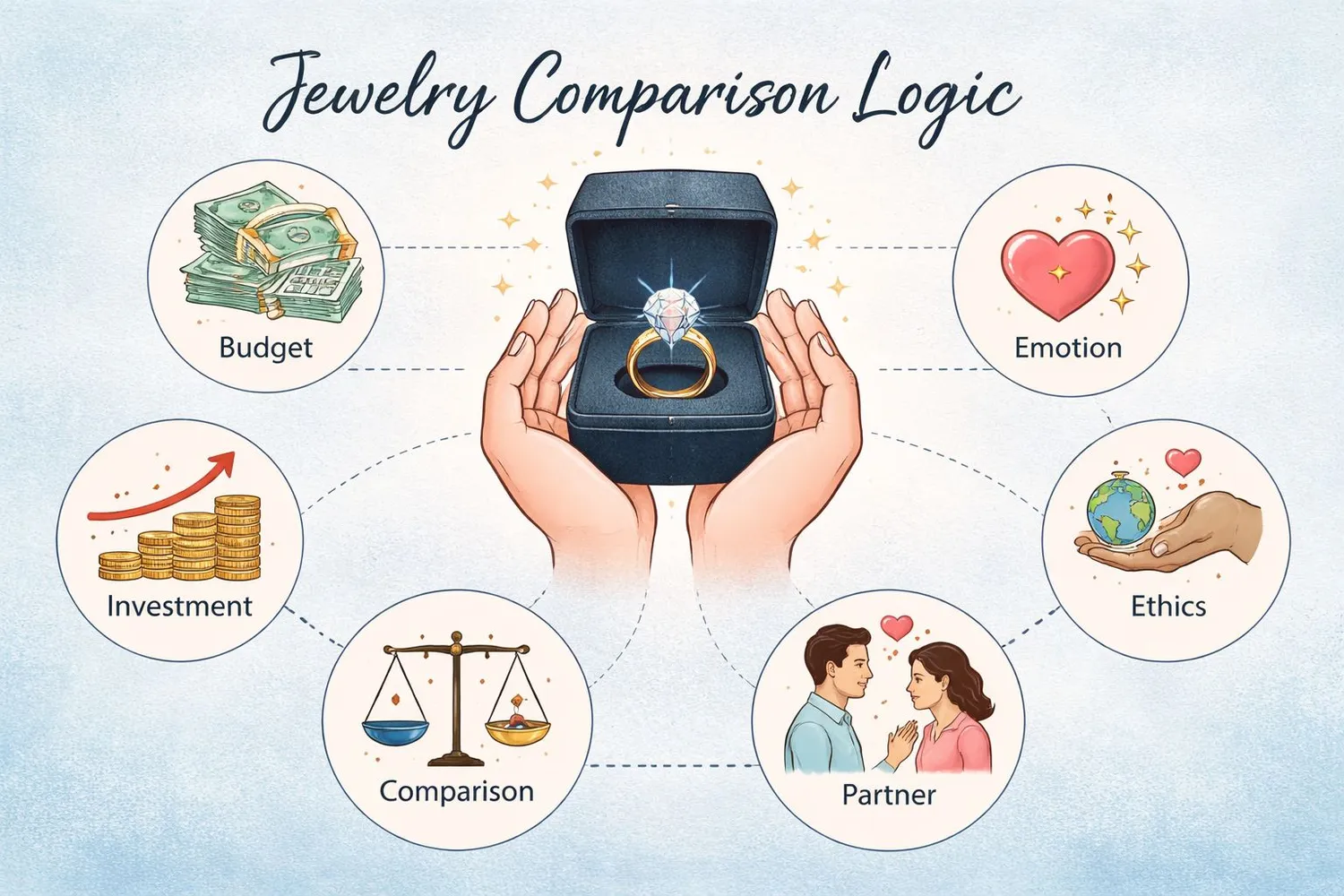
Weddings in the U.S. often come with a quiet assumption: bridal jewelry is special, sacred, and separate from everything else you’ll own.
It’s treated as something that belongs to one day.
And that’s exactly why it can become one of the least practical purchases in your entire wardrobe.
At the same time, multi-use jewelry — pieces designed to work beyond the wedding — rarely gets the same emotional spotlight. It feels less “bridal,” less cinematic.
So the real question isn’t about beauty.
It’s about whether you’re buying something for a moment — or for a life.
Let’s unpack what actually makes one option smarter than the other.
One-Time Use Trap
Bridal jewelry is often selected for visual harmony with:
- The dress neckline
- The hairstyle
- The venue style
- The overall aesthetic of the wedding
This creates a design constraint.
For example:
A chandelier earring that balances a strapless gown may feel oversized with everyday clothing.
A dramatic statement necklace chosen to fill negative space in a deep neckline may have no place in casual or professional settings later.
The problem isn’t that these pieces are impractical by nature — it’s that they are optimized for one environment.
That optimization narrows their future usability.
Many brides discover after the wedding that:
- Pieces feel too formal for daily life
- Designs clash with normal wardrobe silhouettes
- Scale becomes the biggest barrier to reuse
This doesn’t happen because of poor taste.
It happens because wedding styling is theatrical by design.
Multi-use jewelry avoids this trap by starting from a different question:
“Can this function in real life?”
Instead of:
“Does this complete the bridal look?”
That shift changes everything — including size, design complexity, and wearability.
Emotional Pressure in Buying
Weddings are one of the few life events where spending feels socially protected.
There’s a built-in permission structure:
- “It’s your big day.”
- “You deserve something special.”
- “This only happens once.”
Those phrases create emotional pressure that quietly pushes buyers toward:
- Larger pieces
- Higher price points
- Less practical designs
Even when those choices don’t align with personal style.
Bridal jewelry purchases are rarely made in isolation.
They’re influenced by:
- Family expectations
- Visual comparisons
- Cultural narratives about what a bride should look like
This environment can lead to decisions driven more by momentary emotion than long-term satisfaction.
Multi-use jewelry often lacks that emotional spotlight.
Which makes it easier to evaluate rationally.
You’re more likely to ask:
- Will I wear this again?
- Does this match my real wardrobe?
- Is this comfortable?
Emotional spending isn’t wrong.
But it should be conscious.
If a piece is meant to symbolize the wedding itself — like a keepsake — that’s a different category from something expected to integrate into daily life.
Blurring those categories creates regret.
Practical Longevity
The difference between bridal-only and multi-use jewelry becomes obvious after the wedding.
Ask:
Can this piece survive a normal Tuesday?
That includes:
- Office wear
- Casual dinners
- Travel
- Errands
Bridal pieces often struggle here due to:
- Weight
- Fragility
- Visibility level
For example:
Heavy drop earrings may cause discomfort over long hours.
Intricate bracelets may snag on clothing.
Highly reflective designs may feel out of place in daytime settings.
Multi-use jewelry is built with longevity in mind.
That usually means:
- Balanced scale
- Secure construction
- Neutral design elements
It’s not about being plain.
It’s about being adaptable.
A pendant necklace worn at the wedding can transition into:
- Workwear
- Weekend outfits
- Formal events later
The key is structural flexibility.
Pieces that rely on context lose longevity.
Pieces that rely on proportion keep it.
Financial Efficiency
Jewelry is a discretionary purchase, but it still involves real money.
Which makes efficiency worth considering.
A piece worn once carries:
Maximum cost per use.
A piece worn repeatedly distributes that cost over time.
This doesn’t mean every bridal purchase should be optimized for reuse.
But it does mean you should decide intentionally:
Is this:
- A symbolic purchase?
- Or a functional one?
Symbolic purchases don’t need efficiency.
Functional ones do.
Multi-use jewelry almost always wins in cost-per-wear logic because:
- It fits more environments
- It requires fewer complementary purchases
- It remains relevant across seasons
Bridal-only pieces often create secondary spending.
For example:
A necklace chosen for the wedding may require:
- Specific earrings
- Matching bracelet
- Coordinated styling
That entire set may sit unused afterward.
Multi-use pieces reduce this cascading cost because they integrate more easily into existing wardrobes.
Social Expectations
In the U.S., bridal presentation is heavily visual.
There’s an unspoken standard:
Brides are expected to look distinct from guests.
Jewelry plays a role in that separation.
That expectation can push buyers toward:
- Larger
- More ornate
- Less versatile pieces
Not because they love them — but because they signal “bridal.”
Multi-use jewelry doesn’t always deliver that signal as strongly.
Which can create concern:
“Will this feel special enough?”
This is where clarity matters.
Specialness doesn’t have to come from scale.
It can come from:
- Craft
- Personal meaning
- Styling
A refined piece worn with intention can carry more personal authenticity than a dramatic piece worn out of obligation.
Social expectations are real.
But they don’t need to dictate long-term ownership decisions.
You’re dressing for a day — not a performance review.
Future Adaptability
Life after the wedding includes:
- Work environments
- Social changes
- Lifestyle shifts
Jewelry that adapts to those changes retains relevance.
Bridal-only pieces often struggle because:
- They are tied to a specific narrative
- Their scale limits reuse
- Their design feels context-dependent
Multi-use jewelry is less tied to the wedding story.
Which makes it easier to wear without feeling overdressed.
Adaptable pieces can:
- Layer with other jewelry
- Pair with different aesthetics
- Work across formal and informal settings
This flexibility increases emotional longevity too.
A piece worn repeatedly becomes part of your life story — not just your wedding album.
Common Buying Mistakes
Mistake 1: Treating all bridal jewelry as heirloom-worthy
Not every wedding piece becomes meaningful later.
Meaning grows through use, not just memory.
Mistake 2: Overmatching
Choosing pieces solely to match the dress often sacrifices future usability.
Mistake 3: Ignoring comfort
Wedding day adrenaline hides discomfort.
Daily life doesn’t.
Mistake 4: Assuming resale value
Jewelry resale is unpredictable and often lower than expected.
Buy for use, not exit strategy.
When Bridal-Only Jewelry Makes Sense
There are cases where prioritizing bridal pieces is rational.
For example:
- Cultural or ceremonial significance
- Sentimental family traditions
- Symbolic purchases meant as keepsakes
In these situations, practicality may be secondary.
The piece serves memory, not utility.
That’s valid — as long as expectations are aligned.
Practical Decision Framework
Ask yourself:
- Do I want this to live beyond the wedding?
- Will this match at least five existing outfits?
- Can I wear this without needing special styling?
- Does this reflect my personal style — or wedding expectations?
- Would I wear this if it weren’t tied to my wedding?
If the answer to #5 is no, treat it as symbolic.
If yes, it’s a candidate for multi-use investment.
FAQs
Should all bridal jewelry be reusable?
No. Some pieces exist purely for symbolism.
Is multi-use jewelry less special?
Not inherently. Meaning often grows through repeated wear.
Can I mix both approaches?
Yes. A practical core piece paired with one symbolic item balances both goals.
Does simplicity reduce impact?
Not necessarily. Styling plays a major role in perceived presence.
What if I regret choosing practicality?
Consider incorporating one ceremonial piece alongside adaptable ones.
Safety Note
Jewelry purchases involve financial decisions. If your wedding budget is tight or shared with family contributors, consider discussing priorities openly with a financial advisor or planner before making large discretionary purchases.
A Simple Way to Think About It
Bridal-only jewelry honors the moment.
Multi-use jewelry honors the years that follow.
Choosing which deserves more investment depends on which you want your jewelry to serve longer.