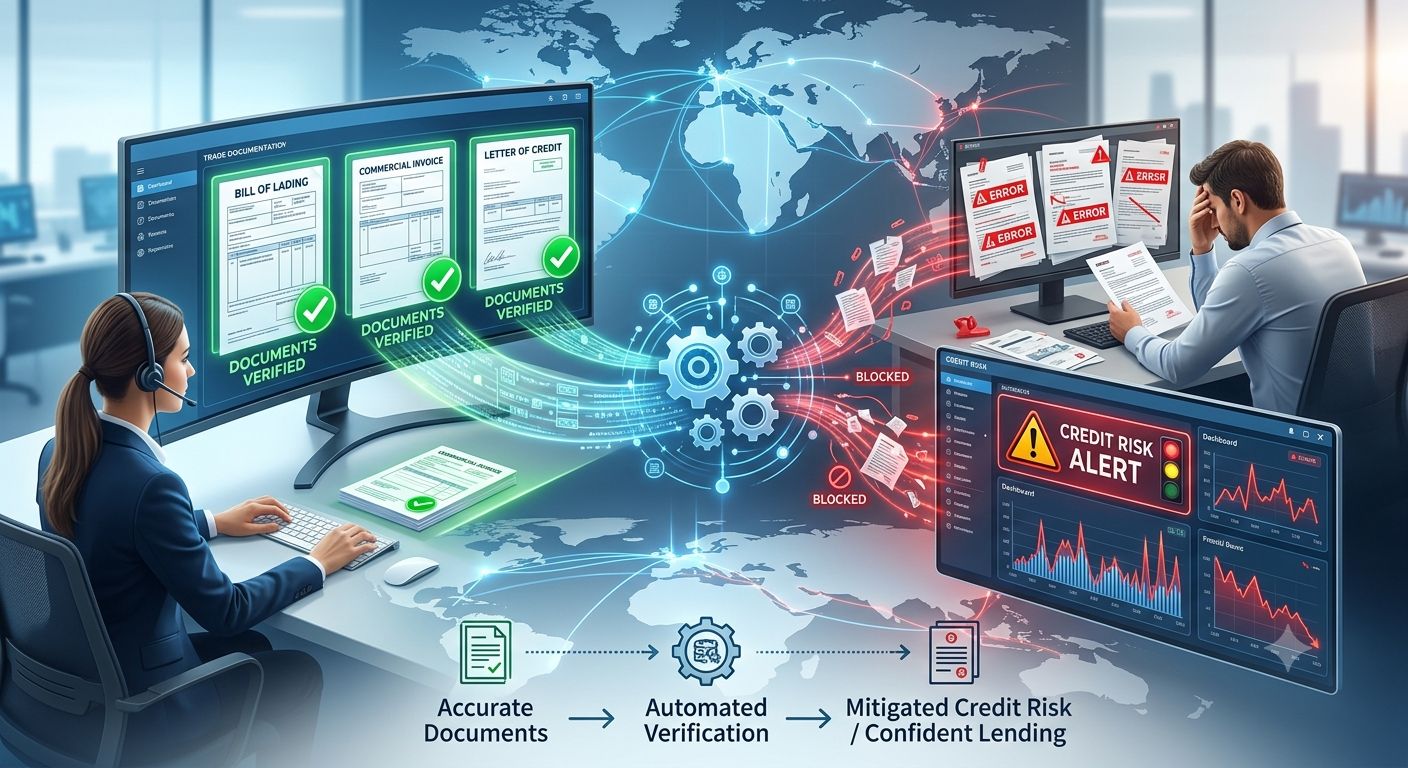
Trade finance depends on documents moving across buyers, sellers, banks, carriers, insurers, and regulators. A small mismatch in invoice value, shipment date, goods description, or letter of credit term can delay payment, raise compliance questions, or weaken the evidence behind financing. For banks, document accuracy is not just an operational concern. It directly affects credit risk review.
Trade finance automation helps banks read, check, compare, and route trade documents with better consistency. This blog explains how document accuracy affects trade finance risk, which documents need careful review, how automation supports checking, and why source traceability matters for safer financing decisions.
What Is Trade Finance Automation?
Trade finance automation uses digital workflows and AI-based document processing to manage trade documents, checks, approvals, and exception reviews.
Trade Finance Automation Definition
Trade finance process automation refers to using automated workflows to capture trade data, classify documents, check values, compare terms, and route exceptions for review.
How Trade Finance Automation Works
It collects trade files, classifies each document, extracts key fields, compares related documents, flags mismatches, and sends exceptions to trade finance teams.
Why Document Accuracy Matters in Trade Finance
Document accuracy matters because financing, payment release, compliance review, and credit exposure depend on values being complete, matched, and traceable.
How Trade Finance and Credit Risk Are Connected
Trade finance and credit risk are connected because banks often provide funding or payment assurance based on the documents submitted.
Credit Risk in Trade Finance Definition
Credit risk in trade finance is the risk that a buyer, seller, or other counterparty fails to meet payment or transaction obligations.
How Trade Documents Affect Payment Risk
Trade documents prove shipment, value, terms, ownership, and compliance. Errors can weaken confidence in the transaction.
Why Banks Need Accurate Trade Data for Risk Review
Banks need accurate trade data to assess exposure, counterparty reliability, facility limits, goods movement, and repayment likelihood.
Why Trade Finance Is Document-Heavy
Trade finance is document-heavy because each transaction involves several parties, geographies, rules, and proof points.
Multiple Parties in One Trade Transaction
Buyers, sellers, issuing banks, advising banks, shipping companies, insurers, and customs bodies may all create or review documents.
Cross-Border Documentation Requirements
International trade requires documents that prove shipment, origin, insurance, payment terms, and regulatory compliance.
Bank Review of Trade Terms and Supporting Records
Banks check whether submitted documents match the agreed trade terms.
Compliance Checks Across Trade Documents
Compliance teams may review sanctions, AML, KYC, country risk, and restricted goods concerns.
Key Trade Finance Documents That Need Accurate Review
Trade finance accuracy depends on checking several documents together.
Letters of Credit
Letters of credit define payment terms, document requirements, shipment conditions, and deadlines.
Bills of Lading
Bills of lading show shipment details, carrier information, ports, goods, and ownership evidence.
Commercial Invoices
Commercial invoices show buyer, seller, goods, value, currency, and payment terms.
Packing Lists
Packing lists show package count, weight, dimensions, and goods details.
Certificates of Origin
Certificates of origin show where goods were produced or processed.
Insurance Documents
Insurance documents prove coverage for shipment risk.
Inspection Certificates
Inspection certificates confirm quality, quantity, or shipment condition.
What Document Accuracy Means in Trade Finance
Document accuracy means every key field should be correct, complete, consistent, and linked across the transaction.
Correct Names, Dates, and Amounts
Names, shipment dates, invoice amounts, currencies, and references must match agreed terms.
Matching Shipment and Invoice Details
Goods, quantities, values, and shipment information should align across documents.
Consistent Goods Descriptions
Descriptions should remain consistent across invoice, packing list, LC, and transport records.
Accurate Port, Route, and Delivery Information
Port of loading, port of discharge, route, and delivery terms must match the transaction.
Complete Terms Across Related Documents
Payment, shipment, insurance, and inspection terms should be complete across all required files.
What Happens When Trade Documents Are Inaccurate?
Inaccurate trade documents can delay transactions and increase review risk.
Payment Delays
Banks may delay payment if documents do not meet terms.
Document Discrepancies
Discrepancies can require correction, waiver, or extra approval.
Shipment Holds
Incorrect shipment information can cause goods to be held or reviewed further.
Compliance Review Delays
Compliance teams may need extra checks when names, countries, or goods details do not match.
Higher Exposure to Credit and Operational Risk
Weak document accuracy can increase financing risk and operational rework.
Common Trade Document Errors That Affect Risk Review
Common trade document errors often appear in names, values, dates, references, and goods details.
Mismatched Invoice and LC Details
Invoice values, shipment terms, or descriptions may differ from LC requirements.
Incorrect Shipment Dates
Wrong dates can breach LC terms or create timing concerns.
Wrong Buyer or Seller Information
Incorrect party details can affect compliance and counterparty review.
Missing Document References
Missing LC numbers, invoice numbers, or transport references can delay review.
Inconsistent Goods Descriptions
Different goods descriptions can raise questions about shipment accuracy.
Incomplete Supporting Documents
Missing certificates, insurance papers, or inspection records can weaken evidence.
How Document Errors Create Credit Risk in Trade Finance
Document errors can create credit risk when banks finance a transaction using weak or mismatched evidence.
Payment Default Risk
If documents do not support payment terms clearly, payment risk increases.
Counterparty Risk
Mismatched details can signal weak counterparty controls or possible misrepresentation.
Collateral and Goods Verification Risk
Goods may be harder to verify when shipment and ownership documents are inconsistent.
Fraud and Duplicate Document Risk
Duplicate or altered documents can increase fraud risk.
Risk of Financing Against Weak Evidence
Financing decisions become weaker when supporting documents are incomplete or unclear.
How Manual Trade Finance Review Creates Risk
Manual review creates risk when teams compare many documents under time pressure.
Slow Document Checking
Manual checking takes time because each document must be read and compared.
Manual Data Entry Errors
Typed values can be wrong, skipped, or entered in the wrong field.
Missed Discrepancies Across Documents
Reviewers may miss mismatches when documents are lengthy or poorly formatted.
Inconsistent Review Across Teams
Different reviewers may apply checks differently.
Weak Source Traceability
Manual notes may not show exactly which page or field supported the decision.
How Trade Finance Automation Improves Document Accuracy
Automation improves document accuracy by capturing, comparing, validating, and routing documents more consistently.
Automated Document Intake
Documents can be collected from emails, portals, and internal banking systems.
Document Classification by Trade Purpose
Each file can be classified as LC, invoice, packing list, bill of lading, or certificate.
Field Extraction From Trade Documents
Key fields such as names, amounts, dates, ports, goods, and references can be extracted.
Cross-Document Matching
Values can be compared across invoices, LC terms, shipment documents, and certificates.
Exception Routing for Human Review
Mismatches, low-confidence fields, and missing items can be routed to trade officers.
How Automation Supports Letter of Credit Document Checking
LC checking benefits from consistent comparison of terms and submitted records.
LC Terms Matched With Submitted Documents
Automation can compare required terms with submitted files.
Invoice and Shipment Details Checked Against LC Conditions
Invoice values, shipment dates, ports, and goods details can be checked against LC conditions.
Discrepancies Flagged Before Approval
Mismatches can be flagged before payment or acceptance.
Reviewer Notes Added for Exceptions
Trade officers can add review notes to explain waivers, corrections, or escalations.
Source Evidence Preserved for Review
The workflow can preserve source references for future review.
How Automation Supports Trade Finance Credit Risk Review
Automation supports credit risk review by giving banks more reliable transaction data.
Buyer and Seller Data Validation
Party names, addresses, and identifiers can be checked against bank records.
Transaction Value and Exposure Review
Transaction values can be compared with facility limits and exposure levels.
Goods and Shipment Verification
Goods descriptions, quantities, and shipment details can be compared across documents.
Counterparty and Facility Limit Checks
Trade data can support counterparty review and facility usage monitoring.
Risk Notes From Document Exceptions
Document exceptions can feed risk notes for review teams. This supports stronger credit risk analysis when transaction evidence affects exposure decisions.
How AI Supports Trade Finance Document Automation
AI supports trade finance document automation by reading varied formats and identifying exceptions.
AI for Document Reading and Classification
AI can identify document type and purpose before extraction.
AI for Table, Field, and Layout Recognition
AI can read tables, labels, stamps, headers, and field positions.
AI for Cross-Document Comparison
AI can compare invoice, LC, packing list, and shipment values.
AI for Discrepancy Detection
AI can flag mismatched amounts, dates, parties, and goods descriptions.
AI for Risk Flag Prioritization
High-value or high-risk exceptions can be sent for faster review.
Where Trade Finance Automation and Compliance Meet
Trade finance automation supports compliance by creating cleaner data and review evidence.
Sanctions Screening Support
Party and country data can support sanctions screening.
AML Review Support
Transaction data can help identify unusual patterns or missing evidence.
KYC Data Validation
Buyer and seller details can be compared with KYC records.
Policy Rule Checks
Documents can be checked against bank policy and trade product rules.
Review Logs for Compliance Evidence
Reviewer actions, comments, and approvals can be stored for compliance review.
How Document Accuracy Supports Better Trade Decisions
Accurate documents help banks make trade decisions with clearer evidence.
Faster Transaction Review
Clean documents reduce repeated checks and rework.
Cleaner Evidence for Financing
Financing decisions need clear shipment, value, and counterparty evidence.
Better Visibility Into Counterparty Risk
Accurate trade data helps banks review buyer and seller reliability.
Stronger Payment Release Review
Payment release becomes safer when terms and documents match.
More Consistent Approval Decisions
Standard checks support consistent approval logic across trade teams.
Document Accuracy in Import and Export Finance
Import and export finance workflows rely on accurate documents at every stage.
Import LC Document Review
Import LC review checks whether submitted documents meet issuing bank terms.
Export LC Document Review
Export LC review helps sellers receive payment based on compliant documents.
Documentary Collections
Documentary collections need accurate shipping and payment instructions.
Open Account Trade Documents
Open account transactions need accurate invoices and shipment records for risk review.
Supply Chain Finance Records
Supplier invoices, buyer confirmations, and payment terms should match financing records.
Credit Risk Signals Found in Trade Documents
Trade documents can reveal early credit and transaction risk signals.
Repeated Document Discrepancies
Repeated discrepancies may signal weak controls or higher risk.
Unusual Shipment or Invoice Changes
Frequent changes to value, quantity, or route may require review.
Buyer or Seller Information Mismatches
Mismatched party details can raise compliance and credit questions.
Value Differences Across Documents
Different amounts across invoice, LC, and shipping documents can affect exposure review.
Missing Proof of Goods Movement
Missing bills of lading or delivery proof can weaken transaction evidence.
Why Source Traceability Matters in Trade Finance Automation
Source traceability helps banks verify every decision and exception.
Linking Extracted Values to Original Documents
Each extracted value should link back to its source file.
Keeping Page and Field References
Page and field references make review faster and clearer.
Supporting Trade Officer Review
Trade officers can verify exceptions without searching through full files.
Reducing Credit Committee Review Friction
Clear source evidence reduces repeated questions during review.
Preparing Evidence for Audit and Compliance Review
Traceable documents support audit, compliance, and internal control testing.
Common Gaps Banks Should Avoid in Trade Finance Automation
Banks should avoid workflows that capture documents but do not validate or connect them.
Automating Intake Without Validation Rules
Document intake alone does not reduce risk without matching and validation rules.
Using OCR Without Cross-Document Matching
Text capture is not enough if values are not compared across related documents.
Ignoring Low-Confidence Fields
Low-confidence values should move to reviewers before decisions.
Separating Document Data From Risk Review
Extracted data should connect with risk, compliance, and approval workflows.
Missing Review Notes for Exceptions
Exceptions need notes that explain decisions and reviewer actions.
What Banks Should Check Before Automating Trade Finance Documents
Banks should assess document volume, formats, fields, rules, systems, and review paths.
Trade Document Volume
High document volume creates stronger need for automation.
Document Format Variation
Banks should review how many formats, scans, and layouts they handle.
Required Fields for Each Trade Product
Each product needs defined fields for checking and approval.
Risk and Compliance Review Rules
Rules should cover risk thresholds, sanctions, AML, KYC, and exception handling.
Integration With Trade Finance and Core Banking Systems
Automation should connect with trade finance platforms, core banking records, and approval systems.
Human Review and Approval Paths
Trade officers should retain review control for exceptions and final approvals.
Metrics That Show Trade Finance Automation Is Working
Banks should measure trade finance automation through speed, accuracy, exceptions, and control results.
Document Processing Time
This measures how long documents take from intake to review.
Data Extraction Accuracy
This tracks whether extracted values match source documents.
Discrepancy Detection Rate
This shows how many mismatches are identified before approval.
Exception Review Time
This measures how long reviewers take to resolve exceptions.
Trade Transaction Review Time
This tracks total time from document receipt to transaction decision.
Manual Touchpoints per Transaction
This shows how many human steps remain in the workflow.
Audit Finding Count
Fewer audit findings may show better evidence and control performance.
How to Build a Reliable Trade Finance Automation Workflow
A reliable workflow connects document intake, validation, matching, exception review, and source evidence.
Start With High-Volume Trade Documents
Start with LCs, invoices, bills of lading, packing lists, and certificates.
Standardize Trade Data Fields
Use standard fields for parties, values, goods, ports, dates, references, and terms.
Define Matching and Validation Rules
Set rules for amounts, shipment details, LC terms, and required documents.
Route Exceptions to Trade Finance Teams
Exceptions should move to assigned trade officers with review status.
Link Final Decisions Back to Source Documents
Final decisions should remain connected to source documents, reviewer notes, and approvals.
End Note: Document Accuracy Makes Trade Finance Automation Safer for Credit Risk Review
Trade finance automation supports faster document review, but its value depends on document accuracy. Banks need correct names, dates, values, shipment details, goods descriptions, compliance checks, and source references before making payment or financing decisions.
For banks and lenders that also review borrower financials, financial spreading software can support source-linked statement extraction, standardized spreading, ratio-ready data, and analyst review. Across trade finance and credit workflows, accurate documents give teams cleaner evidence, stronger review trails, and safer risk decisions.