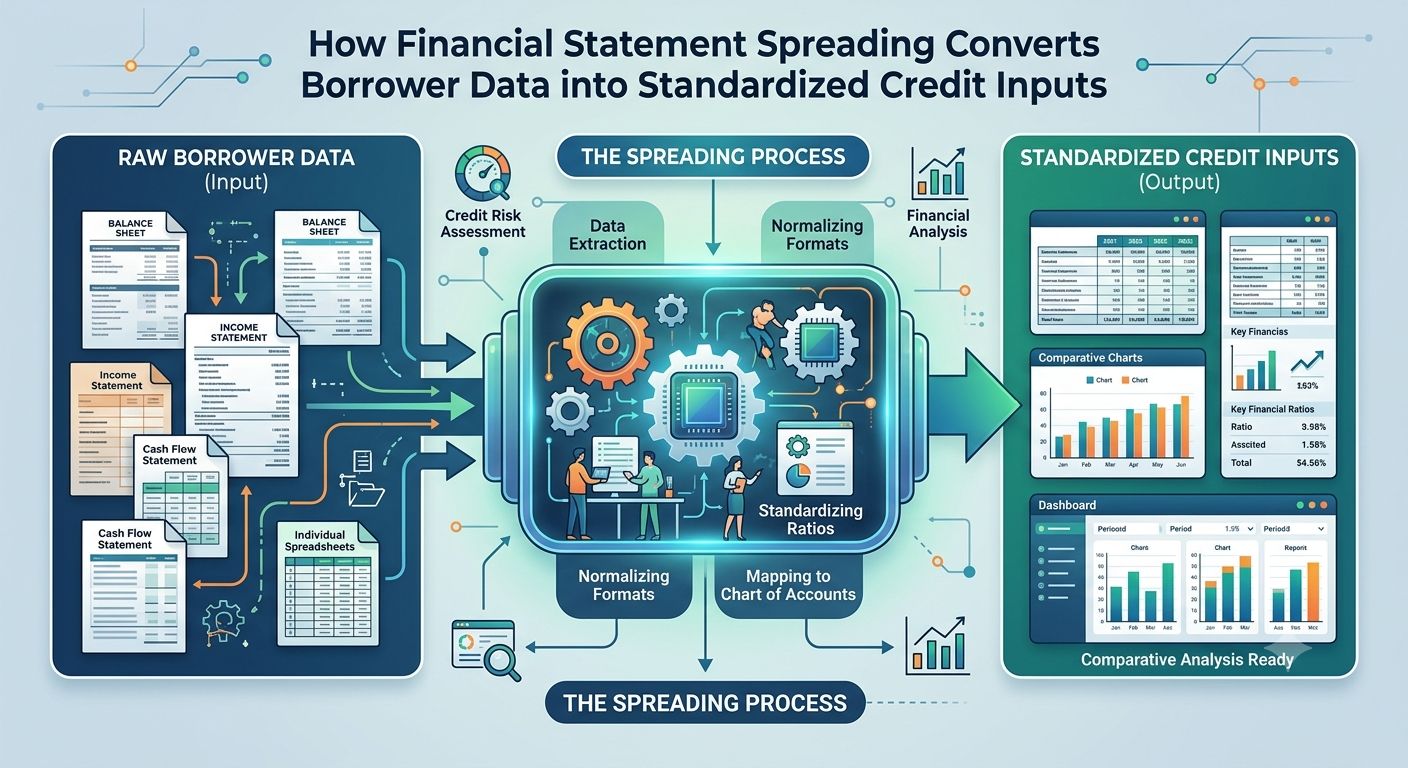
Borrower financial statements rarely arrive in the same format. One company may group expenses broadly, another may separate every cost line, while another may include important liabilities only in notes. The problem begins when credit teams review this data without first converting it into a common format. Ratios become harder to trust, trends become harder to compare, and credit memos may rely on uneven inputs.
Financial statement spreading converts borrower data into standardized credit inputs. This blog explains how spreading captures statement values, maps them into common categories, prepares ratio-ready data, supports commercial lending, and gives analysts source-linked inputs for better credit review.
What Is Financial Statement Spreading?
Financial statement spreading is the process of organizing borrower financial data into a consistent credit review format.
Financial Statement Spreading Definition
Financial statement spreading means capturing, mapping, and standardizing borrower financial statement data for credit analysis.
How Borrower Statements Become Credit-Ready Data
Borrower statements become credit-ready when values are extracted, categorized, checked, and arranged for ratios, trends, and credit notes.
Why Banks and Lenders Use Standardized Credit Inputs
Banks and lenders use standardized inputs to compare borrowers, review repayment capacity, and prepare consistent credit files.
Why Borrower Data Needs Standardization Before Credit Review
Borrower data needs standardization because raw statements vary across industries, accounting styles, and reporting periods.
Different Statement Formats Across Borrowers
Different formats make it harder to compare borrowers using the same credit logic.
Inconsistent Line Item Labels
The same financial item may appear under different names, which can affect mapping and ratio review.
Period and Entity Differences
Credit teams must separate annual, interim, standalone, and consolidated data before review.
Notes and Disclosures That Change Credit Interpretation
Notes can reveal obligations, related-party items, lease commitments, and accounting changes.
The Need for Comparable Credit Data
Comparable data helps analysts review borrowers with the same categories and ratio inputs.
What Are Standardized Credit Inputs?
Standardized credit inputs are borrower financial values arranged in a format that supports credit analysis.
Standardized Credit Inputs Definition
Standardized credit inputs are normalized financial fields used for ratios, risk review, and credit memos.
Financial Statement Values Used in Credit Review
Key values include revenue, expenses, assets, liabilities, equity, debt, cash flow, and working capital.
Ratio-Ready Borrower Data
Ratio-ready data means the spread values are checked and prepared for liquidity, debt, coverage, and cash flow ratios.
Credit Memo Inputs From Spread Data
Spread data supports credit memo sections such as borrower profile, financial trends, repayment capacity, and risk notes.
Source-Linked Data for Analyst Review
Source-linked data lets analysts trace each value back to the original borrower statement.
How Financial Statement Spreading Converts Borrower Data
Financial statement spreading converts borrower data through collection, extraction, mapping, normalization, and analysis preparation.
Step 1: Collect Borrower Financial Documents
Credit teams collect statements, notes, schedules, tax records, management accounts, and debt data.
Step 2: Extract Statement Values
Values are captured from financial statements and supporting documents.
Step 3: Map Line Items to Standard Categories
Borrower labels are mapped into common categories such as revenue, assets, debt, expenses, and equity.
Step 4: Normalize Data Across Periods
Data is aligned across reporting periods so trends can be compared.
Step 5: Prepare Ratios, Trends, and Credit Notes
The final spread supports ratio calculation, trend review, and credit memo preparation.
Source Documents Used for Financial Statement Spreading
A reliable spread uses more than one financial statement.
Balance Sheet
The balance sheet provides assets, liabilities, equity, debt, and working capital data.
Income Statement
The income statement provides revenue, expenses, margins, interest, taxes, and net income.
Cash Flow Statement
The cash flow statement shows whether the borrower generates cash from operations.
Notes to Financial Statements
Notes explain liabilities, commitments, accounting policies, and unusual items.
Tax Returns and Management Accounts
These records help validate income and interim financial performance.
Debt Schedules and Bank Statements
Debt schedules and bank statements help confirm borrowing levels and cash movement.
Balance Sheet Data Converted into Credit Inputs
Balance sheet data helps lenders assess liquidity, leverage, and financial position.
Current and Non-Current Assets
Assets are separated by short-term and long-term use.
Current and Long-Term Liabilities
Liabilities are classified by repayment timing.
Debt, Equity, and Retained Earnings
These fields help analysts understand capital structure.
Working Capital Position
Working capital shows short-term financial flexibility.
Asset and Liability Movement Across Periods
Movement across periods can reveal growth, stress, or debt pressure.
Income Statement Data Converted into Credit Inputs
Income statement data helps lenders assess earnings strength and margin quality.
Revenue and Operating Income
Revenue and operating income show business scale and core performance.
Cost of Sales and Operating Expenses
Costs are separated to support gross and operating margin review.
Interest, Taxes, Depreciation, and One-Time Items
These values affect profit quality and coverage ratios.
EBITDA and Net Income Adjustments
Adjustments should be reviewed and documented before credit use.
Margin Trends Across Reporting Periods
Margin trends show whether profitability is stable, improving, or weakening.
Cash Flow Data Converted into Credit Inputs
Cash flow data helps lenders review repayment capacity.
Operating Cash Flow
Operating cash flow shows cash generated by core business activity.
Investing and Financing Activities
These sections show asset purchases, borrowing, repayments, and equity movement.
Working Capital Movement
Changes in receivables, inventory, and payables can signal cash pressure.
Non-Cash Items
Depreciation and amortization should be separated from cash activity.
Cash Generation Compared With Reported Profit
Profit should be compared with operating cash flow before repayment strength is judged.
How Line Item Mapping Creates Standardized Credit Categories
Line item mapping turns borrower-specific labels into common credit fields.
Borrower Labels Mapped to Common Credit Fields
Different labels are placed into standard categories for analysis.
Consistent Treatment of Similar Line Items
Similar items should be handled the same way across borrowers and periods.
Clear Separation of Operating and Non-Operating Items
Operating performance should stay separate from financing, tax, and one-time items.
Unusual Line Items Flagged for Analyst Review
Unclear or unusual items should move to analysts before ratio use.
Period-Wise Mapping Consistency
Consistent mapping across periods supports reliable trend review.
Why Notes and Adjustments Matter in Standardized Credit Inputs
Notes and adjustments can change the meaning of borrower data.
Related-Party Transactions
Related-party items can affect cash flow, control, and repayment analysis.
Contingent Liabilities
Guarantees, claims, and disputes may create future obligations.
Lease Obligations
Lease commitments can affect debt capacity and coverage review.
Off-Balance Sheet Exposure
Off-balance sheet exposure may increase borrower risk.
One-Time Income and Expense Items
One-time items should be separated from recurring performance.
Accounting Policy Changes
Policy changes can affect comparison across periods.
How Standardized Credit Inputs Support Ratio Analysis
Standardized credit inputs give ratios reliable source values.
Liquidity Ratio Inputs
Current assets and current liabilities support liquidity ratios.
Debt Ratio Inputs
Debt, equity, and assets support leverage review.
Coverage Ratio Inputs
EBITDA, interest, and debt service values support coverage analysis.
Profitability Ratio Inputs
Revenue, margins, and income values support profitability review.
Cash Flow Ratio Inputs
Operating cash flow values support repayment analysis.
Covenant-Linked Ratio Inputs
Covenant-linked inputs help lenders monitor loan agreement limits.
How Standardized Spread Data Supports Credit Analysis
Standardized spread data supports borrower review across multiple credit questions.
Borrower Financial Health Review
Analysts can review liquidity, leverage, profitability, and cash flow.
Repayment Capacity Assessment
Repayment capacity depends on earnings, cash generation, and debt service ability.
Multi-Year Performance Comparison
Multi-year spreads reveal changes in borrower performance.
Peer and Sector Comparison
Standardized data helps compare borrowers within similar sectors.
Credit Risk Signal Identification
Spread data can reveal risk signals before final credit approval.
Credit Risk Signals Found Through Standardized Borrower Data
Standardized borrower data helps analysts find early financial stress.
Declining Revenue Growth
Lower growth may signal demand or pricing pressure.
Margin Pressure
Lower margins may show rising costs or weaker operating control.
Rising Debt Burden
Higher debt can reduce borrower flexibility.
Weak Operating Cash Flow
Weak operating cash flow can show poor cash conversion.
Working Capital Stress
Rising receivables or inventory can create liquidity pressure.
Disclosure-Based Risk Signals
Disclosures may reveal guarantees, leases, related-party exposure, or legal claims.
How Standardized Credit Inputs Support Commercial Lending
Commercial lending needs borrower data that is consistent, traceable, and ready for review.
Borrower File Preparation
Standardized spread data helps prepare borrower files for analyst review.
Credit Memo Preparation
Credit memos use spread values, ratios, trends, and risk notes.
Loan Structuring Inputs
Loan terms, pricing, limits, and covenants depend on borrower financial strength.
Covenant Review Inputs
Covenant review depends on verified ratio inputs and period comparisons.
Portfolio-Level Borrower Comparison
Standardized data helps compare borrowers across portfolios.
How Standardized Credit Inputs Support Loan Renewals and Annual Reviews
Renewals need updated financial data and prior-year comparison.
Current-Year and Prior-Year Spread Comparison
Analysts compare current results with earlier spread data.
Covenant Movement Review
Covenant movement helps lenders identify stress before renewal.
New Debt and Liability Changes
New debt can change repayment capacity and risk level.
Cash Flow Weakness Before Renewal
Cash flow weakness can signal renewal concern.
Updated Borrower Risk Notes
Risk notes should reflect current spread findings.
Common Problems When Borrower Data Is Not Standardized
Unstandardized borrower data can weaken the full credit review.
Incorrect Ratio Calculations
Ratios can be wrong when inputs are misclassified or incomplete.
Inconsistent Borrower Comparison
Borrower comparison weakens when data categories differ.
Missed Statement Adjustments
Unreviewed adjustments can distort earnings and debt review.
Weak Credit Memo Inputs
Credit memos lose quality when inputs are not verified.
Delayed Credit Committee Review
Committees may need more time when values are unclear.
Manual Challenges in Creating Standardized Credit Inputs
Manual spreading often creates delays and review gaps.
Data Entry Errors
Manual entry can lead to wrong or missing values.
Spreadsheet Formula Issues
Formula issues can distort totals, ratios, and trends.
Inconsistent Mapping Across Analysts
Different analysts may classify the same item differently.
Missed Notes and Disclosures
Important obligations may stay hidden if notes are missed.
Slow Turnaround for High-Volume Credit Files
High borrower volume can delay credit review.
How AI-Based Spreading Helps Standardize Borrower Data
AI-based spreading helps prepare borrower data faster while keeping analysts in control.
Statement Data Extraction
AI can capture values from borrower financial statements.
Table and Line Item Recognition
AI can read statement tables, rows, headers, and labels.
Standardized Mapping Rules
Mapping rules help classify borrower data consistently.
Low-Confidence Field Review
Low-confidence values can be routed to analysts.
Source-Linked Spread Outputs
Source links help reviewers verify spread values.
Quality Checks Before Using Standardized Credit Inputs
Standardized inputs should be checked before they enter credit review.
Reconcile Spread Totals With Source Statements
Spread totals should match source statements.
Validate Entity Names and Reporting Periods
Borrower entity and period details should be confirmed.
Review Mapping Rules Across Periods
Mapping should remain consistent across reporting periods.
Check Ratio Inputs Before Credit Use
Ratio inputs should be verified before analysis.
Document Analyst Adjustments and Assumptions
Adjustments and assumptions should be recorded for credit review.
Metrics That Show Standardized Credit Input Quality
Credit teams can measure data quality through accuracy, consistency, exceptions, and turnaround.
Data Accuracy Rate
This measures how often spread values match source records.
Mapping Consistency Rate
This tracks whether similar items are mapped consistently.
Exception Rate
This shows how many values need analyst review.
Manual Correction Time
This measures time spent fixing spread data.
Financial Spreading Turnaround Time
This tracks time from document receipt to completed spread.
Credit Review Turnaround Time
This shows whether standardized inputs help review move faster.
How to Build a Reliable Spreading Workflow for Standardized Credit Inputs
A reliable workflow needs complete documents, standard categories, review rules, and source links.
Start With Complete Borrower Documents
Collect statements, notes, schedules, bank records, and debt data first.
Define Standard Statement Categories
Use common categories for revenue, assets, liabilities, debt, cash flow, and expenses.
Review Notes Before Ratio Calculation
Notes should be reviewed before ratios and credit memos are finalized.
Route Exceptions to Credit Analysts
Unclear values should move to analysts for review.
Link Final Credit Inputs Back to Source Records
Final inputs should connect back to the original borrower documents.
End Note: Standardized Credit Inputs Start With Reliable Financial Statement Spreading
Standardized credit inputs help lenders review borrowers with cleaner data, consistent ratios, better risk notes, and clearer source evidence. Financial statement spreading is the step that converts raw borrower statements into a format credit teams can compare, verify, and use for lending decisions.
For banks and lenders handling high borrower volumes, financial spreading software can support source-linked extraction, standardized statement mapping, ratio-ready outputs, exception review, and analyst-led credit workflows.