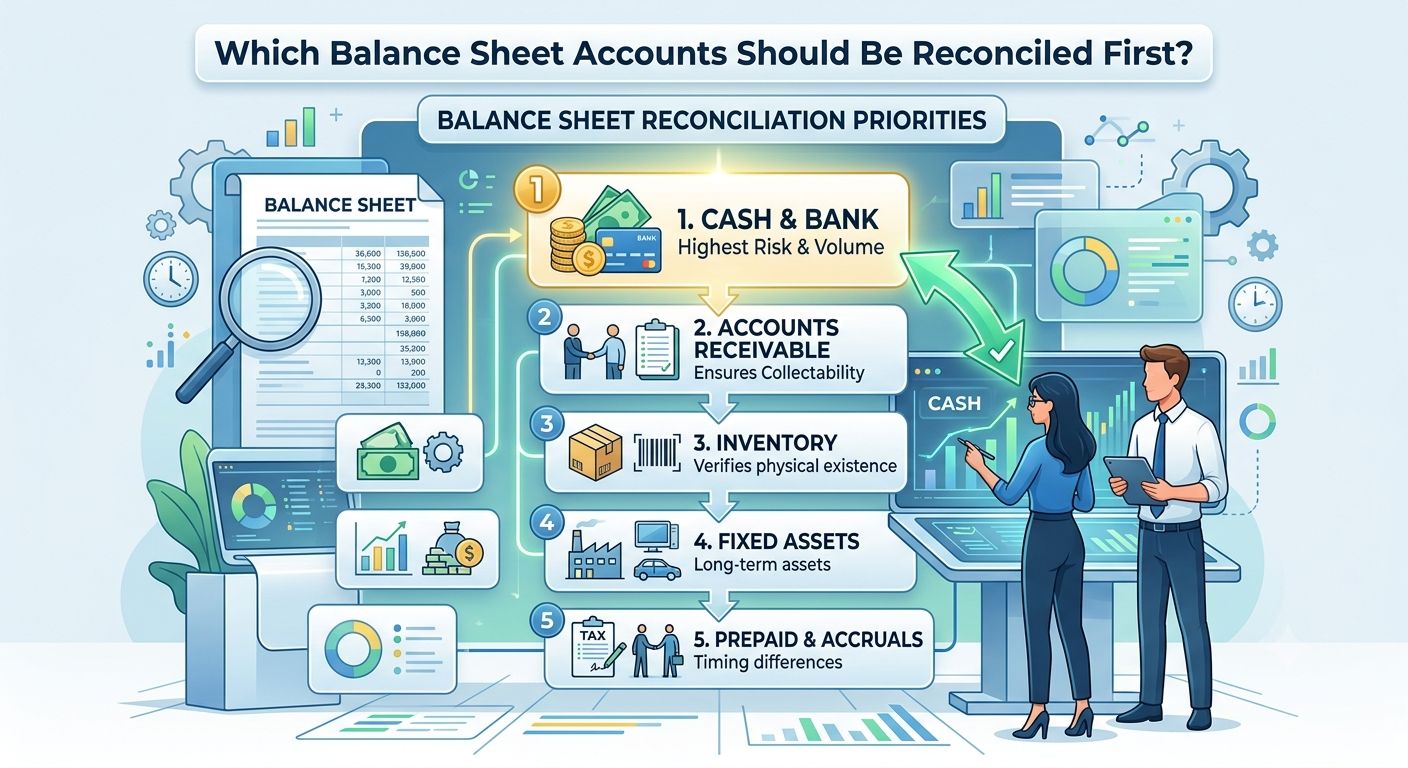
Finance teams rarely have unlimited time during month-end close. Every account needs review, but not every balance carries the same level of risk. A cash mismatch can affect liquidity. An unresolved AR balance can distort working capital. An intercompany difference can delay consolidation. If every account receives the same priority, high-risk balances may be reviewed too late.
The best approach is risk-based prioritization. Finance teams should reconcile balance sheet accounts based on transaction volume, materiality, fraud exposure, audit risk, and past reconciliation issues. This article explains which balance sheet accounts should be reconciled first, how to rank them, and how automation supports faster review.
Why Reconciliation Priority Matters for Balance Sheet Accounts
Reconciliation priority matters because some balance sheet accounts can affect reporting faster than others.
Limited finance resources during month-end close
Finance teams must review many accounts within short close windows. Prioritization helps them focus on the balances most likely to affect reporting.
Why every balance sheet account does not carry the same level of risk
A high-volume cash account carries more immediate risk than a low-activity prepaid account with a fixed schedule.
Impact of prioritization on reporting accuracy and financial control
When teams review high-risk accounts first, they can resolve issues earlier and reduce late adjustments.
What Determines Which Accounts Should Be Reconciled First
The right order depends on risk, activity, and reporting impact. Before deciding which balance sheet accounts deserve immediate attention, finance teams should understand that balance sheet reconciliation is one part of a broader reconciliation strategy. Different businesses also perform bank, customer, supplier, intercompany, and other types of account reconciliation, each with its own review frequency and risk profile.
Transaction volume and account activity
High-volume accounts create more chances for missing transactions, duplicates, timing differences, and posting errors.
Materiality of account balances
Large balances should be reviewed earlier because errors can affect financial statements.
Exposure to fraud, errors, and unauthorized activity
Cash, bank, and payment-related accounts need earlier review because they are exposed to unauthorized activity.
Regulatory, audit, and compliance requirements
Tax, payroll, and regulated balances need timely review because they may affect filings and audit evidence.
Frequency of historical reconciliation issues
Accounts with recurring exceptions should move higher in the review order.
Risk-Based Prioritization for Balance Sheet Reconciliation
Balance Sheet Reconciliation should be prioritized using risk, not habit.
High-risk accounts requiring immediate review
Cash, receivables, payables, intercompany, and high-volume clearing accounts often need early review.
Medium-risk accounts reviewed after critical balances
Inventory, payroll, accruals, and tax accounts may follow after cash and working capital accounts.
Low-risk accounts aligned with reporting schedules
Low-activity accounts with stable balances can be reviewed later if strong support exists.
Building a reconciliation priority matrix
A simple matrix can rank accounts by materiality, activity, risk exposure, audit impact, and past exception trends.
1. Cash and Bank Accounts
Cash and bank accounts should usually be reconciled first.
High transaction volume and liquidity impact
Cash balances affect liquidity reporting, treasury decisions, and cash-flow visibility.
Unauthorized payments and missing deposits
Bank accounts can show unauthorized payments, missing deposits, bank fees, interest, and direct debits.
Why cash balances should be reconciled first
Cash errors can affect management reporting quickly, so early review reduces financial-control risk.
2. Accounts Receivable
Accounts receivable should be reviewed early because it affects reported assets and collections.
Customer balances affecting reported assets
AR balances appear as assets and influence working capital reporting.
Unapplied cash and disputed invoices
Unapplied payments, customer disputes, and credit notes can distort receivable balances.
Aging trends requiring timely investigation
Old customer balances may need escalation, collection action, or adjustment review.
3. Accounts Payable
Accounts payable should follow because it affects liabilities and cash planning.
Supplier balances and payment obligations
AP reconciliation confirms what the company owes suppliers.
Duplicate invoices and unrecorded liabilities
Duplicate invoices can overstate liabilities, while missing invoices can understate expenses or payables.
Vendor statement reconciliation before close
Vendor statement review helps identify missing credits, payment differences, and disputed balances.
4. Intercompany Accounts
Intercompany accounts require early review in multi-entity organizations.
Differences between related entities
One entity may record a transaction while the other has not posted the matching entry.
Timing and currency-related variances
Cross-border activity can create timing and exchange-rate differences.
Coordinating reconciliation across business units
Early review gives entities enough time to investigate differences before consolidation.
5. Inventory Accounts
Inventory accounts affect asset valuation and cost reporting.
Inventory valuation and quantity differences
Inventory balances may differ because of stock count variances, valuation errors, or system mismatches.
Goods in transit and cut-off issues
Goods received or shipped near period-end can create timing differences.
Inventory adjustments requiring investigation
Write-offs, shrinkage, damaged goods, and manual adjustments should be reviewed before reporting.
6. Payroll and Accrual Accounts
Payroll and accrual balances require review because they depend on schedules, estimates, and reversals.
Payroll liabilities awaiting settlement
Payroll liabilities may include wages, benefits, taxes, and deductions not yet paid.
Accrual reversals and supporting schedules
Accruals should tie to schedules and reverse in the correct period.
Period-end adjustments affecting reported balances
Late accruals or incorrect reversals can affect liabilities and expenses.
7. Tax Accounts
Tax accounts need timely reconciliation because they affect compliance.
Indirect tax and payroll tax balances
Sales tax, VAT, withholding, and payroll tax balances should tie to filings and payment records.
Deferred tax and current tax reconciliations
Tax balances should be reviewed against calculations, schedules, and statutory requirements.
Compliance risks associated with tax accounts
Unsupported tax balances can create audit, filing, and regulatory issues.
8. Prepaid Expenses
Prepaid expenses can usually be reviewed after higher-risk balances unless the amounts are material.
Amortization schedules and prepaid balances
Prepaid balances should agree with amortization schedules, invoices, and contracts.
Identifying expired or incorrectly classified prepayments
Expired prepaids should be expensed, not carried as assets.
Supporting documentation for prepaid assets
Contracts and invoices should support each remaining prepaid balance.
9. Fixed Assets
Fixed assets are often reconciled after high-activity accounts unless there were major asset movements.
Asset additions, disposals, and transfers
New assets, disposals, and transfers should be compared with invoices and approval records.
Depreciation calculations and accumulated depreciation
Depreciation should agree with asset schedules and accounting policies.
Asset-register validation
The fixed asset register should match the general ledger.
Accounts That Can Usually Be Reconciled Later
Some accounts can be reviewed later if they are stable and low-risk.
Low-activity balance sheet accounts
Accounts with limited movement may not need immediate review.
Stable balances with limited transaction volume
Stable balances can follow high-risk accounts in the reconciliation schedule.
Accounts supported by periodic schedules
Accounts with strong schedules and predictable activity may be reviewed later.
Applying risk rather than account order
Finance teams should avoid fixed account order and use risk-based review instead.
Warning Signs That an Account Should Move Higher in Priority
An account should move higher in priority when it shows signs of risk.
Recurring reconciliation differences
Repeated differences show unresolved process issues.
Large unexplained balance movements
Material changes should be reviewed early.
Frequent manual journal entries
Manual activity increases the need for review.
Outstanding reconciling items from prior periods
Aged open items should be escalated before close.
How Reconciliation Priority Supports Month-End Close
The right priority order improves close quality and timing.
Resolving high-risk balances earlier
Early review gives finance teams more time to resolve material issues.
Reducing controller review delays
Well-prioritized reconciliations reduce bottlenecks during review.
Improving confidence before financial reporting
High-risk balances are validated before statements are finalized.
Reducing post-close adjustments
Early issue resolution reduces late corrections.
Prioritizing Balance Sheet Accounts in Multi-Entity Organizations
Multi-entity teams need coordinated priority planning.
Shared ERP environments
Shared ERPs require clear account ownership and entity-level review standards.
Cross-border entities and currency differences
Currency differences can create material reconciliation issues.
Intercompany dependency during reconciliation
Intercompany accounts depend on more than one team, so they need early attention.
Enterprise-wide reconciliation calendars
Central calendars help teams align review deadlines across entities.
Controls That Support Risk-Based Reconciliation Priorities
Controls help teams apply priorities consistently.
Risk-based account classification
Accounts should be classified as high, medium, or low risk.
Standardized reconciliation calendars
Calendars should reflect risk, close deadlines, and account ownership.
Ownership for priority accounts
Each high-priority account should have a clear preparer, reviewer, and escalation owner.
Escalation procedures for unresolved balances
Unresolved high-risk balances should move to the right decision-maker quickly.
Metrics That Validate Reconciliation Priorities
Metrics show whether the prioritization approach is working.
Number of unresolved high-risk accounts
Open high-risk accounts indicate close risk.
Aging of open reconciliation items
Older items require escalation.
Percentage of priority reconciliations completed on time
This shows whether key balances are ready before close deadlines.
Financial-close delays linked to critical accounts
Close delays reveal which accounts need earlier review.
Frequency of recurring balance sheet exceptions
Recurring exceptions help refine future priorities.
How Automation Helps Prioritize Balance Sheet Reconciliation
Automation helps finance teams identify which accounts need attention first.
Risk-based account scoring
Systems can score accounts based on value, activity, exceptions, and history.
Continuous monitoring of high-risk balances
High-risk accounts can be reviewed throughout the reporting period.
Automated alerts for material differences
Alerts notify teams when balances move unexpectedly or exceptions age.
Centralized visibility into reconciliation status
A centralized view helps managers see account status, owner, aging, and risk.
What High-Performing Finance Teams Do Differently
Strong finance teams prioritize based on risk rather than routine.
Prioritize accounts using risk and materiality
They focus first on accounts with the highest reporting impact.
Resolve high-risk balances throughout the reporting period
They avoid waiting until close to investigate high-risk accounts.
Review reconciliation priorities regularly
Account priorities are updated as transaction activity and business risk change.
Use historical exception trends to refine priorities
Recurring issues help teams adjust review order and controls.
Future Direction of Risk-Based Balance Sheet Reconciliation
Balance sheet reconciliation is moving toward continuous risk monitoring.
AI-assisted prioritization of reconciliation workload
AI can suggest which accounts need earlier review based on risk signals.
Predictive identification of high-risk accounts
Predictive checks can flag accounts likely to delay close.
Continuous reconciliation across finance systems
Continuous reconciliation reduces period-end pressure.
Real-time visibility into balance sheet account risk and reconciliation status
As transaction volumes increase and finance environments become more complex, many organizations are adopting an account reconciliation platform to prioritize high-risk accounts, monitor reconciliation status, centralize supporting documentation, and resolve exceptions before financial close.