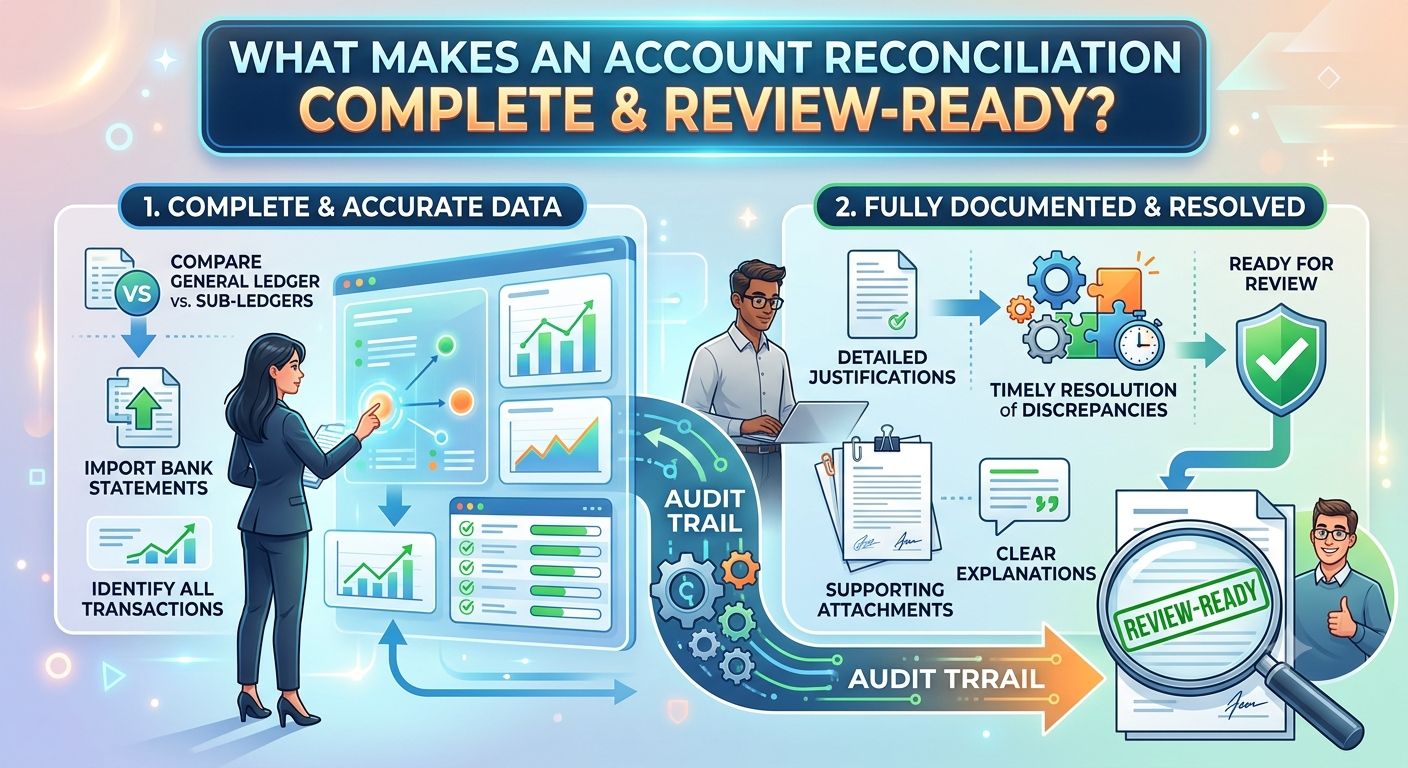
Account reconciliation can look finished on the surface while still being difficult to review. A balance may match, but the support may be missing. An exception may be listed, but the owner may be unclear. An adjustment may be posted, but approval evidence may not be attached. These gaps slow reviews, delay close, and create audit questions.
A complete reconciliation proves that the account balance is accurate, supported, explained, and ready for review. This article explains what makes an account reconciliation complete, what reviewers expect, why matching alone is not enough, and how finance teams can improve review readiness before month-end close.
Why Review-Ready Reconciliations Matter in Modern Finance Operations
Review-ready reconciliations matter because finance teams need reliable balances before reporting.
Growing transaction volumes across finance systems and business units
Finance teams handle payments, invoices, payroll records, accruals, journal entries, and adjustments across several systems.
Why reviewers expect clear support for every reconciled balance
Reviewers need to see where the balance came from, what supports it, and whether exceptions were handled properly.
Impact of incomplete reconciliations on financial reporting and close quality
Incomplete reconciliations create rework, delayed approvals, reporting corrections, and audit follow-ups.
What a Complete Account Reconciliation Actually Means
A complete reconciliation confirms that the account balance is correct and supported.
Definition of a completed reconciliation process
A completed reconciliation compares the ledger balance with supporting records, explains differences, resolves or documents open items, and records preparer ownership.
Relationship between reconciled balances and supporting evidence
A reconciled balance should tie back to invoices, statements, schedules, contracts, subledgers, or other source records.
Why completion involves more than matching transactions
A transaction match does not prove the ending balance is fully supported. Account Reconciliation also requires balance validation, exception review, and documentation.
What Review-Ready Means in Account Reconciliation
Review-ready means the reconciliation can be checked without extra searching.
Definition of review readiness in finance operations
Review readiness means the reconciliation has complete support, clear explanations, open-item tracking, and approval evidence.
Expectations of reviewers, controllers, and auditors
Reviewers expect clean schedules, traceable support, documented differences, and clear sign-off history.
Characteristics of a reconciliation that can be reviewed efficiently
A review-ready reconciliation is organized, complete, traceable, and easy to follow.
Core Components of a Complete Account Reconciliation
A complete account reconciliation includes several required parts.
Accurate account balance under review
The general ledger balance should match the reporting period and account being reviewed.
Supporting records tied to the balance
Supporting records should connect directly to the account balance.
Identification and explanation of differences
Any difference should have a clear reason.
Resolution or documentation of outstanding items
Open items should show owner, status, reason, and next action.
Evidence of preparer ownership and accountability
The reconciliation should show who prepared it and when.
Why Matching Transactions Alone Is Not Enough
Matching transactions is useful, but it is not the full review.
Differences between transaction matching and account substantiation
Matching confirms activity. Account substantiation confirms that the ending balance is valid.
Accounts that require supporting schedules beyond transaction data
Accruals, prepaids, tax accounts, payroll liabilities, and intercompany balances need schedules and explanations.
Importance of validating ending balances, not just activity
The final balance is what appears in reporting, so it must be supported.
Information Required Before Starting a Reconciliation Review
Review quality depends on the information available.
General ledger balances and account activity
The reviewer needs the account balance and period activity.
Supporting schedules and source documentation
Schedules, invoices, statements, contracts, and reports support the balance.
Prior-period reconciliation records
Prior records help explain carry-forward items.
Open items carried forward from earlier periods
Open items should not continue without review.
Approved adjustments and journal entries
Adjustments should include approval and supporting evidence.
What Reviewers Look for in Reconciliation Documentation
Reviewers check whether the reconciliation can support the balance.
Clear linkage between balances and supporting records
Every balance should tie to source records.
Documented explanations for differences
Differences should be explained in plain language.
Evidence supporting adjustments and corrections
Corrections should include reason, approval, and source support.
Consistent formatting and presentation standards
A consistent format makes reviews faster.
Traceability from source records to final balances
Reviewers should be able to follow the balance from source to ledger.
How Outstanding Items Affect Reconciliation Completeness
Outstanding items do not automatically make a reconciliation incomplete, but they must be documented.
Differences awaiting supporting documentation
Missing documents should have owner and due date.
Transactions pending settlement or posting
Pending items should have a clear expected resolution.
Aging unresolved balances across reporting periods
Old items need closer review.
Documentation requirements for open exceptions
Open exceptions should include reason, impact, owner, and status.
Common Reasons Reconciliations Fail Review
Reconciliations often fail review because support is incomplete.
Missing supporting documents
A balance without support cannot be reviewed properly.
Unsupported adjustments and write-offs
Adjustments need approval and explanation.
Unexplained balance differences
Differences should never be left without context.
Incomplete investigation of exceptions
Open items need investigation notes.
Lack of preparer and reviewer sign-off evidence
Sign-off confirms responsibility and review status.
Relationship Between Reconciliation Quality and Month-End Close
Review-ready reconciliations help month-end close move faster.
Impact of incomplete reconciliations on close timelines
Incomplete files cause rework and delayed approvals.
Delayed approvals caused by unresolved balances
Reviewers cannot approve balances that lack support.
Increased reporting corrections after review
Weak reconciliations often lead to late corrections.
Why close confidence depends on review-ready accounts
Finance leaders need reconciled accounts before they rely on reported numbers.
Review-Ready Reconciliation Across Different Account Types
Different accounts need different support.
Cash and bank accounts
Cash accounts need bank statements, deposits, payments, and outstanding items.
Accounts receivable and customer balances
AR accounts need invoices, receipts, credits, and customer balances.
Accounts payable and vendor balances
AP accounts need supplier invoices, credits, payments, and outstanding balances.
Payroll, tax, and accrual accounts
These accounts need payroll records, filings, schedules, and calculation support.
Intercompany and clearing accounts
These accounts need matching records across entities and clear settlement tracking.
Materiality and Risk in Reconciliation Reviews
Review depth should reflect account risk.
Prioritizing high-value accounts
High-value accounts should receive closer review.
Risk-based review of unusual balances
Unusual balances need explanation and support.
Treatment of immaterial differences
Small differences should still be documented based on policy.
Escalation of material unresolved exceptions
Material open items should move to the right reviewer quickly.
Why Timing Differences Require Clear Documentation
Timing differences are common, but they must be explained.
Transactions posted in different reporting periods
Cross-period entries should show why the timing difference exists.
Delayed settlements and system updates
Delayed settlements should be tracked until cleared.
Pending adjustments awaiting approval
Pending entries should show approval status.
Reviewer expectations for timing-related differences
Reviewers expect timing items to be valid, supported, and monitored.
Risks of Managing Reconciliation Reviews Through Spreadsheets
Spreadsheets can weaken review readiness as volume grows.
Version-control issues and duplicate files
Different file versions create confusion.
Missing audit trails for changes and approvals
Manual files may not show who changed what.
Limited visibility into review status
Teams may not know what is prepared, reviewed, or rejected.
Difficulty maintaining a single source of truth
Evidence can become scattered across files and emails.
Controls That Improve Reconciliation Review Readiness
Controls help finance teams prepare better reconciliations.
Standardized reconciliation templates
Templates create consistency across accounts.
Segregation of preparer and reviewer responsibilities
Preparation and review should be separate.
Approval checkpoints before period-end close
Approvals should happen before reporting deadlines.
Documentation standards for supporting evidence
A clear Account Reconciliation Review Checklist helps teams confirm that support, explanations, approvals, and open items are complete before review.
Exception Management as Part of the Review Process
Exception management keeps open items visible.
Classification of reconciliation exceptions by risk level
High-risk items should be reviewed first.
Escalation workflows for unresolved balances
Exceptions need clear owners.
Aging visibility for open items
Aging reports help prevent stale balances.
Root-cause analysis for recurring review findings
Recurring issues should be corrected at the source.
How Automation Improves Reconciliation Completeness and Review Readiness
Automation helps finance teams prepare cleaner reconciliations.
Automated collection of supporting evidence
Documents and records can be connected to balances faster.
Continuous validation of balances and transactions
Accounts can be reviewed throughout the period.
Real-time visibility into open exceptions
Teams can see open items, aging, and owners in one place.
Centralized tracking of preparation and review status
An account reconciliation platform helps centralize matching, evidence, approvals, open items, and review status.
Future Direction of Reconciliation Reviews
Reconciliation reviews are moving to continuous validation.
AI-assisted identification of incomplete reconciliations
AI can flag missing support, unusual balances, and incomplete records.
Predictive detection of review risks before close
Predictive checks can identify accounts likely to fail review.
Continuous account-certification processes
Finance teams can certify accounts throughout the period.
Real-time review readiness supported by intelligent validation logic
The future of reconciliation depends on better evidence, faster exception review, and real-time visibility into account readiness.