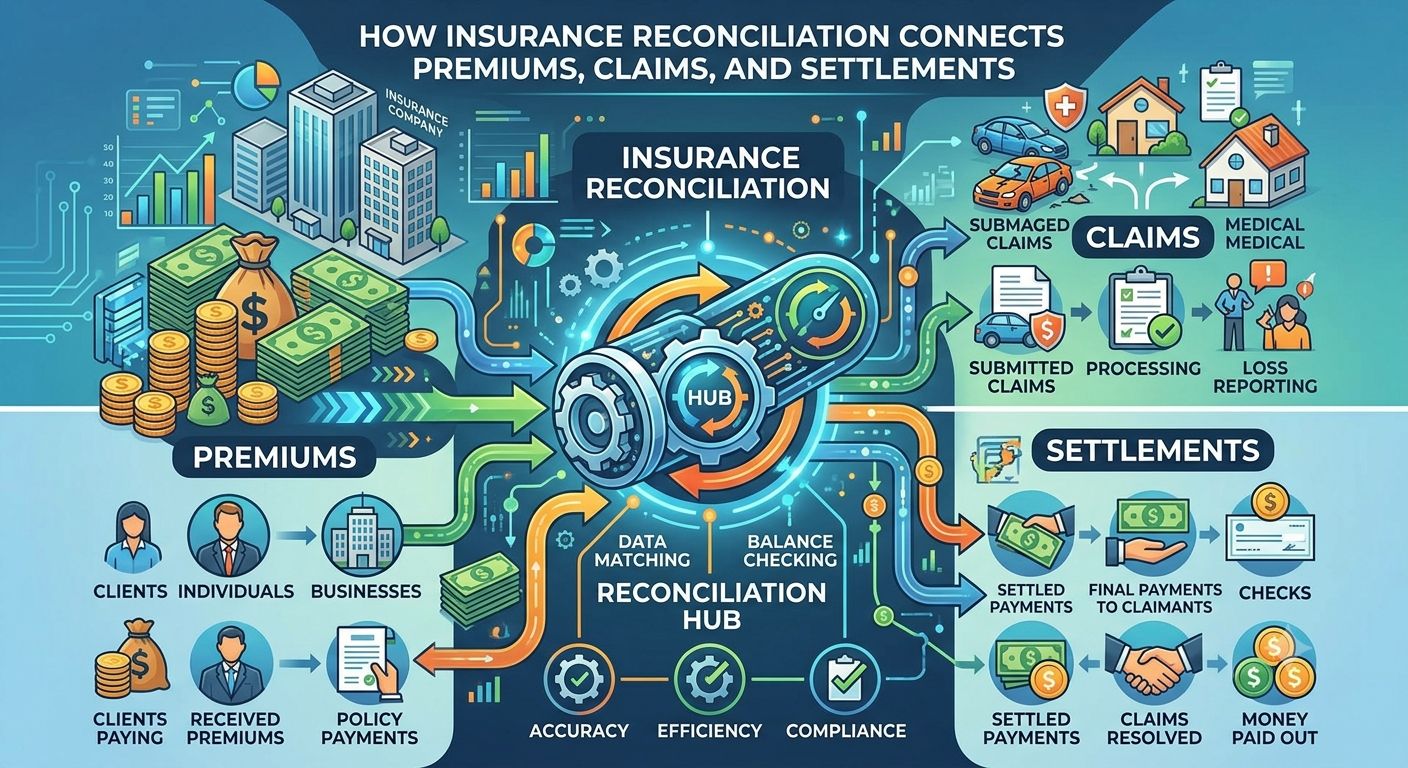
Insurance finance records rarely move through one system or at the same time. Premiums may be collected through agents, claims may remain open for months, and settlements may pass through banks, brokers, reinsurers, and third-party administrators. When these records do not align, insurers face inaccurate balances, delayed close, payment disputes, and weak cash visibility.
Insurance reconciliation connects policy activity, premium collections, claim payments, recoveries, and settlements with the general ledger. It helps finance teams identify missing transactions, timing differences, duplicate entries, and unsupported adjustments. This guide explains how premium, claims, and settlement reconciliation work together, which records are compared, common differences, controls, performance metrics, and the role of automation.
Why Insurance Reconciliation Is Central to Financial Accuracy
Insurance reconciliation confirms that operational insurance activity agrees with accounting and banking records.
Relationship between premiums, claims, and settlements
Premiums create revenue and receivable activity. Claims create liabilities, reserves, and payments. Settlements complete the movement of funds between insurers, customers, brokers, providers, and reinsurers.
Why insurance transactions require continuous reconciliation
Policies, collections, claims, endorsements, refunds, and recoveries change throughout the reporting period. Frequent reconciliation helps finance teams identify differences before they accumulate.
Risks of disconnected insurance financial records
Disconnected records can create misstated premiums, inaccurate claim liabilities, duplicate payments, missed recoveries, and unexplained bank differences.
What Is Insurance Reconciliation?
Insurance reconciliation compares policy, premium, claims, settlement, banking, and accounting records to confirm that transactions and balances are accurate.
Definition of insurance reconciliation
Insurance Reconciliation is the process of matching insurance transactions across operational systems, payment records, subledgers, and the general ledger.
Objectives of insurance reconciliation
Its objectives are to confirm transaction completeness, validate balances, identify exceptions, support close, and maintain reliable financial records.
How it differs from standard account reconciliation
Standard account reconciliation may compare one ledger balance with one supporting source. Insurance reconciliation often connects policy, claim, broker, payment, recovery, and reinsurance records across several systems.
Which Insurance Transactions Need Reconciliation?
Any insurance transaction that affects revenue, liabilities, payments, receivables, or cash should be reconciled.
Premium collections
Premium invoices, customer receipts, broker remittances, direct debits, and bank settlements should agree.
Claims payments
Approved claims, payment instructions, bank transactions, reserve movements, and ledger postings require comparison.
Policy cancellations and refunds
Cancelled policies may create premium reversals, customer refunds, commission corrections, and changes to earned premium.
Commission and broker payments
Broker statements, commission schedules, premium collections, deductions, and payment records should be matched.
Reinsurance transactions
Ceded premiums, recoverable claims, commissions, treaty balances, and reinsurer statements require separate review.
Settlement and recovery transactions
Claim recoveries, subrogation receipts, salvage proceeds, refunds, and final settlement amounts should connect to the related policy or claim.
How Premium Reconciliation Works
Premium reconciliation confirms that billed, collected, earned, and outstanding premium records agree.
Match premium invoices with collections
Finance teams compare premium invoices with customer receipts, broker remittances, direct debits, and bank records.
Validate policy details and billing records
Policy number, insured party, coverage period, premium amount, tax, currency, and payment schedule should match billing data.
Identify outstanding or short-paid premiums
Unpaid, partially paid, or incorrectly allocated premiums should be assigned for collection or correction.
Confirm earned and unearned premium balances
Finance teams verify whether premium revenue is recognized according to the policy period and whether the remaining balance is recorded as unearned premium.
How Claims Reconciliation Works
Claims reconciliation confirms that approved claims, reserves, payments, and recoveries are recorded correctly.
Match claim records with payment transactions
Claim number, claimant, approved amount, payment date, payee, and bank reference should agree across systems.
Validate claim approvals and reserve balances
Claim payments should have valid approval, while open claim reserves should reflect the latest expected settlement value.
Reconcile recoveries and subrogation amounts
Recoveries from reinsurers, liable third parties, or salvage proceeds should be linked to the correct claim.
Confirm final claim settlement values
Closed claims should show consistent approved, paid, recovered, and outstanding amounts.
How Settlement Reconciliation Connects Premiums and Claims
Settlement reconciliation connects operational insurance transactions with actual cash movement.
Linking policy transactions to claim payments
Policy and claim references help confirm that payments relate to valid coverage and approved claims.
Reconciling insurer, broker, and customer settlements
Finance teams compare broker remittances, customer collections, insurer payments, deductions, commissions, and refunds.
Matching bank settlements with accounting records
Bank transactions should match premium receipts, claim payments, refunds, recovery receipts, and ledger postings.
Validating settlement adjustments and reversals
Returned payments, failed direct debits, reversals, refunds, and corrections should have documented reasons and approval.
Core Records Used During Insurance Reconciliation
Reliable reconciliation depends on records that explain both the transaction and its accounting effect.
Policy administration records
These records provide policy numbers, coverage periods, premium schedules, endorsements, cancellations, and customer details.
Premium billing and collection reports
Billing reports show amounts due, paid, overdue, refunded, or allocated through brokers and collection channels.
Claims management records
Claims systems contain claim status, reserves, approvals, payments, recoveries, and closure information.
Bank statements and payment files
Bank records confirm whether premiums, refunds, claim payments, and recoveries were settled.
General ledger and subledger balances
The ledger shows how insurance transactions affect revenue, receivables, liabilities, expenses, reserves, and cash.
Reinsurance and broker statements
These statements support ceded premiums, commissions, recoveries, deductions, and outstanding balances.
Common Differences Found During Insurance Reconciliation
Insurance reconciliation differences often come from timing, missing records, allocation errors, or system updates.
Missing premium receipts
A payment may appear in a bank or broker statement but remain absent from the premium system.
Duplicate premium postings
The same collection may be recorded twice through repeated uploads or overlapping payment feeds.
Outstanding claim payments
A claim may be approved and recorded but remain unpaid or uncleared at the bank.
Settlement timing differences
An insurer may record a payment before the bank, broker, customer, or provider reflects it.
Policy endorsement adjustments
Coverage changes may alter premiums, taxes, commissions, and billing balances after the original posting.
Incorrect commission calculations
Commission differences can arise from wrong rates, policy changes, cancellations, or inaccurate premium bases.
Why Timing Differences Are Common in Insurance Reconciliation
Insurance transactions pass through several approval, collection, and settlement stages.
Premium collection timing
Premiums may be collected before policy records update or received by brokers before insurer remittance.
Claim approval and payment timing
A claim may be approved in one period and paid in another.
Bank settlement delays
Banks may process payments, refunds, and direct debits after internal systems record them.
Cross-period accounting entries
Claims, premiums, recoveries, and adjustments recorded in different periods can create temporary differences.
Insurance Reconciliation Across Multiple Systems
Insurance reconciliation often requires records from operational, accounting, and payment systems.
Policy administration systems
These systems hold policy issuance, billing, endorsement, cancellation, and renewal data.
Claims management platforms
Claims records include reserves, approvals, payments, recoveries, and claim status changes.
ERP and finance systems
ERP systems record premium revenue, receivables, claim expenses, liabilities, commissions, and cash activity.
Banking and payment platforms
Payment platforms provide settlement status, transaction references, reversals, fees, and returned-payment details.
Controls That Strengthen Insurance Reconciliation
Controls help insurers apply consistent matching, correction, and approval procedures.
Segregation of financial responsibilities
Preparation, correction, approval, and final review should be assigned to different individuals where risk is material.
Approval controls for adjustments
Premium write-offs, claim corrections, reserve changes, refunds, and settlement adjustments should require documented authorization.
Standardized reconciliation procedures
Each reconciliation should follow defined records, matching rules, deadlines, tolerance limits, and escalation steps.
Documentation supporting audit requirements
Reconciliations should retain source records, exception explanations, approvals, adjustments, and reviewer sign-off.
Challenges Insurance Companies Face During Reconciliation
Insurance companies must reconcile large transaction volumes across policy, claims, broker, payment, and accounting systems.
High transaction volumes
Large numbers of premium receipts, claim payments, refunds, and adjustments make manual matching difficult.
Multiple policy and claim updates
Endorsements, renewals, cancellations, reserve revisions, and claim reopenings can change previously recorded balances.
Large broker and agent networks
Different reporting formats, remittance schedules, deductions, and commission arrangements create reconciliation differences.
Manual reconciliation across disconnected systems
Manual exports and spreadsheets can create version conflicts, broken formulas, and limited visibility into exception status.
Regulatory reporting requirements
Insurers need reliable reconciliation evidence to support financial statements, reserve reporting, solvency monitoring, and audits.
Metrics That Measure Insurance Reconciliation Performance
Performance metrics show whether insurance balances are being reviewed and resolved on time.
Reconciliations completed on time
This measures the percentage of scheduled reconciliations approved before reporting deadlines.
Number of unresolved reconciliation items
A rising number of open items may indicate weak matching, ownership, or follow-up.
Aging of premium and claim differences
Older differences require faster review because evidence becomes harder to obtain.
Frequency of manual adjustments
Frequent adjustments may indicate source-data issues, policy-system gaps, or recurring posting errors.
Financial close delays caused by reconciliation issues
This measures how unresolved premium, claims, and settlement differences affect reporting timelines.
How Automation Improves Insurance Reconciliation
Automation helps finance teams compare large volumes of insurance records and focus on exceptions.
Automated matching of premiums, claims, and settlements
Systems can compare policy numbers, claim IDs, amounts, dates, currencies, counterparties, and bank references.
Continuous monitoring of insurance transactions
Premium collections, claims payments, refunds, and recoveries can be checked throughout the reporting period.
Centralized management of reconciliation evidence
Statements, payment files, policy records, claim approvals, and investigation notes can remain connected to each reconciliation.
Real-time visibility into reconciliation exceptions
Dashboards can display open items by policy, claim, owner, amount, age, source, and resolution status. Transaction reconciliation supports this process by confirming whether individual insurance transactions agree across operational and financial records.
What High-Performing Insurance Finance Teams Do Differently
Strong insurance finance teams treat reconciliation as a continuous financial control.
Reconcile premium and claim activity throughout the reporting period
They review collections, claims, refunds, recoveries, and settlements before month-end pressure builds.
Prioritize high-value policies and claims
Material policies, large claims, overdue premiums, and aged settlements receive earlier attention.
Standardize reconciliation rules across business units
Common matching rules, documentation standards, tolerance limits, and ownership models support consistent reporting.
Investigate recurring reconciliation differences at the source
Repeated issues are traced to policy configuration, claim processing, broker reporting, payment references, or accounting mappings.
Future Direction of Insurance Reconciliation
Insurance reconciliation is moving from periodic comparison to continuous financial visibility.
AI-assisted identification of reconciliation exceptions
AI can identify likely matches, duplicate records, unusual amounts, missing relationships, and inconsistent transaction patterns.
Predictive detection of premium and claim discrepancies
Historical patterns can indicate which policies, claims, brokers, or payment channels are likely to create differences.
Continuous reconciliation across insurance ecosystems
Connected policy, claim, broker, bank, and ERP records allow transactions to be reviewed throughout the period.
Real-time visibility into policy, claim, and settlement balances
An account reconciliation software can help insurers match premiums, claims, recoveries, and settlements, assign exceptions, centralize supporting records, and maintain current visibility into financial balances.