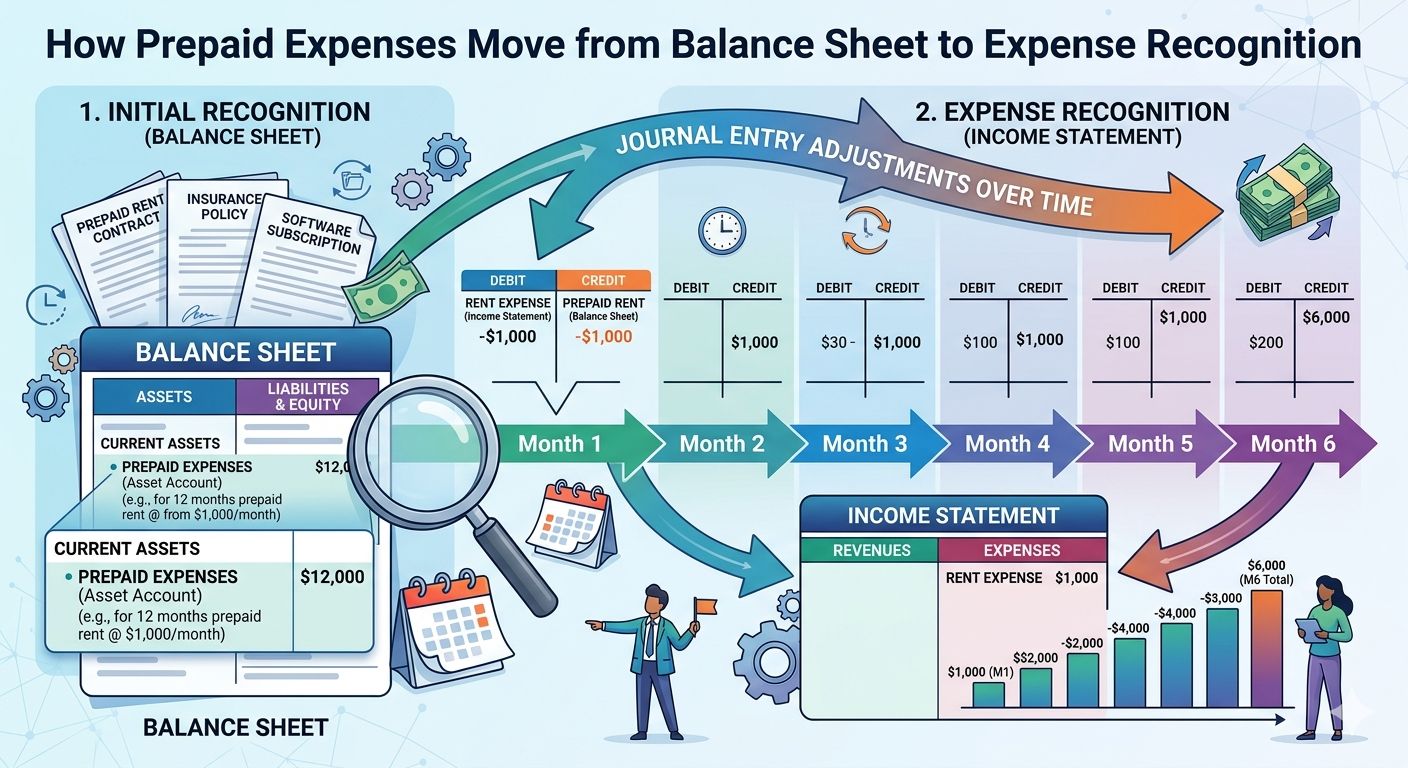
Finance teams often struggle with prepaid expense accounting during month-end close because payments, contracts, expense schedules, and amortization entries rarely move together in real time. A prepaid balance may appear correctly on the balance sheet while expense recognition schedules remain outdated, incomplete, or manually adjusted. These gaps create inaccurate operating expenses, overstated assets, delayed close cycles, and audit concerns.
The problem becomes larger in enterprise environments where finance teams manage recurring subscriptions, insurance contracts, lease agreements, software licenses, and vendor retainers across multiple entities and reporting periods. This article explains how prepaid expenses move from balance sheet classification into expense recognition, the accounting logic behind that movement, the records finance teams must validate, common tracking mistakes, and how automation improves prepaid accounting accuracy.
Why Prepaid Expense Accounting Creates Confusion During Financial Close
Prepaid accounting looks simple initially, but reporting complexity increases significantly during financial close cycles.
Difference between payment timing and expense recognition timing
A business may pay cash upfront today, but accounting rules require the expense to be recognized gradually over future periods. This timing difference creates prepaid asset balances that must be monitored continuously.
Why prepaid balances remain on the balance sheet initially
Prepaid expenses remain on the balance sheet because the underlying service or benefit has not yet been fully consumed by the organization.
Impact of incorrect prepaid treatment on financial reporting
Incorrect prepaid accounting can overstate assets, understate expenses, distort profitability analysis, and weaken reporting accuracy.
Because prepaid balances affect multiple reporting areas, finance teams must understand their accounting purpose clearly.
What Prepaid Expenses Actually Represent
Prepaid balances represent future economic value that will gradually convert into expenses over time.
Definition of prepaid expenses in accounting
Prepaid expenses are advance payments made for services or goods that will be consumed in future accounting periods.
Why prepaid expenses are treated as current assets
Since prepaid balances provide future business value, they are initially recorded as assets rather than immediate expenses.
Difference between prepaid expenses and accrued expenses
Prepaid expenses involve payments made before expense recognition, while accrued expenses represent expenses recognized before payment occurs.
A detailed breakdown of Prepaid Expenses on Balance Sheet explains how prepaid balances appear within financial statements and why they require ongoing reconciliation.
How Prepaid Expenses First Appear on the Balance Sheet
The accounting lifecycle of prepaid expenses begins when organizations make advance payments.
Recording advance payments before service consumption
When companies pay for future services in advance, the amount is recorded within prepaid asset accounts instead of expense accounts.
Initial journal entries for prepaid expenses
The initial accounting entry typically debits prepaid expense assets and credits cash or accounts payable balances.
Relationship between cash payments and prepaid asset balances
Cash payments create prepaid asset balances because the service benefit has not yet been consumed operationally.
After the initial recording stage, finance teams must determine how and when expense recognition occurs.
Why Prepaid Expenses Cannot Be Recognized Immediately
Accounting principles require expense recognition to align with actual usage periods.
Matching principle in accounting
The matching principle requires expenses to appear in the same accounting period as the related operational benefit.
Expense recognition across multiple accounting periods
Prepaid balances are gradually recognized across months, quarters, or years depending on the contract duration.
Risks of recording prepaid costs entirely in one period
Immediate recognition distorts profitability reporting and creates inaccurate financial statements.
This gradual conversion process introduces amortization schedules into prepaid accounting operations.
How Expense Recognition Happens Over Time
Expense recognition occurs through systematic amortization entries across reporting periods.
Periodic amortization of prepaid balances
Finance teams reduce prepaid asset balances incrementally through monthly or scheduled amortization postings.
Relationship between amortization schedules and expense recognition
Amortization schedules define when prepaid balances move into operating expenses.
How prepaid balances gradually reduce on the balance sheet
Each amortization entry decreases prepaid asset balances while increasing operating expenses.
Different types of prepaid expenses require different amortization treatment and tracking structures.
Common Types of Prepaid Expenses Finance Teams Track
Enterprise finance teams manage prepaid balances across multiple operational categories.
Insurance and subscription prepayments
Annual insurance contracts and subscription renewals commonly create recurring prepaid balances.
Software licensing and SaaS agreements
Software contracts often involve advance payments amortized across contract periods.
Rent and lease-related prepaid costs
Advance rental payments and lease obligations require scheduled expense allocation.
Vendor retainers and long-term service contracts
Service retainers create prepaid balances that must align with vendor contract timelines.
Marketing and advertising prepayments
Advance advertising commitments often span multiple reporting periods.
Because prepaid balances affect reporting accuracy directly, finance teams must validate supporting records carefully.
Core Records Finance Teams Must Match During Prepaid Tracking
Reconciliation accuracy depends on validating schedules, contracts, invoices, and accounting entries together.
Vendor invoices against prepaid schedules
Invoices should reconcile with prepaid schedules and contractual obligations.
Contract periods versus amortization timelines
Contract start and end dates must align with amortization periods.
Payment records against prepaid asset balances
Payment records should support active prepaid balances recorded in the ledger.
General ledger balances versus amortization entries
Ledger balances should reconcile against active amortization schedules.
Expense recognition records against prepaid reductions
Expense postings must match corresponding prepaid balance reductions.
Once reconciliation begins, finance teams typically identify recurring prepaid tracking errors.
Most Common Prepaid Expense Tracking Mistakes
Most prepaid accounting issues originate from manual processes and inconsistent schedule management.
Missing amortization entries during close cycles
Missed amortization entries leave prepaid balances overstated.
Incorrect prepaid classification between asset and expense accounts
Improper classification creates inaccurate asset and operating expense balances.
Duplicate amortization postings across periods
Duplicate entries inflate operating expenses unnecessarily.
Failure to update schedules after contract changes
Renewals, cancellations, and amendments often require updated amortization schedules.
Unsupported manual adjustments to prepaid balances
Manual adjustments without documentation weaken audit readiness.
Incorrect cut-off treatment during reporting periods
Incorrect cut-off treatment shifts expenses into the wrong reporting period.
As discrepancies increase, finance teams experience greater operational pressure during close.
Why Prepaid Expense Errors Escalate During Month-End Close
Month-end close exposes prepaid inconsistencies that remain hidden during regular operations.
Delayed updates to amortization schedules
Outdated schedules create inaccurate expense recognition activity.
Spreadsheet dependency across finance teams
Spreadsheet-based tracking introduces version-control problems and inconsistent formulas.
Lack of centralized visibility into prepaid balances
Finance teams struggle to identify inactive or unsupported prepaid balances without centralized monitoring.
Inconsistent tracking practices across departments and entities
Different business units often maintain inconsistent prepaid accounting practices.
Because prepaid balances affect financial reporting directly, organizations increasingly automate reconciliation workflows.
How Automation Improves Prepaid Expense Recognition Accuracy
Automation improves consistency, visibility, and reporting control across prepaid accounting operations.
Automated amortization schedule management
Automated workflows maintain amortization schedules based on contract timelines and accounting rules.
Real-time visibility into prepaid balances
Centralized dashboards provide better monitoring of prepaid balances across entities and departments.
Continuous validation of prepaid expense entries
Continuous validation identifies discrepancies earlier instead of waiting until month-end close.
Reduction in repetitive manual reconciliation effort
Automation reduces spreadsheet dependency while improving reconciliation consistency.
Organizations seeking stronger prepaid accounting visibility and more consistent month-end validation increasingly adopt enterprise account reconciliation software that supports centralized reconciliation workflows, automated amortization management, and continuous prepaid expense monitoring.