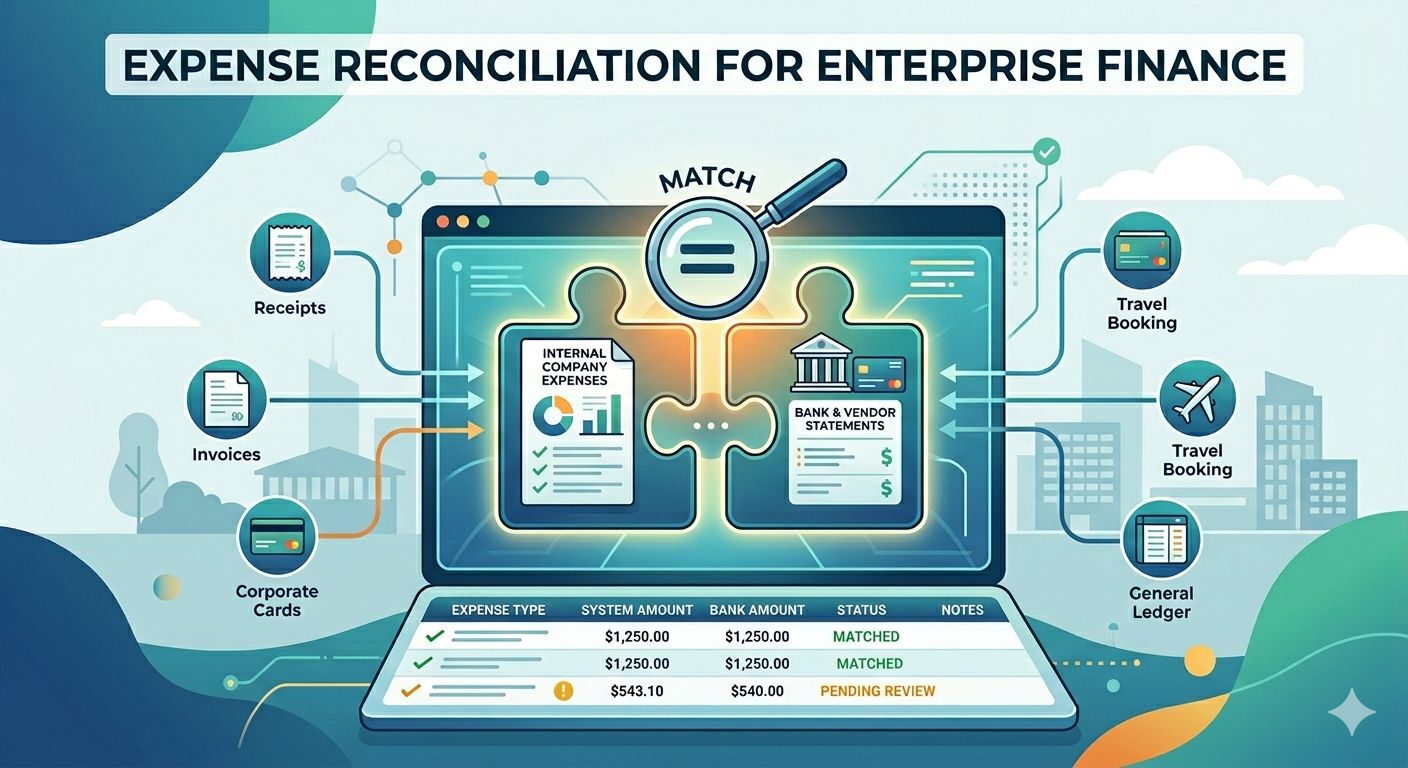
Enterprise finance teams process expenses across departments, subsidiaries, reimbursement systems, corporate cards, ERP platforms, and vendor networks every day. As transaction volume increases, finance leaders often struggle to maintain visibility into whether every expense entry, reimbursement, approval, and accrual has been accurately recorded. Even small mismatches can create reporting gaps that delay financial close, distort departmental spending visibility, and increase audit exposure.
The challenge becomes larger when expense data is scattered across disconnected systems and manual reconciliation workflows. Finance teams spend significant time identifying duplicate entries, missing documentation, unsupported adjustments, and delayed approvals before reporting cycles close. This article explains what enterprise expense reconciliation actually covers, what records need to match, where discrepancies usually begin, and how modern finance teams improve reconciliation accuracy across large-scale operations.
Why Expense Reconciliation Becomes Difficult in Enterprise Finance Operations
Enterprise finance operations involve constant movement of expense data between departments, systems, and entities. As organizations grow, reconciliation complexity increases across operational and financial workflows.
Growth in expense transaction volume across departments and entities
Large organizations process thousands of expense transactions related to procurement, travel, reimbursements, payroll adjustments, vendor invoices, and shared-service operations. Every transaction creates accounting activity that must eventually reconcile with ledger balances.
Why disconnected expense systems create reconciliation gaps
Expense records often exist across ERP systems, reimbursement applications, AP platforms, payroll systems, and corporate card portals. When systems do not synchronize properly, finance teams encounter inconsistent records and unresolved discrepancies.
Impact of unresolved expense discrepancies on financial close
Unresolved mismatches increase manual corrections during close cycles. Delayed validations also create uncertainty around accrual balances and operating expense reporting.
These issues make structured reconciliation workflows necessary for enterprise finance teams.
What Expense Reconciliation Actually Covers
Expense reconciliation involves more than validating invoices or reimbursements. It focuses on verifying whether all expense-related activity aligns with financial records.
Definition of expense reconciliation in enterprise finance
Expense reconciliation is the process of comparing expense transactions, reimbursements, invoices, approvals, and ledger postings to confirm accuracy, completeness, and policy compliance.
Difference between expense reconciliation and invoice validation
Invoice validation checks whether invoice details are accurate before processing. Expense reconciliation validates the full lifecycle of expense activity after posting, reimbursement, approval, and accrual recognition.
Why expense balances must align with general ledger records
Expense balances directly affect profitability, cost visibility, budgeting, and financial reporting accuracy. Incorrect balances create unsupported accruals and unreliable reporting outcomes.
A deeper explanation of Expense Reconciliation outlines how enterprise finance teams validate expenses across operational and accounting systems.
Why Enterprise Expense Reconciliation Requires Multi-System Validation
Enterprise expense workflows involve multiple finance environments operating simultaneously. Reconciliation accuracy depends on validating transactions across all connected systems.
Expense activity across ERPs, AP systems, and reimbursement platforms
Expense data moves between expense-management systems, ERP environments, accounts payable workflows, payroll systems, and reimbursement applications before final ledger posting occurs.
Relationship between operational expenses and accounting balances
Every operational expense eventually impacts expense accounts, liability balances, accruals, departmental budgets, and financial statements.
Why enterprise finance teams need centralized reconciliation visibility
Without centralized monitoring, unresolved discrepancies remain hidden across business units, increasing close-cycle pressure and audit risk.
Because of this operational complexity, finance teams prioritize validating specific records first during reconciliation reviews.
Core Expense Records That Need to Match During Reconciliation
Accurate reconciliation depends on comparing records across operational and accounting environments to identify inconsistencies early.
Expense reports against ledger balances
Approved employee expense reports should align with posted ledger entries and reimbursement records.
Corporate card transactions versus approved reimbursements
Corporate card transactions must reconcile against submitted expense claims and approved reimbursements to prevent duplicate or unsupported expenses.
Vendor invoices against recorded expense postings
Vendor invoices linked to operational expenses should match expense entries and liability balances in finance systems.
Employee reimbursements versus payroll adjustments
Employee reimbursement payouts and payroll deductions should reconcile against approved expense activity.
Tax entries and withholding-related expense records
Tax deductions, withholding adjustments, and expense-related tax entries should align with recorded expense balances.
Accrual balances versus actual expense recognition
Accrued expenses should reconcile with actual invoices and reimbursements after expense recognition occurs.
After core records are identified, finance teams usually focus on high-risk mismatches first.
What Finance Teams Should Match First During Expense Reviews
Early validation reduces the likelihood of unresolved discrepancies escalating during financial close.
Opening expense balances and prior-period carry-forwards
Finance teams first verify whether prior-period balances were correctly transferred into the current reporting cycle.
Unmatched expense transactions and pending approvals
Pending approvals and unmatched transactions often create reporting delays and inaccurate accrual balances.
Duplicate claims and repeated expense postings
Duplicate reimbursements and repeated ledger entries can inflate operating costs and create audit issues.
Supporting receipts against recorded expense activity
Receipts and supporting documentation validate the legitimacy and categorization of recorded expenses.
Expense-category mapping across departments and entities
Incorrect mapping across departments or cost centers creates distorted reporting visibility.
As reviews continue, finance teams frequently encounter recurring mismatch patterns.
Most Common Expense Reconciliation Mismatches
Expense discrepancies usually originate from manual processing delays, inconsistent documentation, or disconnected workflows.
Missing receipts and incomplete documentation
Incomplete documentation creates unsupported expense balances during audit reviews.
Incorrect expense categorization across cost centers
Incorrect categorization affects departmental budget visibility and financial reporting accuracy.
Timing differences between expense submission and posting
Expense submissions and ledger postings may occur in different reporting periods, creating temporary mismatches.
Duplicate reimbursements and duplicate ledger entries
Duplicate reimbursements increase operational spending and weaken reconciliation accuracy.
Currency conversion inconsistencies in global expense operations
Global expense environments often create inconsistencies because of exchange-rate differences.
Unsupported manual adjustments and write-offs
Manual adjustments without supporting evidence reduce audit traceability and reporting confidence.
As discrepancies grow, reconciliation delays escalate rapidly across enterprise finance operations.
Why Expense Reconciliation Gaps Escalate Quickly in Enterprise Operations
Large organizations often experience reconciliation delays because of fragmented workflows and decentralized approvals.
Fragmented approval workflows across departments
Disconnected approvals slow expense validation and increase unresolved balances.
Delayed submission of employee expense reports
Late expense submissions create accrual uncertainty during reporting cycles.
Lack of centralized visibility into unresolved balances
Finance leaders struggle to monitor unresolved discrepancies without centralized reconciliation visibility.
Manual reconciliation effort across multiple systems and entities
Manual comparison across systems increases operational workload and slows financial close.
To reduce manual dependency, enterprise finance teams increasingly adopt automation-driven reconciliation workflows.
How Automation Improves Enterprise Expense Reconciliation
Automation helps finance teams improve consistency, visibility, and reconciliation speed across high-volume operations.
Automated matching across expenses, invoices, and reimbursements
Automated workflows compare expense records across invoices, reimbursements, approvals, and ledger balances without repetitive manual review.
Real-time visibility into unresolved expense balances
Centralized dashboards provide visibility into pending approvals, unmatched entries, and unresolved discrepancies.
Continuous validation of expense transactions
Continuous reconciliation identifies mismatches earlier instead of waiting for month-end review cycles.
Reduction in repetitive manual reconciliation effort
Automation reduces repetitive review effort while improving reconciliation consistency across departments and entities.
Organizations seeking stronger expense visibility and faster discrepancy resolution increasingly adopt enterprise account reconciliation software that supports intelligent matching, centralized reconciliation workflows, and continuous expense validation.