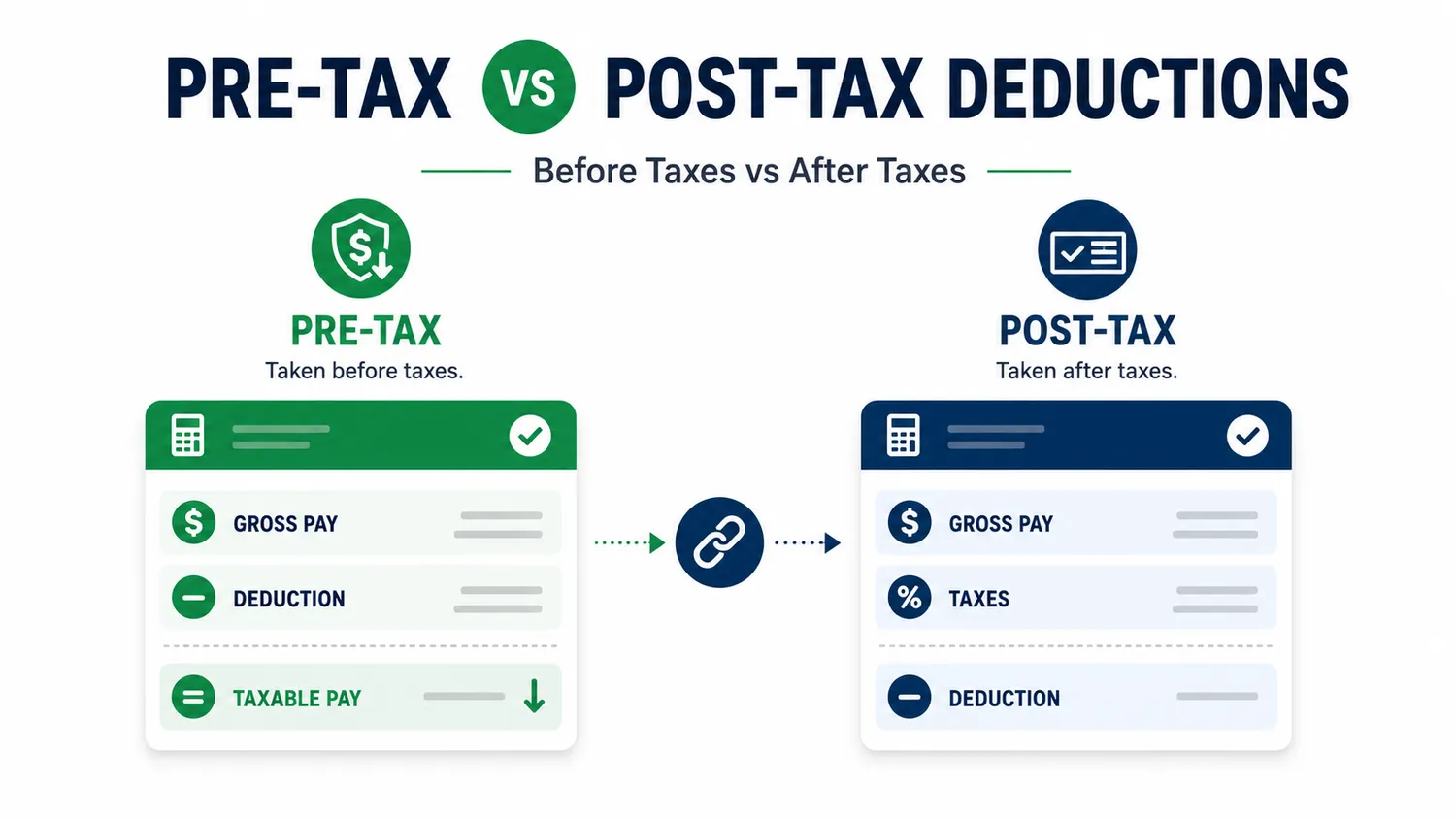
A health savings account can be funded in more than one way, and the difference is easy to miss. You can fund it through payroll or transfer money from your bank. Either route may produce a federal income-tax benefit, but the payroll-tax result can differ.
Why the Contribution Route Matters
When an employee contributes through a qualifying Section 125 cafeteria plan, the amount is generally taken from wages before federal income tax, Social Security tax, and Medicare tax are calculated.
A personal contribution happens after payroll taxes have already been withheld. You may claim an eligible federal deduction, but that normally does not return Social Security and Medicare taxes already charged through payroll.
This distinction is a useful example of why pre-tax deductions do not all affect wages in exactly the same way.
A Payroll Contribution in Everyday Numbers
Imagine an employee earns $3,000 during a pay period and chooses to contribute $200 to an HSA through the employer’s qualifying cafeteria plan.
The $200 goes directly into the HSA. Depending on the plan and the employee’s situation, federal income-tax wages and FICA wages may be calculated using $2,800 rather than the full $3,000. The employee’s take-home pay falls, but usually by less than $200 because the contribution also reduces certain taxes.
The pay stub may show an HSA deduction under benefits or pre-tax deductions. Taxable-wage lines reveal how payroll treated it.
What Happens With a Direct Contribution?
Now imagine the employee transfers $200 from a checking account after payday.
If eligible, the employee may claim the HSA deduction on Form 8889. However, payroll already calculated Social Security and Medicare taxes before the money reached the account.
That is the main reason a qualifying payroll contribution can be more tax-efficient than an otherwise identical personal contribution.
How Large Could the Payroll-Tax Difference Be?
Below the annual Social Security wage base, the employee Social Security and Medicare rate is generally 7.65% combined.
If that employee contributes $4,000 through a qualifying payroll arrangement, the potential employee FICA saving is approximately $306. The result can differ after the Social Security wage base or when Additional Medicare Tax applies.
It is worth understanding FICA on a pay stub before comparing the two methods. A deduction that lowers federal taxable wages does not automatically lower every payroll-tax wage base.
Is Every HSA Payroll Deduction Pre-Tax?
No. This is where employees should slow down and check the plan details.
A payroll deduction may simply send after-tax money to an account. The favourable treatment generally depends on the contribution being made through a qualifying Section 125 salary-reduction arrangement.
Check the deduction label, taxable wages, and employer benefits documents. Payroll should confirm whether it reduces federal and FICA wages.
Do not rely only on the word “HSA” appearing beside a deduction.
The 2026 HSA Contribution Limits
For 2026, the contribution limit is $4,400 for eligible people with self-only coverage and $8,750 for eligible people with family coverage. An eligible account holder who is at least 55 by the end of the year may generally contribute an additional $1,000.
Payroll, personal, and employer contributions share the same annual limit. If an employer contributes $1,000, that amount reduces what remains available.
Where the Contribution Appears on Form W-2
Employer HSA contributions and employee salary-reduction contributions made through a cafeteria plan are generally reported in Box 12 of Form W-2 using Code W.
Code W may combine employer money with qualifying employee payroll contributions, so it is not necessarily an employer-only benefit.
Direct personal contributions are generally handled through the individual’s HSA records and Form 8889.
Keep year-end forms and compare them with pay-stub totals before filing.
Does Medicare Tax Always Fall With an HSA Deduction?
A qualifying Section 125 HSA salary-reduction contribution generally lowers wages subject to regular Medicare tax. A direct contribution normally does not undo Medicare tax already withheld.
The epaystubs guide to Medicare on a pay stub explains why Medicare wages can differ from gross pay and why Medicare does not have the same annual wage ceiling as Social Security.
What If the Employer’s HSA Has High Fees?
The employer-selected HSA may not have the lowest fees or best investment choices.
Some workers use payroll and later consider a trustee-to-trustee transfer. Review transfer rules, fees, and investment limits first.
Moving money does not remove the need to track contributions across all HSAs. A second account does not create another limit.
How to Check the Deduction on Your Pay Stub
Begin with gross pay, then find the HSA contribution and each taxable-wage line. Compare federal taxable wages, Social Security wages, and Medicare wages with a paycheck that had no HSA contribution.
Other pre-tax benefits may also change those wage lines.
Use the epaystubs guide on how to read a pay stub if the deduction section or taxable wages are unclear. Then ask payroll how the plan is classified.
Which Method Is Better?
For an eligible employee whose workplace offers qualifying Section 125 HSA contributions, payroll funding often provides the broader immediate tax advantage. It may reduce federal income-tax withholding and employee Social Security and Medicare taxes while placing money into the HSA automatically.
A direct contribution can add money outside payroll, use a preferred provider, and still produce an income-tax deduction when eligibility rules are met.
The important point is that “pre-tax” is not one universal treatment. Check how the contribution was made, which wage bases changed, and how much has already been contributed for the year. That is the only reliable way to understand why gross pay and net pay moved the way they did.