Introduction
Learning Java and DSA is most effective when the journey follows a clear progression. Beginners often struggle because they move too quickly from syntax into difficult algorithms without building enough confidence in loops, arrays, methods, object-oriented programming, recursion, and complexity. Advanced problems become easier when each earlier concept is strong enough to support the next one.
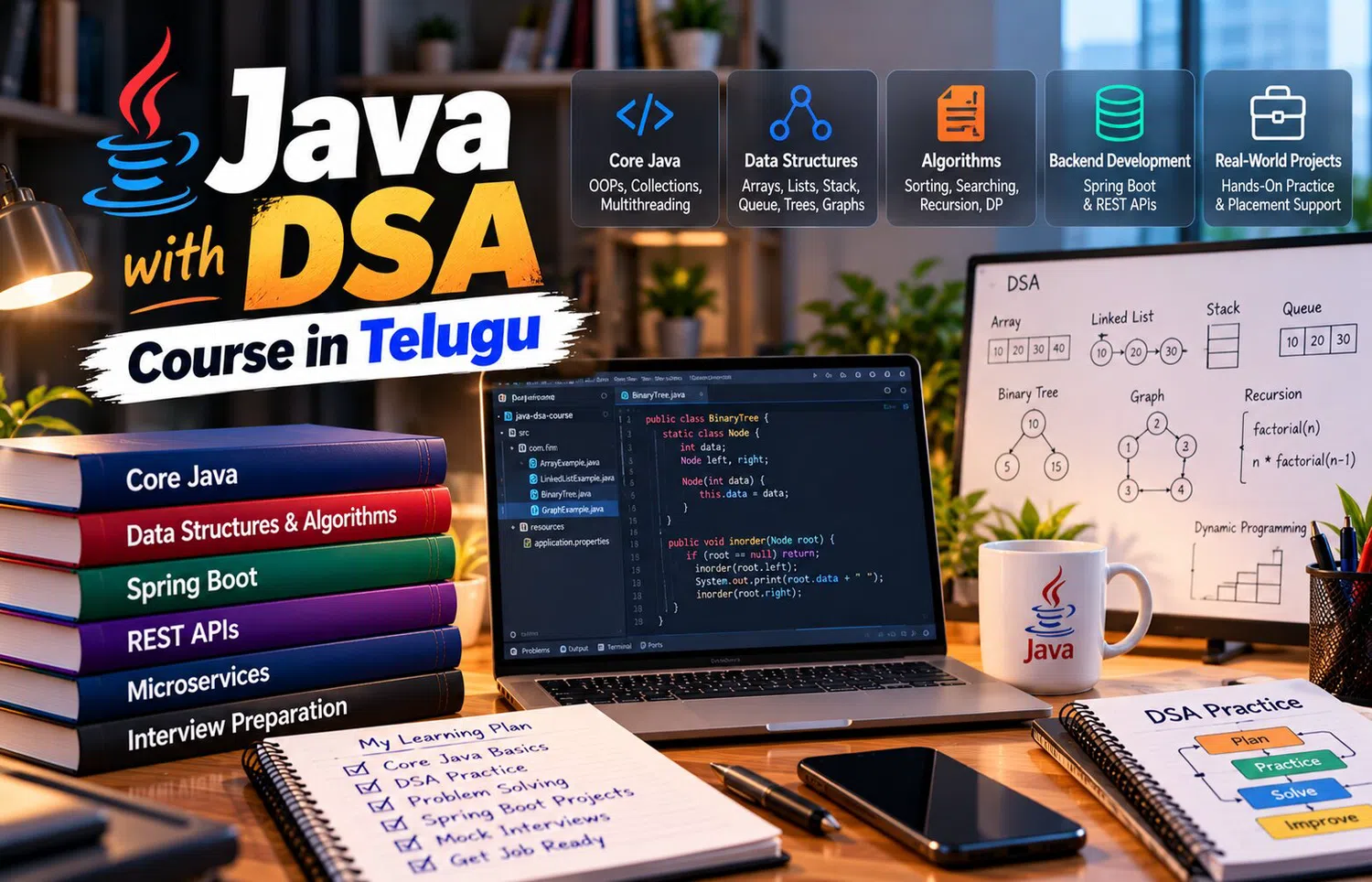
A Java with DSA Course in Telugu can help learners move from Java fundamentals to advanced DSA problems in a structured way. The goal is to build programming comfort first, then learn core data structures, recognize common problem-solving patterns, analyze complexity, and finally approach trees, graphs, backtracking, and dynamic programming with confidence.
Step 1: Learn Java Fundamentals
Start with the language basics.
Important topics include:
Variables.
Data types.
Operators.
Input and output.
Conditions.
Loops.
Methods.
Arrays.
Strings.
These concepts are used in almost every DSA problem.
A learner who is still confused about loops or method parameters will find recursion and graph traversal much harder.
Step 2: Practice Conditions and Loops
Simple problems build coding logic.
Useful exercises include:
Even or odd.
Largest of three numbers.
Sum of digits.
Reverse a number.
Palindrome number.
Factorial.
Prime check.
Pattern printing.
The goal is not to spend months on basic problems. It is to become comfortable translating a small requirement into working Java code.
Step 3: Strengthen Arrays and Strings
Arrays and strings introduce many reusable patterns.
Practice:
Traversal.
Maximum and minimum.
Searching.
Reversal.
Frequency counting.
Subarrays.
Substrings.
Two pointers.
Sliding windows.
Arrays also teach index management, which becomes important in binary search, dynamic programming tables, matrices, and many interview problems.
Strings add character processing and immutability concepts.
Step 4: Learn Complexity
After writing correct code, ask how efficiently it scales.
Understand:
O(1).
O(log n).
O(n).
O(n log n).
O(n²).
Also learn auxiliary space.
Compare different solutions to the same problem.
For example, duplicate detection can use nested loops with low extra memory or a HashSet with faster average lookup and additional space.
Step 5: Learn Searching and Sorting
Start with:
Linear search.
Binary search.
Bubble sort.
Selection sort.
Insertion sort.
Then move to:
Merge sort.
Quick sort.
These algorithms teach searching conditions, swaps, divide and conquer, recursion, and complexity.
Binary search is especially important because it later appears in many “search on answer” style problems.
Step 6: Learn Hashing
Hashing solves many problems involving repeated lookup.
Practice with:
HashMap.
HashSet.
Frequency maps.
Duplicate detection.
Two Sum.
Anagrams.
First unique character.
Last-seen indexes.
Hashing teaches an important optimization idea: additional memory can reduce repeated searching.
It also combines naturally with sliding windows and prefix-based techniques.
Step 7: Learn Linked Lists
Linked lists strengthen reference-based thinking.
Important problems include:
Insert node.
Delete node.
Reverse list.
Find middle.
Detect cycle.
Merge sorted lists.
Learners should draw nodes and arrows before coding.
Understanding how references change is more important than memorizing linked-list templates.
Fast and slow pointers become useful at this stage.
Step 8: Learn Stacks and Queues
Stacks teach Last In, First Out behavior.
Practice:
Balanced brackets.
Expression-related problems.
Next greater element.
DFS-style processing.
Queues teach First In, First Out behavior.
Practice:
Task processing.
Tree level-order traversal.
BFS.
Step 9: Learn Recursion
Recursion introduces:
Base case.
Recursive relation.
Call stack.
Backtracking of function calls.
Start with simple exercises such as:
Print numbers.
Factorial.
Array sum.
Palindrome.
Then connect recursion with tree traversal and divide-and-conquer algorithms.
Draw the call stack for small inputs until the execution order is clear.
Step 10: Learn Trees
Begin with binary-tree terminology:
Root.
Parent.
Child.
Leaf.
Height.
Depth.
Then practice:
Preorder.
Inorder.
Postorder.
Level order.
Height calculation.
Node counting.
Move next to Binary Search Trees.
Practice:
Search.
Insert.
Minimum and maximum.
Deletion concepts.
Trees combine recursion, queues, references, and complexity.
Step 11: Learn Graphs
Graphs model connected data.
Understand:
Vertices.
Edges.
Directed graphs.
Undirected graphs.
Adjacency lists.
Visited tracking.
Then learn:
BFS.
DFS.
Connected components.
Path existence.
Grid traversal.
Cycle concepts.
Graphs feel easier when learners already understand queues, recursion, hashing, and trees.
Step 12: Learn Backtracking
Backtracking explores choices and reverses a decision when necessary.
Common learning problems include:
Generate subsets.
Generate permutations.
Combination problems.
Maze-style search.
N-Queens as an advanced exercise.
A useful mental model is:
Choose.
Explore.
Undo.
Backtracking becomes much easier when recursion is already comfortable.
Step 13: Learn Dynamic Programming
Dynamic Programming should come after recursion.
Start with:
Fibonacci.
Climbing stairs.
Minimum-cost problems.
House robber.
Grid paths.
Then move toward:
Knapsack patterns.
Subsequence problems.
Coin-change problems.
For every DP question:
Define the state.
Write the recurrence.
Set base cases.
Try memoization.
Convert to tabulation when useful.
Consider space optimization last.
Step 14: Mix Problem-Solving Patterns
Once individual topics are familiar, stop practicing only chapter-wise questions.
Mix:
Two pointers.
Sliding window.
Hashing.
Binary search.
Stack.
Tree traversal.
BFS and DFS.
Backtracking.
Dynamic Programming.
Mixed practice forces the learner to identify the technique independently.
That is closer to coding interviews where the problem is not labeled by topic.
Step 15: Build a Revision System
DSA requires repeated revision.
Maintain notes containing:
Pattern name.
Recognition clues.
Complexity.
Important mistakes.
One representative problem.
Alternative approach.
Re-solve old questions without looking at previous code.
If a solution can only be reproduced immediately after watching it, the concept may not yet be learned deeply.
Frequently Asked Questions
How long should beginners spend on Java before DSA?
There is no fixed duration. Begin DSA once variables, conditions, loops, methods, arrays, strings, and basic Java syntax feel comfortable.
Should I finish one DSA topic completely before moving on?
Learn the core ideas and practice enough problems to understand the pattern, then revisit topics through mixed revision.
Which advanced topic should come first?
Trees and recursion usually provide a good foundation before graphs, backtracking, and Dynamic Programming.
Is solving hard problems necessary from the beginning?
No. Start with simple and medium problems that build reusable patterns before attempting harder combinations.
Conclusion
A Java with DSA Course in Telugu can help learners progress from basic Java programming to advanced algorithmic problem solving without skipping essential foundations.
Java fundamentals build coding comfort, arrays and strings develop indexing and pattern recognition, hashing improves lookup, linked lists strengthen reference handling, stacks and queues introduce processing order, recursion prepares learners for trees and backtracking, and graphs and Dynamic Programming expand algorithmic thinking.
The strongest learning journey is gradual and repetitive. When learners practice, analyze complexity, review mistakes, mix topics, and revisit older problems, advanced DSA becomes a continuation of earlier skills rather than an entirely separate challenge.