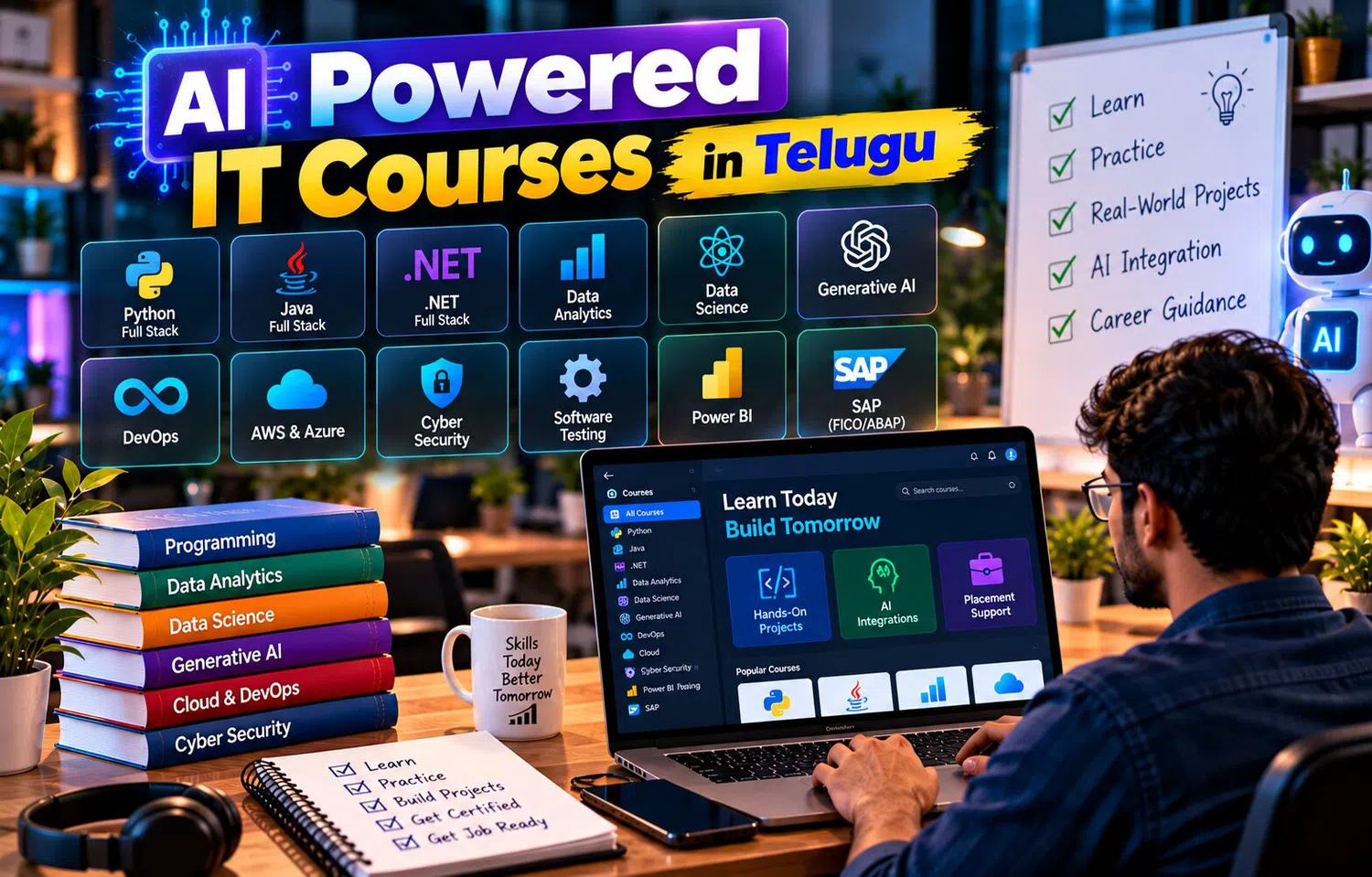
A learner's technology journey can begin with something very simple.
It may start with understanding what a database is.
Then comes a small SQL query.
Later, the learner builds a dashboard.
After that, AI may be used to explain an error or suggest an improvement.
This gradual progression is often more effective than beginning with complex AI projects before understanding the basics.
AI Powered IT Courses in Telugu can support this journey from fundamentals to practical, AI-assisted project work.
Phase 1: Understand Basic IT Concepts
Before choosing advanced tools, learners should understand basic ideas.
Examples include:
What is software?
What is a database?
What is a server?
What is an API?
What is cloud computing?
What is data?
What is automation?
These concepts help learners understand how different technologies connect.
Phase 2: Choose a Primary Career Direction
Once the basics are clear, the learner can choose one main path.
The five popular directions provide useful examples.
Java Full Stack
For learners interested in building applications.
Data Analytics
For learners interested in data, dashboards, and business insights.
Java with DSA
For learners interested in coding logic and problem solving.
Cyber Security
For learners interested in protecting systems and investigating threats.
Digital Marketing
For learners interested in online growth, campaigns, content, and analytics.
Choosing one primary direction prevents unnecessary confusion.
Phase 3: Learn the Core Tools
Each path has its own toolkit.
A Java learner may study:
Java
SQL
APIs
frameworks
A data learner may study:
Excel
SQL
Power BI
A cybersecurity learner may study:
Linux
networking
security tools
A marketer may study:
SEO tools
analytics
advertising platforms
AI should be introduced alongside the tools, not instead of them.
Phase 4: Practice Small Tasks
Before building a large project, learners should complete smaller exercises.
Examples:
Java → create a calculator
SQL → query customer records
Power BI → create one dashboard page
Cyber Security → analyze sample logs
Digital Marketing → create a keyword plan
Small tasks reduce the pressure of complex projects.
Phase 5: Learn to Use AI for Explanation
AI can first be used as a tutor.
Useful questions include:
Explain this code.
Why is this query wrong?
What does this error mean?
Give me a simple example.
Compare these two approaches.
This builds understanding before AI is used for larger work.
Phase 6: Use AI for Review
Once the learner can complete tasks independently, AI can review the work.
For example:
review Java code
check SQL logic
suggest dashboard improvements
identify missing test cases
review an SEO plan
This is a safer stage for AI because the learner already has enough knowledge to judge the suggestions.
Phase 7: Build a Complete Project
Now the learner can create something meaningful.
A Java Full Stack project might be:
employee-management application
A Data Analytics project might be:
retail sales dashboard
A Cyber Security project might be:
incident-analysis report
A Digital Marketing project might be:
campaign strategy and analytics report
A Java with DSA project might be:
structured coding portfolio
The project should show practical ability.
Phase 8: Add AI-Assisted Features
After the basic project works, AI can be added in a controlled way.
For example:
Java application → AI-assisted support feature
Analytics project → AI-generated insight draft
Security project → AI-assisted log summary
Marketing project → AI-assisted content variations
This progression helps learners understand what AI is actually contributing.
Phase 9: Connect Supporting Skills
A learner can then add related technologies.
For Java:
DSA
DevOps
Azure
Testing
SQL
For Data Analytics:
Excel
Power BI
Python
Data Science
For Cyber Security:
Cloud
Automation
Linux
For Digital Marketing:
Analytics
Excel
AI tools
This creates a stronger career profile.
Phase 10: Explore the Broader 32-Course Portfolio
Frontlines Edutech offers 32 courses, allowing learners to continue beyond the initial specialization.
Examples include:
Java Full Stack
Data Analytics
Java with DSA
Cyber Security
Digital Marketing
Power BI
Excel
Python
SQL
Data Science
Generative AI
DevOps
Azure
ServiceNow
Salesforce
SAP
Workday
.NET
Software Testing
Machine Learning
UI/UX Design
Business Analytics
Graphic Design
The learner can add another course when it supports a clear career goal.
Do Not Collect Courses Without Practice
Completing several courses without building projects can create shallow knowledge.
A better approach is:
learn
practice
build
explain
then expand
One well-understood skill is more useful than several technologies the learner cannot apply.
AI-Assisted Projects Should Still Show Human Thinking
Suppose a learner creates a dashboard with AI assistance.
They should still be able to explain:
why the metrics were chosen
why the chart was selected
how the data was cleaned
what the insight means
Similarly, a Java learner should explain:
architecture
database design
API logic
testing
AI should not hide the learner's reasoning.
Add Documentation to Every Project
A project can include:
problem statement
tools
process
screenshots
challenges
solution
results
AI usage
future improvements
This helps learners reflect on what they built.
It also makes the project easier to present.
Practice Interview Explanations
After completing a project, try explaining it without looking at the code.
Answer questions such as:
What problem did you solve?
Which tools did you use?
What was difficult?
Where did AI help?
What did you verify manually?
What would you improve?
This prepares learners for interviews and project discussions.
Use Telugu for Understanding, English for Technical Vocabulary
Learning in Telugu does not mean avoiding English terminology.
A learner can understand:
API
deployment
query
dashboard
algorithm
vulnerability
in Telugu explanations while continuing to use the English words.
This supports both conceptual clarity and workplace readiness.
Build Independence Gradually
At the beginning, learners may need:
trainer guidance
examples
AI explanations
Over time, they should become more independent.
The goal is to reach a stage where the learner can:
understand a requirement
choose tools
build a solution
use AI when useful
verify the result
explain the work
This is a stronger outcome than simply completing lessons.
Frequently Asked Questions
When should AI be introduced into a project?
After the learner understands the basic workflow and core concepts.
Should learners build projects before finishing a course?
Yes. Small projects can begin during learning, while larger projects can come later.
Is one specialization enough to start?
Yes. Begin with one strong direction and add complementary skills gradually.
What is the purpose of the 32-course range?
It gives learners multiple pathways and supporting technologies based on their interests and career goals.
Conclusion
A strong technology-learning journey usually moves through stages.
First come fundamentals.
Then tools.
Then practice.
Then projects.
Finally, AI can be added to improve speed, support analysis, and assist problem solving.
AI Powered IT Courses in Telugu can help learners follow this progression while understanding concepts in a familiar language.
Popular paths such as Java Full Stack, Data Analytics, Java with DSA, Cyber Security, and Digital Marketing provide clear starting points, while the wider 32-course portfolio allows learners to expand into cloud, automation, data science, enterprise platforms, design, and other modern technologies.