Every data application begins with something simple: information.
A customer places an order. A sensor records a value. An employee completes a task. A student submits an assignment. A user writes a review.
These individual events create raw records.
Turning those records into a useful intelligent application requires several stages. The data must be collected, cleaned, explored, transformed, modeled, tested, and finally connected to a practical use case.
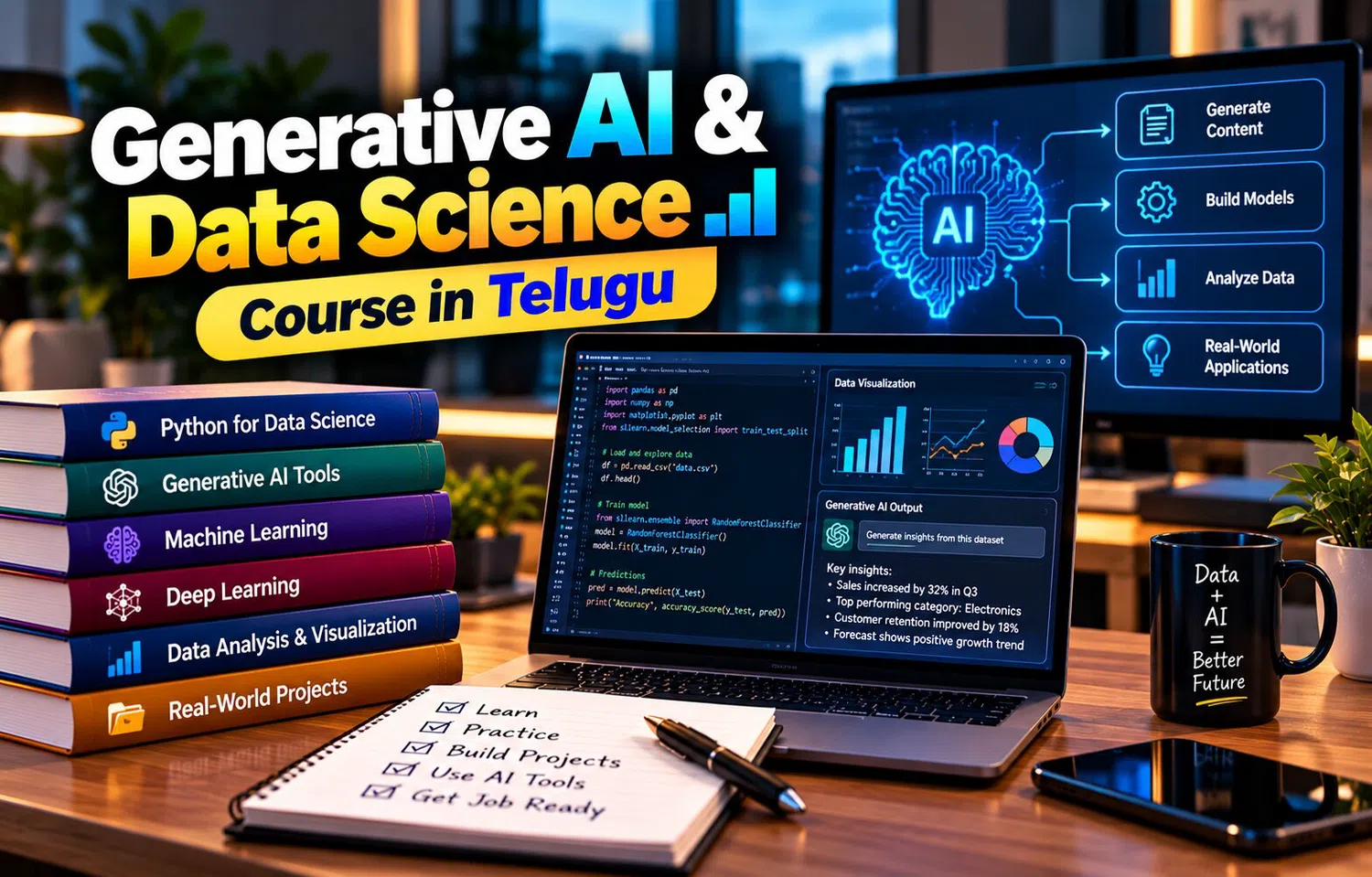
A Generative AI & Data Science Course in Telugu can help learners understand this complete journey instead of seeing data science as a collection of unrelated tools.
Raw Data Is Only the Starting Point
Imagine a food-delivery company collecting millions of records.
The raw information may include:
order time, restaurant, customer area, food category, order value, delivery time, rating, and cancellation status.
On its own, this file is not an intelligent system.
It is simply stored information.
The value appears when someone uses it to answer questions.
Which locations experience more delays?
Which restaurants have higher cancellations?
What times of day create the most demand?
Can delivery time be predicted before an order is placed?
Each question requires a different part of the data science process.
Step One: Collect Relevant Information
Good analysis depends on collecting the right data.
More data is not always better.
Suppose the company wants to predict delivery delay.
Relevant features may include:
distance, restaurant preparation time, traffic level, order time, weather, and delivery location.
Customer name may not be useful for the prediction.
Collecting large amounts of irrelevant information increases complexity without necessarily improving the result.
The data should be connected to the problem being solved.
Step Two: Clean the Records
Raw data often contains problems.
Some delivery times may be missing.
Restaurant names may be written inconsistently.
Duplicate orders may exist.
Dates may use different formats.
Before analysis, these issues need attention.
Cleaning improves reliability.
A model built on incorrect or inconsistent records can produce misleading results even if the algorithm itself is advanced.
This is why data quality should never be treated as a minor task.
Step Three: Explore Before Predicting
Exploration helps the analyst understand what the dataset is saying.
The learner can calculate averages, compare categories, check distributions, and create charts.
For the delivery example, useful questions include:
What is the median delivery time?
Which locations have the widest variation?
Do delays increase during specific hours?
Do certain restaurants consistently take longer to prepare orders?
These observations may reveal patterns that influence later modeling choices.
Step Four: Create Better Features
Raw columns are not always the most useful form of information.
Suppose the dataset contains order timestamp and delivery timestamp.
The analyst can calculate actual delivery duration.
The order timestamp can also be converted into:
hour of day,
day of week,
or weekend indicator.
These new variables may help the model understand behavior more clearly.
Feature engineering turns existing information into more meaningful representations.
Step Five: Train a Model
Once the data is prepared, a machine learning model can be trained.
If the goal is to estimate delivery time in minutes, regression may be appropriate.
If the goal is to predict whether an order will be late or on time, classification may be more suitable.
The model studies historical examples and learns relationships between features and outcomes.
It can then make predictions for new orders.
Step Six: Evaluate the Prediction
A model should not be trusted just because it produces an output.
Its performance must be measured.
For delivery-time prediction, the team may calculate the average difference between predicted and actual time.
For late-order classification, precision and recall may be useful.
The chosen metric should reflect the real business objective.
A model that looks strong on paper may still be unsuitable if its errors are too costly.
Step Seven: Add a User-Friendly Layer
A useful application often needs more than a model.
The prediction must be delivered in a form that people can use.
For example, a delivery app may display:
“Estimated arrival: 38 minutes.”
A business dashboard may show:
“High delay risk in Zone 4.”
A support assistant may answer:
“Your order is likely to arrive within the next 20 minutes.”
This is where data science connects with product design and user experience.
Generative Technology Can Add New Capabilities
Traditional models are often designed for specific predictions.
Generative systems can provide a more flexible interaction layer.
For example, a manager may ask:
“Why were delays higher last weekend?”
A language-based system could retrieve relevant data, summarize the main patterns, and present the findings in plain language.
The answer should still be grounded in verified data.
The generative layer should not invent causes that are not supported by evidence.
Intelligent Applications Need Multiple Components
A practical application may include:
a database for storing information,
data-processing code,
machine learning models,
APIs,
dashboards,
language models,
and monitoring tools.
Data science is one part of a larger system.
This is why learners benefit from understanding the complete flow.
A model in a notebook is useful for learning.
An application requires additional thinking about reliability, privacy, speed, and user needs.
Monitoring Matters After Deployment
A model that performs well today may not perform equally well later.
Customer behavior can change.
New products may be introduced.
Pricing may change.
External conditions may shift.
This can reduce model quality.
Teams should monitor the application after deployment.
If performance declines, the model may need new data or retraining.
Machine learning is therefore not a one-time activity.
Human Oversight Remains Important
An intelligent system can make recommendations, but important decisions may still require people.
Suppose a model flags a financial transaction as suspicious.
That may trigger a review rather than an automatic punishment.
Suppose a system predicts that an employee may resign.
That information should be handled carefully and ethically.
Technical ability must be balanced with fairness, privacy, and responsibility.
A Beginner-Friendly Project Path
Learners can practice the full journey using smaller projects.
Start with a sales dataset.
Clean it.
Create charts.
Build a simple prediction.
Evaluate the result.
Add a small interface or report.
Then use a language model to help explain the output.
This gives learners experience across several stages without requiring a large production system.
Why Telugu-Based Learning Can Help
The journey from raw data to an intelligent application involves many concepts:
data cleaning,
feature engineering,
model training,
evaluation,
deployment,
and language-based interaction.
Learning all of them only through technical English can feel difficult for some beginners.
Telugu explanations can make the overall process easier to understand.
The industry terms can still remain in English so that learners become comfortable using them professionally.
A Generative AI & Data Science Course in Telugu can help learners connect theory with practical application.
Frequently Asked Questions
Is every data project an intelligent application?
No. Some projects only analyze and report information. Intelligent applications usually include prediction, automation, or adaptive interaction.
Do I need machine learning for every data problem?
No. Many problems can be solved using simple analysis, rules, or reporting.
Can generative systems replace predictive models?
Not necessarily. They serve different purposes and can be used together.
Is deployment part of data science learning?
It is useful to understand basic deployment concepts, especially when moving from projects to practical applications.
Conclusion
The journey from raw information to an intelligent application involves much more than training a model.
Data needs to be collected carefully, cleaned, explored, transformed, evaluated, and connected to a real user need.
Generative technology can add a flexible interaction layer, while machine learning can handle prediction and classification.
Learners who understand this complete path are better prepared to see how data science works beyond individual tools and classroom examples.