Introduction
Digital marketing teams use different tools for different stages of work. One tool may help with keyword research, another with ad creation, another with content planning, and another with reporting. AI can support several of these tasks by generating ideas, organizing information, rewriting drafts, and summarizing structured results. The challenge is choosing the right use case instead of using AI everywhere.
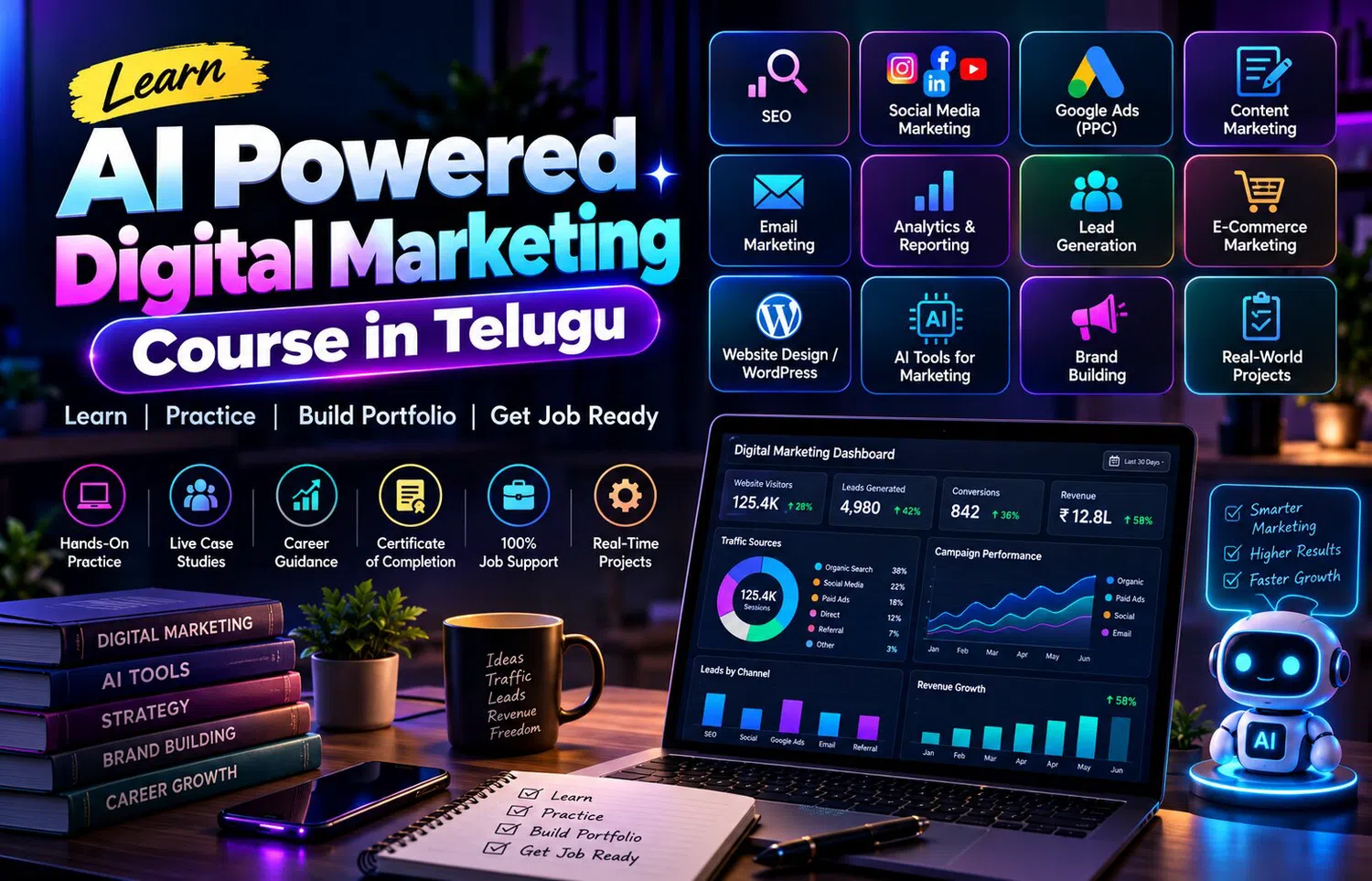
An Ai Powered Digital Marketing Course in Telugu can help learners understand how AI tools fit into advertising, content, and research workflows. The focus should be on practical value, not on collecting tool names. A useful marketer knows what problem needs solving, what information the tool requires, and how the output will be checked.
Use AI for Research Planning
Research is often the first stage of a campaign.
AI can help generate:
Audience questions
Keyword themes
Competitor research categories
Content gaps
Survey questions
Campaign hypotheses
For example, a marketer planning a cybersecurity campaign can ask AI to suggest beginner questions around career paths, tools, common misconceptions, and learning prerequisites.
Organize Customer Feedback
AI is useful for grouping large amounts of text.
Suppose a company collects comments from:
Social media
Webinars
Support tickets
Sales calls
Surveys
AI can group them into categories such as:
Pricing.
Course timing.
Career questions.
Technical doubts.
Support issues.
Support Keyword Research
AI can expand one seed keyword into related themes and questions.
For example:
Seed:
“digital marketing automation”
Possible themes:
Email workflows.
CRM integration.
Lead nurturing.
Reporting automation.
Audience segmentation.
The marketer should then validate whether these topics have real search relevance and business value.
AI is strong at brainstorming, not at proving demand.
Explore Competitor Themes
AI can help organize competitor observations after the marketer collects them.
For example, provide notes from several competitor pages and ask:
Which topics appear frequently?
Which questions are missing?
Which formats are commonly used?
Which areas could be explained more clearly?
Generate Content Ideas
Content teams can use AI to create multiple angles from one topic.
A single topic such as “Google Ads” could lead to:
Beginner checklist.
Common mistakes.
Landing-page tips.
Negative keyword guide.
Conversion tracking explainer.
Budget planning basics.
The marketer can then choose ideas based on audience need, search intent, and campaign objective.
Create Content Briefs
AI can organize approved research into a structured brief.
A content brief may include:
Audience.
Purpose.
Primary topic.
Supporting questions.
Examples.
Source material.
Call to action.
Internal links.
This reduces uncertainty for writers and keeps the content focused.
Draft Ad Variations
Paid campaigns often require several creative options.
AI can help generate:
Headlines
Descriptions
CTAs
Value propositions
Creative angles
A useful prompt should include:
Audience.
Offer.
Objective.
Platform.
Tone.
Claims to avoid.
Character limits where relevant.
The final ad should be reviewed for accuracy, clarity, and platform compliance.
Build Creative Testing Ideas
AI can help marketers think through test variations.
For example:
Test headline benefit.
Test CTA wording.
Test short vs detailed description.
Test educational vs direct-response angle.
Use AI for Landing-Page Copy
AI can support:
Headline variations.
Benefit statements.
FAQ ideas.
CTA alternatives.
Section outlines.
The marketer should provide clear product facts.
AI should not invent testimonials, guarantees, numbers, or product features.
A landing page must remain accurate because it directly affects customer expectations.
Repurpose Content Across Channels
One strong content asset can become:
Social post
Carousel
Short video
Email
Ad concept
FAQ
AI can help transform the format quickly.
Use AI for Report Summaries
After a campaign runs, AI can summarize structured performance data.
For example:
Campaign A:
₹30,000 spend, 150 leads, 45 qualified leads.
Campaign B:
₹25,000 spend, 100 leads, 50 qualified leads.
AI can help describe differences and suggest questions.
The analyst should calculate and verify the metrics first.
Do not rely on generated arithmetic without checking it.
Know the Difference Between AI and Automation
AI and automation are related but different.
AI can:
Interpret text.
Generate content.
Classify feedback.
Summarize information.
Automation can:
Send an email.
Update CRM.
Create a task.
Move data.
Schedule a reminder.
A strong workflow may combine both.
For example, AI classifies a lead, and automation routes it to the correct team.
Choose Tools Based on the Task
Before selecting an AI tool, ask:
What problem am I solving?
What type of input do I have?
What output do I need?
Does the tool support the required format?
What privacy considerations apply?
How will I verify the result?
Avoid Tool Overload
Using too many tools can reduce productivity.
A marketer may waste time:
Switching platforms.
Copying information.
Learning overlapping features.
Managing subscriptions.
Protect Marketing Data
Campaign and customer data may contain:
Emails.
Phone numbers.
CRM notes.
Audience segments.
Revenue.
Internal strategy.
Do not upload sensitive information into unapproved tools.
Use anonymized or synthetic examples when possible.
Privacy should be considered before the workflow is designed.
Practical Tool Evaluation Exercise
Choose three marketing tasks:
Keyword research.
Ad drafting.
Campaign reporting.
For each task, test one AI-assisted workflow.
Record:
Input
Prompt
Output
Time saved
Errors found
Human editing required
Privacy risk
Final usefulness
Then compare the results.
This helps learners judge tools based on practical value rather than marketing claims.
Frequently Asked Questions
Do marketers need many AI tools?
No. A small set of well-understood tools and workflows can be more useful than constantly switching platforms.
Can AI replace keyword and analytics tools?
No. AI can organize and explain information, while dedicated tools provide important search, advertising, and performance data.
What should be checked in AI-generated ad copy?
Accuracy, claims, brand tone, character limits, audience relevance, and platform policies.
Can AI help with competitor research?
Yes. It can organize collected information and identify themes, but marketers should gather reliable source material themselves.
Conclusion
An Ai Powered Digital Marketing Course in Telugu can help learners use AI tools purposefully across research, advertising, content, and reporting.
AI can generate ideas, organize feedback, prepare briefs, create copy variations, repurpose content, and summarize campaign results. Dedicated marketing tools and human judgment still provide the data, validation, strategy, and accountability required for strong decisions.
The best marketer is not the person using the largest number of AI tools. It is the person who understands which tool fits the problem, how the output will be verified, and whether the workflow genuinely improves marketing quality or productivity.