Irrigation projects refer to the construction and management of systems and infrastructure that provide water to agricultural lands for crop production. These projects aim to enhance agricultural productivity by supplying water to areas where rainfall is insufficient or unreliable.
There are various types of irrigation projects implemented worldwide, including:
Surface Irrigation: This method involves the application of water to the soil surface, allowing it to infiltrate and reach plant roots. It includes techniques like furrow irrigation, border irrigation, and basin irrigation.
Sprinkler Irrigation: Sprinklers are used to distribute water over the agricultural fields in a manner similar to rainfall. This method is suitable for a wide range of crops and can be automated for efficient water use.
Drip Irrigation: Drip irrigation involves the precise application of water directly to the root zone of plants through a network of pipes and emitters. This method minimizes water loss due to evaporation and delivers water in a targeted manner, conserving water resources.
Canal Systems: Large-scale irrigation projects often involve the construction of canals to transport water from rivers or reservoirs to agricultural areas. Canals distribute water to fields through a network of smaller channels or pipes.
Dam and Reservoir Projects: These projects involve the construction of dams across rivers to create reservoirs that store water. The stored water can be released as needed for irrigation, providing a reliable water supply during dry seasons or droughts.
Groundwater Irrigation: In regions where groundwater is available, irrigation projects may involve the drilling of wells and installation of pumps to extract water for agricultural use. Groundwater irrigation requires careful management to prevent overexploitation and depletion of aquifers.
Irrigation projects play a crucial role in enhancing agricultural productivity, food security, and rural development. They help mitigate the risks associated with unreliable rainfall patterns, enabling farmers to cultivate crops throughout the year and improve yields. However, it is essential to manage irrigation projects sustainably to ensure efficient water use, minimize environmental impacts, and address water scarcity challenges.
how water current making process
It seems like you're asking about the process of generating electricity from water currents, specifically hydropower. Hydropower is a renewable energy source that harnesses the energy of moving water to generate electricity. Here's a general overview of the process:
Site Selection: Suitable locations for hydropower projects are identified based on the availability of flowing water, such as rivers, streams, or tidal areas. Factors like water flow rate, head (vertical drop), and environmental considerations are taken into account.
Dam or Diversion Structure: A dam or diversion structure is built to control the flow of water. The dam creates a reservoir by impounding water or diverts water from a river through a canal or penstock (pipeline).
Intake and Penstock: Water is taken from the reservoir or diversion canal through an intake structure and directed into a large pipe called a penstock. The penstock carries the water to the turbine.
Turbine: The water flowing through the penstock strikes the blades of a turbine, causing it to rotate. There are different types of turbines used in hydropower plants, such as Francis, Pelton, or Kaplan turbines, depending on the specific characteristics of the water flow.
Generator: The rotating turbine is connected to a generator. As the turbine spins, it rotates the rotor within the generator, which generates electrical energy through electromagnetic induction
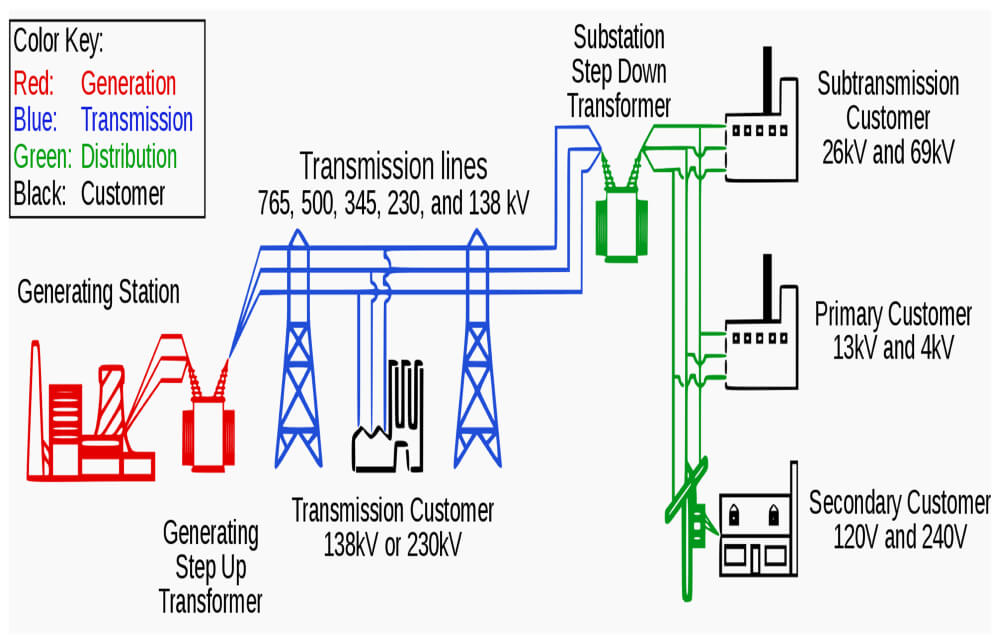
Transmission: The electricity produced by the generator is sent to a transformer, where the voltage is increased for efficient transmission over long distances. High-voltage transmission lines then carry the electricity to consumers or the power grid.
Environmental Considerations: Hydropower projects must also consider environmental factors. Fish passage systems, such as fish ladders or fish bypass channels, are often incorporated to enable fish migration and minimize ecological impacts.
It's worth noting that there are different types of hydropower systems, including run-of-river systems that do not require a dam, but instead use the natural flow of a river to generate electricity. Tidal and wave energy converters are also used to harness the power of ocean currents.
- Each hydropower project is unique, and the specific design and implementation depend on the characteristics of the site and the desired electricity output. The process described above provides a general framework for understanding how water currents can be utilized to generate electricity through hydropower.