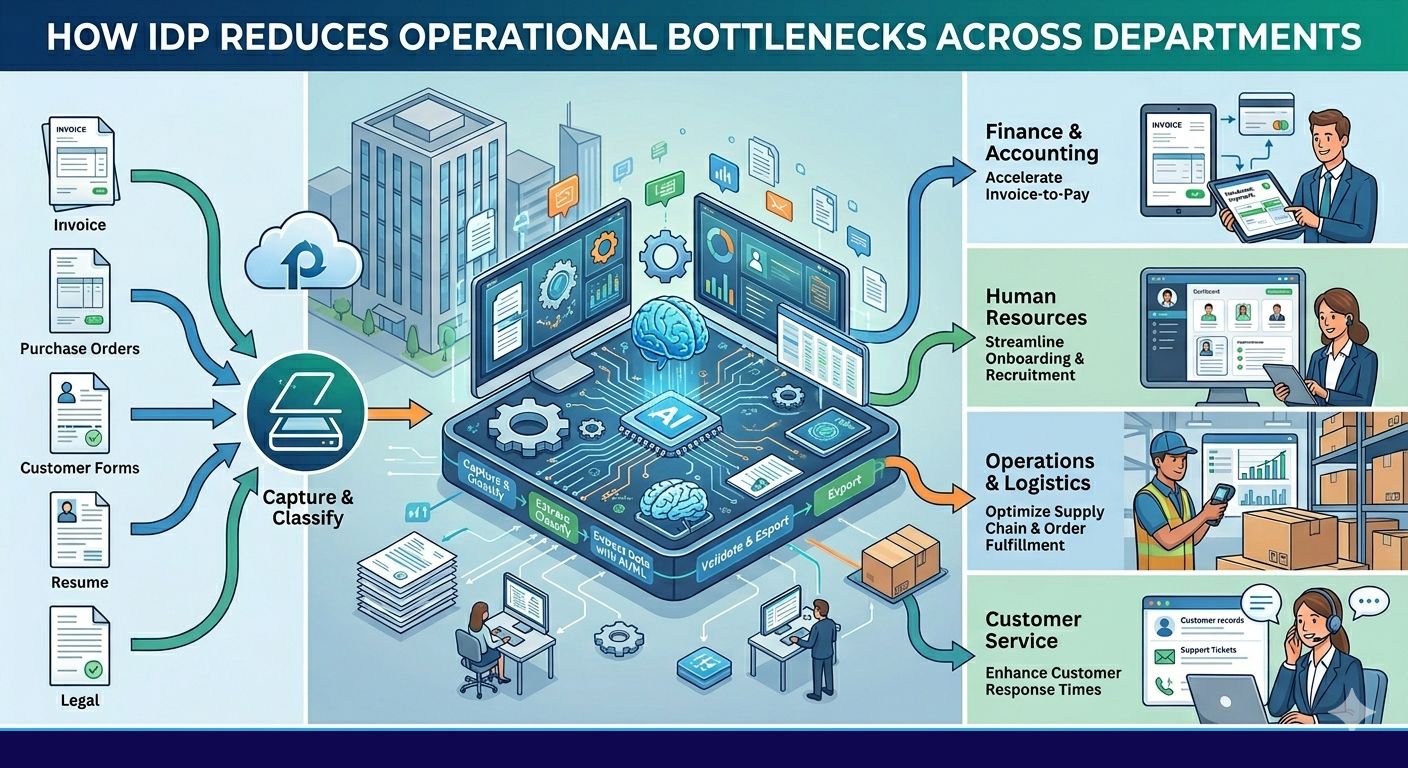
Document-heavy workflows continue to slow down enterprise operations in ways that are often underestimated. Teams wait for approvals, re-enter the same data across systems, and spend time resolving exceptions that could have been prevented earlier. These delays compound across departments, affecting finance cycles, customer onboarding, and compliance processes. As document volumes increase, these inefficiencies become harder to manage. Intelligent Document Processing addresses this by automating data capture, improving interpretation, and enabling faster movement of information across systems. This blog explains where bottlenecks originate, how IDP removes them, and how it improves workflow speed, accuracy, and coordination across departments.
What Are Operational Bottlenecks in Document-Driven Workflows?
Operational bottlenecks occur when a specific stage in a workflow slows down the entire process due to delays, inefficiencies, or dependencies.
Definition of Bottlenecks in Enterprise Processes
Bottlenecks are points where work accumulates because the process cannot move forward at the required pace.
How Document Dependency Slows Down Business Operations
Many enterprise workflows rely on documents for validation and approvals. When documents are processed manually, delays increase across the workflow.
Common Signs of Bottlenecks Across Departments
Frequent backlogs, delayed approvals, repeated corrections, and lack of visibility into document status indicate bottlenecks.
These issues often trace back to how documents are processed.
Why Document Processing Is the Root Cause of Many Bottlenecks
Document processing sits at the center of many workflows, making it a key source of delays.
Manual Data Entry and Repetitive Processing Delays
Manual entry slows down workflows and introduces errors that require correction.
Fragmented Systems and Lack of Data Flow
Data stored across disconnected systems creates delays in accessing and validating information.
Delays in Document Validation and Approvals
Documents often wait for manual review, which increases processing time.
To address these challenges, organizations are shifting toward automated approaches.
How Intelligent Document Processing Addresses Bottlenecks
IDP reduces bottlenecks by automating and optimizing document workflows.
Moving from Manual Processing to Automated Data Capture
Automation reduces dependency on manual data entry and speeds up processing.
Enabling Faster Document Interpretation and Routing
Documents are classified and routed automatically based on content and context.
Reducing Dependency on Sequential Workflows
Parallel processing allows multiple tasks to occur simultaneously, reducing delays.
For a deeper understanding, explore the benefits of intelligent document processing.
Core Capabilities of IDP That Remove Operational Delays
IDP systems include several capabilities that directly address workflow inefficiencies.
Automated Document Classification and Sorting
Documents are categorized instantly, removing the need for manual sorting.
Context-Aware Data Extraction Across Formats
Data is extracted accurately across different document types.
Real-Time Validation and Exception Detection
Errors and discrepancies are identified early in the process.
Integration with Enterprise Systems for Continuous Workflows
Data flows seamlessly between systems without manual intervention.
These capabilities improve workflow speed across departments.
How IDP Improves Workflow Speed and Efficiency
IDP reduces delays and improves coordination.
Eliminating Waiting Time Between Process Stages
Automation removes idle time between steps.
Enabling Parallel Processing Across Tasks
Multiple processes can run at the same time instead of waiting in sequence.
Reducing Rework Through Accurate Data Capture
Accurate extraction reduces the need for corrections.
This impact becomes clearer when viewed across departments.
Department-Wise Impact of IDP on Bottlenecks
Different departments experience improvements in specific ways.
Accounts Payable and Invoice Processing Workflows
Invoice processing becomes faster with automated data capture and validation.
Finance and Reconciliation Processes
Reconciliation improves with accurate and timely data.
Operations and Supply Chain Documentation
Document flow in logistics becomes more efficient.
Customer Service and Onboarding Workflows
Faster document processing improves customer response times.
Legal and Compliance Document Handling
Compliance processes become more consistent and traceable.
These improvements change how documents move across systems.
How IDP Changes Document Flow Across Departments
IDP enables continuous movement of information.
From Batch Processing to Continuous Data Flow
Documents are processed as they arrive rather than in batches.
Real-Time Visibility into Document Status
Teams can track document progress at every stage.
Faster Handoffs Between Teams and Systems
Automated routing reduces delays between departments.
Beyond visible bottlenecks, IDP also addresses hidden inefficiencies.
Bottlenecks That IDP Eliminates but Are Often Ignored
Some bottlenecks are less obvious but equally impactful.
Delays in Exception Identification and Resolution
Early detection allows faster resolution of issues.
Repeated Data Entry Across Multiple Systems
Automation removes duplicate data entry tasks.
Lack of Ownership in Document Processing Stages
Clear workflows assign responsibility at each stage.
Contextual understanding further improves efficiency.
Role of Contextual Understanding in Reducing Bottlenecks
Contextual AI improves how documents are interpreted.
Identifying Relationships Between Data Points
Context helps connect related information within documents.
Reducing Manual Intervention in Complex Documents
Complex documents are processed with minimal manual effort.
Improving Decision Speed Through Accurate Interpretation
Accurate data enables faster decision-making.
This capability supports processing across multiple formats.
Handling Multi-Format Documents Without Process Delays
Enterprises deal with diverse document formats.
Processing PDFs, Emails, and Scanned Documents Together
IDP handles multiple formats without conversion delays.
Adapting to Layout Variations Across Document Sources
Systems adjust to different layouts automatically.
Maintaining Consistency Across Diverse Document Types
Standardized output ensures consistent results.
These features support scalability.
How IDP Supports Scalability Without Creating New Bottlenecks
IDP allows systems to handle growth efficiently.
Handling High Document Volumes Without Additional Resources
Automation manages increased volume without increasing headcount.
Maintaining Performance During Peak Workloads
Systems handle spikes in workload without delays.
Supporting Business Expansion Without Workflow Slowdowns
Growth does not lead to operational strain.
To understand practical implementations, review intelligent document processing use cases.
Measuring Reduction in Operational Bottlenecks
Performance metrics help track improvements.
Turnaround Time and Processing Speed Metrics
Processing time decreases with automation.
Reduction in Manual Effort and Error Rates
Automation reduces human effort and errors.
Improvement in Workflow Throughput
More documents are processed in less time.
Removing bottlenecks also creates indirect benefits.
Hidden Benefits of Removing Bottlenecks with IDP
Beyond speed, IDP improves overall operations.
Improved Employee Productivity and Focus
Teams focus on strategic tasks instead of repetitive work.
Faster Decision-Making Across Departments
Accurate data enables quicker decisions.
Better Collaboration Between Teams
Shared visibility improves coordination.
Implementation challenges must also be considered.
Integration Challenges That Can Limit Bottleneck Reduction
Adoption requires careful planning.
Connecting IDP with Existing Enterprise Systems
Integration ensures smooth data flow.
Managing Data Consistency Across Platforms
Consistency must be maintained across systems.
Ensuring Smooth Transition from Manual Workflows
Transition planning reduces disruption.
Choosing the right system is critical.
What to Look for in an IDP System to Reduce Bottlenecks
System selection impacts long-term results.
Flexibility Across Document Types and Formats
Systems should handle diverse inputs.
Ability to Learn from Workflow Patterns
Learning improves performance over time.
Real-Time Monitoring and Exception Management
Monitoring ensures continuous improvement.
Future developments continue to shape this space.
Future Direction of IDP in Enterprise Operations
IDP continues to advance with new technologies.
Movement Toward Real-Time Document Processing
Real-time processing reduces delays.
Increasing Role of AI in Workflow Optimization
AI improves efficiency across workflows.
Convergence of Document Processing with Enterprise Automation
Document processing becomes part of broader automation systems.
Conclusion
Operational bottlenecks often originate in document processing. Manual workflows, fragmented systems, and delayed validations slow down enterprise operations. IDP addresses these challenges by automating data capture, improving interpretation, and enabling continuous data flow. As organizations scale, removing bottlenecks becomes critical for maintaining efficiency and accuracy across departments.