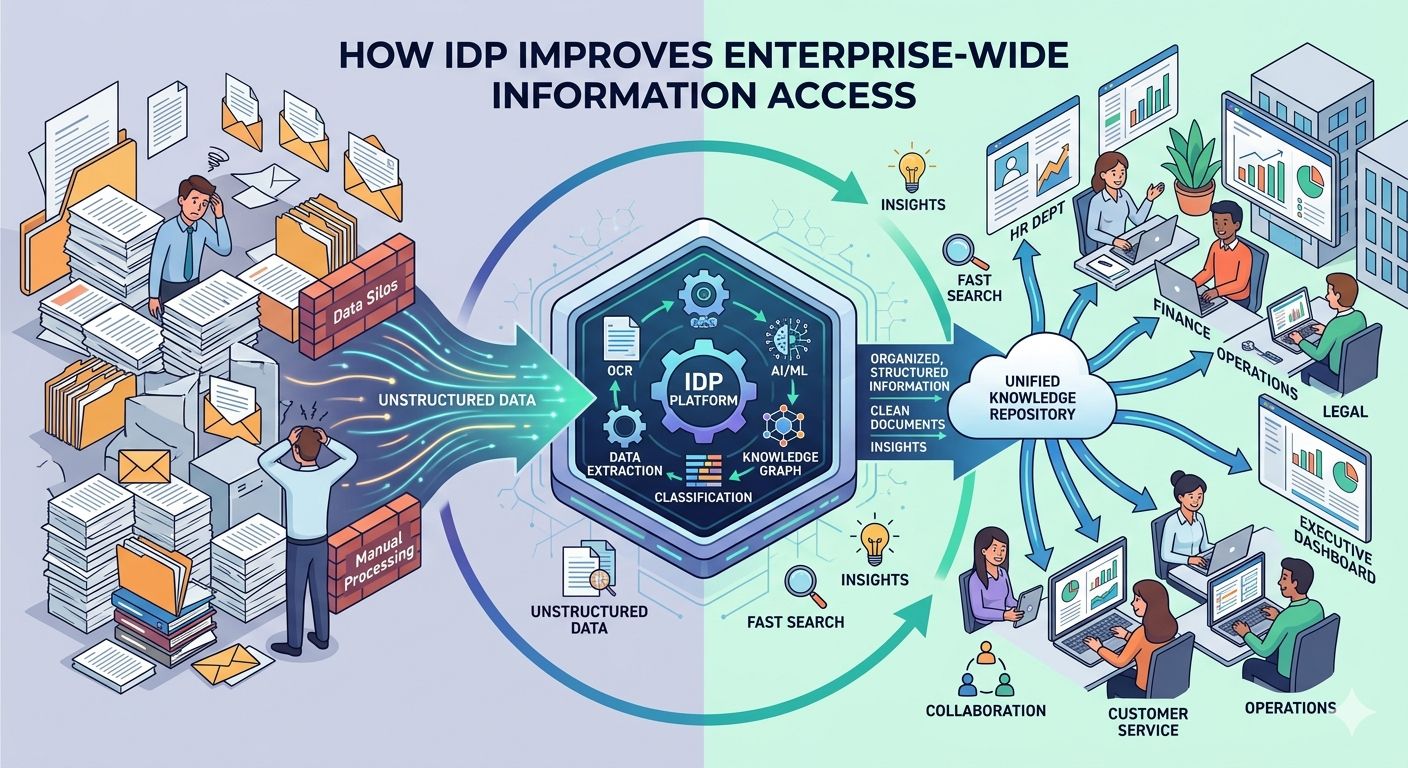
Organizations generate large volumes of documents every day, yet accessing the information inside them remains slow and inconsistent. Data exists, but finding the right information at the right time often requires manual effort, system switching, and repeated searches. This creates delays in decision-making and limits how effectively teams use available data. Intelligent Document Processing addresses this gap by converting documents into structured, searchable, and accessible data across systems. This blog explains how enterprise-wide information access works, why traditional approaches fall short, and how IDP improves visibility, retrieval, and usability of document data across departments.
What Is Enterprise-Wide Information Access?
Enterprise-wide information access refers to the ability to retrieve relevant data across systems and departments.
Definition of Information Access Across Enterprise Systems
It involves making data available and usable across multiple platforms.
Difference Between Data Availability and Data Accessibility
Data may exist in systems, but accessibility means it can be easily retrieved and used.
Role of Documents as Primary Data Sources
Documents hold critical business data in finance, operations, and compliance workflows.
Understanding this sets the context for IDP.
What Is Intelligent Document Processing in This Context?
IDP converts document data into usable information.
Converting Documents into Structured and Searchable Data
Documents are transformed into structured outputs.
Moving Beyond Storage to Usable Information
Data becomes actionable instead of static.
Enabling Access Across Departments and Systems
Information is shared across enterprise systems. Learn more about the benefits of intelligent document processing.
Traditional systems often limit this access.
Why Information Access Is Limited in Traditional Systems
Many systems fail to provide effective access.
Data Locked Inside Unstructured Documents
Information is trapped in formats that are not easily searchable.
Dependency on Manual Search and Retrieval
Users rely on manual lookups.
Fragmentation Across Multiple Systems and Repositories
Data is spread across disconnected platforms.
IDP addresses these limitations.
How IDP Unlocks Document-Centric Data
IDP makes document data usable.
Extracting Structured Data from Unstructured Inputs
Unstructured data is converted into structured form.
Making Document Data Machine-Readable
Systems can process extracted data.
Standardizing Outputs Across Document Types
Data remains consistent across formats.
Context further improves access.
Role of Context in Improving Information Access
Context defines meaning.
Understanding Relationships Between Data Points
Related fields are linked together.
Interpreting Meaning Across Document Sections
Sections are analyzed together.
Enabling Accurate Retrieval Beyond Keywords
Search is based on meaning, not just text.
This enables better retrieval systems.
From Document Storage to Intelligent Retrieval
Access evolves beyond storage.
Limitations of Basic Document Management Systems
Traditional systems store files but do not interpret them.
Shift Toward Searchable and Queryable Data Layers
Data becomes searchable at a deeper level.
Accessing Information Based on Intent, Not File Names
Users retrieve data based on need. This is enabled by intelligent document search.
Search and discovery improve significantly.
How IDP Improves Search and Discovery
IDP enables faster retrieval.
Indexing Extracted Data for Faster Retrieval
Data is indexed for quick access.
Enabling Context-Aware Search Across Documents
Search results are more accurate.
Reducing Dependency on Manual Document Lookup
Users no longer rely on manual searches.
This also reduces data silos.
Eliminating Data Silos Across Enterprise Systems
IDP connects data sources.
Connecting Document Data with ERP, CRM, and Core Platforms
Data flows across systems.
Ensuring Consistent Data Availability Across Departments
All teams access the same information.
Creating a Unified View of Enterprise Information
A single view improves decision-making.
This improves cross-department usage.
Impact on Cross-Department Information Access
Access improves across teams.
Finance Accessing Operational and Transactional Data
Finance teams gain broader visibility.
Operations Accessing Vendor and Contract Information
Operations use relevant data quickly.
Customer-Facing Teams Accessing Relevant Records
Customer interactions improve with better access.
Real-time access further enhances this.
Real-Time Access to Document Data
Speed is a key factor.
Reducing Delay Between Document Intake and Data Availability
Data becomes available faster.
Supporting Immediate Query and Retrieval
Users access data instantly.
Enabling Faster Decision Support Across Teams
Decisions happen quicker.
Handling diverse formats remains important.
Handling Multi-Format Documents for Unified Access
Enterprises deal with multiple formats.
Processing PDFs, Emails, Images, and Scanned Files
All formats are processed together.
Managing Layout Variability Across Document Sources
Systems adapt to layout differences.
Maintaining Consistency Across Diverse Inputs
Outputs remain consistent.
Accuracy supports reliable access.
Improving Data Accuracy for Reliable Access
Accurate data ensures trust.
Reducing Errors During Data Extraction
Fewer errors improve reliability.
Ensuring Consistent Data Representation Across Systems
Data remains uniform.
Minimizing Duplicate or Conflicting Records
Conflicts are reduced.
AI expands these capabilities.
Role of AI in Expanding Information Access
AI improves data interpretation.
Context-Aware Extraction and Interpretation
AI understands context.
Linking Related Documents and Data Points
Connections improve retrieval.
Learning from Usage Patterns to Improve Retrieval
Systems improve with usage.
Access shifts toward dynamic models.
From Static Access to Dynamic Information Flow
Information becomes continuous.
Moving Beyond File-Based Retrieval Models
Files are no longer the focus.
Enabling Continuous Data Updates Across Systems
Data updates automatically.
Supporting Live Data Access Across Workflows
Teams access live data.
Measurement helps evaluate improvements.
Measuring Improvements in Information Access
Metrics define progress.
Time Taken to Retrieve Relevant Information
Faster retrieval indicates improvement.
Reduction in Manual Search Effort
Manual work decreases.
Increase in Data Utilization Across Teams
More data is used effectively.
Barriers still exist.
Hidden Barriers to Enterprise Information Access
Some challenges remain.
Over-Reliance on File Names and Folder Structures
File-based systems limit access.
Limited Visibility Into Document Content
Content remains hidden.
Lack of Standardized Metadata Across Documents
Metadata inconsistencies affect search.
Integration adds complexity.
Integration Challenges in Improving Access
Systems must connect effectively.
Connecting IDP with Existing Enterprise Systems
Integration enables data flow.
Maintaining Data Consistency Across Integrated Platforms
Consistency must be maintained.
Managing Access Across Distributed Environments
Access must be controlled.
Governance ensures proper usage.
Data Governance and Access Control Considerations
Governance defines access.
Defining Access Permissions Across Roles
Permissions control usage.
Ensuring Data Security and Privacy
Sensitive data is protected.
Maintaining Audit Trails for Information Usage
Tracking ensures accountability.
Enterprises must focus on priorities.
What Enterprises Should Prioritize for Better Access
Focus areas drive improvement.
Building Searchable and Structured Data Layers
Structured data improves access.
Reducing Dependency on Manual Retrieval Processes
Automation replaces manual effort.
Ensuring Scalability Across Document Volumes
Systems handle growth effectively.
Future trends indicate further progress.
Future Direction of Enterprise Information Access
Access continues to improve.
Movement Toward Semantic and Context-Aware Search
Search becomes more intelligent.
Increasing Role of AI in Knowledge Retrieval
AI supports deeper insights.
Convergence of Document Processing with Enterprise Knowledge Systems
Systems integrate with knowledge platforms.
Conclusion
Intelligent Document Processing improves enterprise-wide information access by converting documents into structured, searchable, and accessible data. By reducing manual effort, improving accuracy, and enabling real-time retrieval, organizations can ensure that information is available when needed. As document volumes continue to grow, adopting context-aware and integrated systems will be key to maintaining efficient and reliable access across business functions.