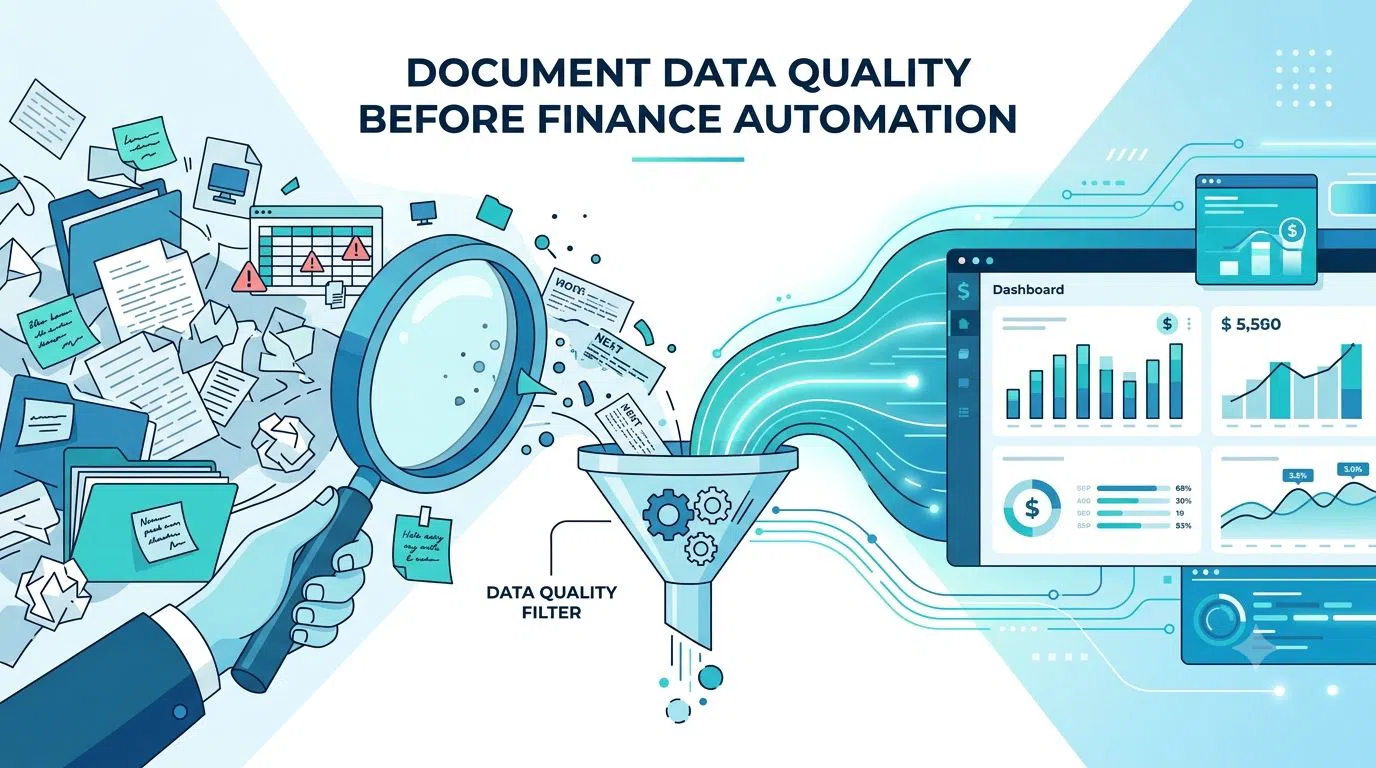
Finance automation can process invoices, statements, expenses, reconciliations, and journal data at remarkable speed. But speed becomes a liability when the information entering those processes is incomplete, duplicated, misclassified, or linked to the wrong account.
Poor document data does not disappear once automation begins. It moves into payment decisions, general ledger postings, reconciliations, reporting, and audit records, where correction becomes harder and more expensive.
Reliable finance automation therefore starts before posting or approval. It starts with dependable document data. This article explains what document data quality means, where problems arise, how they affect finance processes, what validation should happen first, and how finance teams can assess data readiness.
Why Document Data Quality Determines Whether Finance Automation Works Reliably
Finance automation depends on the quality of its inputs. If document data is unreliable, automated processes can repeat and distribute the same problems at greater scale.
Automation Processes the Data It Receives, Including Its Errors
An automated process cannot independently assume that every captured value is correct. Incorrect dates, amounts, supplier information, or account codes can continue into later stages.
Poor Source Data Creates More Exceptions Instead of Less Manual Work
Missing fields, inconsistent formats, and conflicting records can trigger exception queues that require employees to reopen documents and investigate errors.
Data Quality Problems Become Harder to Correct After Information Enters Finance Systems
Once incorrect data reaches accounting or payment systems, correction may require reversals, reconciliations, approvals, or changes across several records.
What Does High-Quality Document Data Mean in Finance?
High-quality finance document data is accurate, complete, consistent, valid, current, and traceable to its source.
Accuracy Means Extracted Values Match the Source Document
Amounts, dates, identifiers, descriptions, and account information should match the original document.
Completeness Means Every Required Field, Line Item, and Supporting Record Is Present
A transaction may be unusable even if captured fields are correct when required evidence or information is missing.
Consistency Means Related Data Uses the Same Formats, Definitions, and Identifiers
Supplier names, currencies, account codes, dates, and entity identifiers should remain consistent across related records.
Validity Means Data Meets Finance Rules, Formats, and Allowed Conditions
Values should satisfy defined accounting rules, field formats, tolerances, and approved business conditions.
Timeliness Means Finance Teams Are Working With Current Information
Old supplier records, expired documents, or outdated account information can create incorrect processing decisions.
Traceability Means Every Material Value Can Be Connected Back to Its Source
Finance users should be able to locate the document, page, table, line item, or field supporting a processed value.
Where Document Data Quality Problems Begin
Document data problems can begin before extraction and continue through classification, interpretation, reference-data matching, and validation.
Poor Scans, Faded Text, Skewed Pages, and Low-Quality Images Affect Data Capture
Unreadable or distorted documents increase the chance of characters and values being captured incorrectly.
Different Supplier and Customer Formats Create Inconsistent Field Structures
The same information may appear in different locations, labels, tables, or formats across suppliers and customers.
Tables and Line Items Can Lose Relationships During Extraction
Values become unreliable if row, column, header, quantity, or unit relationships are broken.
Missing Pages and Supporting Documents Create Incomplete Records
An invoice, statement, or financial record may depend on schedules, attachments, or later pages.
Duplicate Documents Can Produce Duplicate Transactions
Repeated invoices or statements may enter the same process more than once unless duplicate checks identify them.
Incorrect Supplier, Customer, and Account Master Data Creates Mismatches
Even accurate document data can fail validation if related master records are outdated or incorrect.
Dates, Currencies, Tax Values, and Units Can Be Interpreted Incorrectly Without Context
A number cannot always be used correctly until its period, currency, tax treatment, unit, and business meaning are established.
Related Documents Can Contain Conflicting Information
Invoices, purchase orders, receipts, statements, and supporting records may contain values that do not agree.
How Poor Document Data Disrupts Finance Automation
Once unreliable document data enters finance processes, the effects can spread across payments, accounting, reconciliation, and reporting.
Incorrect Invoice Data Can Lead to Wrong Payments or Posting Decisions
Incorrect totals, vendor information, or tax values can affect approval and payment outcomes.
Inconsistent Vendor Data Can Prevent Automatic Matching
Differences in names, identifiers, or account details may stop otherwise valid transactions from matching.
Missing Information Creates Exception Queues and Approval Delays
Incomplete fields or supporting records force transactions into manual review.
Duplicate Records Can Pass Into Payment and Accounting Processes
Undetected duplicate invoices can create duplicate liabilities or payment risk.
Incorrect Account Mapping Can Affect General Ledger Entries
A correctly extracted amount may still create an accounting error if assigned to the wrong account. This connection between document processing and downstream accounting accuracy is one reason intelligent document processing in accounting extends beyond basic data capture.
Bad Document Data Can Create Reconciliation Breaks Later in the Finance Cycle
Errors introduced during document processing may appear later as unmatched balances, unexplained differences, or transactions requiring manual investigation.
Data Errors Can Carry Into Financial Reporting and Audit Records
Once incorrect entries are recorded, they can affect reports, close activities, and supporting audit evidence.
Why Extraction Accuracy Alone Is Not Enough for Finance Automation
Extraction accuracy measures whether information was captured. Finance automation also requires the information to be interpreted and validated correctly.
Character Accuracy Does Not Confirm Business Accuracy
Reading "$8,500" correctly does not confirm whether it represents tax, total amount, balance due, or another financial value.
A Correctly Extracted Value Can Still Be Assigned to the Wrong Field
A date may be captured perfectly but classified as the invoice date instead of the payment due date.
Context Determines Whether a Number Represents the Right Entity, Period, Currency, or Account
Financial values gain meaning from their surrounding labels, document section, reporting period, and entity.
Field-Level Accuracy Does Not Confirm That Related Documents Agree
Correct invoice fields can still conflict with purchase orders, receipts, or supplier records.
Model Confidence Does Not Always Reflect the Financial Impact of an Error
A highly confident output can still create material consequences if the underlying interpretation is wrong.
Why Document Data Validation Should Happen Before Automated Posting
Validation should take place before document data becomes an accounting entry, payment instruction, or other operational record.
Field-Level Checks Confirm Required Values and Expected Formats
Required fields can be tested for presence, format, range, and allowed values.
Cross-Field Checks Test Relationships Within the Same Document
Dates, totals, taxes, quantities, and line items can be checked against one another.
Cross-Document Validation Compares Invoices, Purchase Orders, Receipts, Statements, and Other Records
Related records can be compared before a transaction is approved or posted.
Reference Data Checks Compare Document Information With Approved Finance Records
Supplier, customer, account, tax, and entity information can be checked against approved records.
Accounting and Policy Rules Determine Whether Data Is Ready to Proceed
Tolerance limits, approval conditions, coding rules, and internal policies can determine whether a transaction continues automatically.
Uncertain or Conflicting Data Should Be Flagged Before It Reaches the System of Record
Cases with incomplete evidence or inconsistent values should be reviewed before posting.
The Hidden Cost of Poor Data Quality: Finance Teams End Up Checking the Automation
Poor inputs can replace manual data entry with another form of manual work: verifying automated output.
Employees Reopen Source Documents to Confirm Extracted Values
Finance staff lose time when they repeatedly compare system values with original documents.
Exception Queues Replace the Manual Data Entry That Automation Was Meant to Reduce
Large exception volumes can shift manual effort rather than reduce it.
Downstream Teams Correct Problems That Should Have Been Detected During Document Processing
Errors become more expensive when accounting, reconciliation, or reporting teams must correct them later.
Repeated Manual Verification Reduces Confidence in Automated Finance Processes
Employees are less likely to rely on automation if outputs regularly require independent checking.
Which Finance Processes Depend Most on Reliable Document Data?
Almost every document-heavy finance process depends on accurate and validated source information.
Accounts Payable and Invoice Processing
Invoices require correct supplier, PO, tax, line-item, total, and payment information.
Purchase Order and Receipt Matching
Matching requires consistent quantities, prices, suppliers, purchase orders, and receipt records.
Expense Processing and Employee Reimbursements
Receipts, amounts, categories, dates, and policy conditions must align before reimbursement.
Bank and Account Reconciliation
Accurate transaction references, dates, balances, entities, and amounts are necessary for reliable matching.
Financial Close and General Ledger Posting
Incorrect document data can create journal corrections and reconciliation issues during close.
Financial Statement Processing and Credit Analysis
Balance-sheet, income-statement, and cash-flow values require correct entity, period, account, and hierarchy context.
Tax, Compliance, and Audit Documentation
Tax values, supporting evidence, approval records, and source traceability must remain dependable.
How Intelligent Document Processing Prepares Data for Finance Automation
Preparing documents for automated finance processes involves more than extracting fields. Intelligent document processing for finance can combine classification, contextual extraction, validation, review, and source traceability so incoming information is checked before finance systems depend on it.
Document Classification Identifies What Each Finance Record Represents
Classification distinguishes invoices, statements, receipts, tax documents, financial reports, and supporting records.
Context-Aware Extraction Connects Values With the Correct Business Fields
Context helps associate values with the right supplier, period, account, entity, or financial concept.
Layout Analysis Preserves Tables, Line Items, and Document Hierarchy
Structure can be retained so extracted values remain connected to their rows, columns, headings, and sections.
Validation Checks Data Before It Enters Automated Finance Processes
Extracted information can be tested against finance rules and related records before posting.
Confidence-Based Review Directs Uncertain Information to Finance Teams
Employees can focus on values that are unclear, conflicting, or financially significant.
Source Traceability Keeps Processed Data Connected to Supporting Documents
Users can verify where information originated without manually searching through complete files.
How to Assess Document Data Readiness Before Automating a Finance Process
Finance teams should examine the quality and movement of document data before deciding how much processing can run automatically.
Map Every Document Source Entering the Finance Workflow
Identify email, portals, shared storage, scanners, supplier systems, and other intake sources.
Identify Which Fields and Documents Are Required for Each Transaction
Define the minimum information required for processing and approval.
Measure Current Data Errors, Missing Information, and Duplicate Records
Baseline measurements reveal where quality issues occur most often.
Find the Document Types Producing the Most Manual Corrections
These document categories may offer the clearest opportunity for better processing.
Review Supplier, Customer, Account, and Other Reference Data
Reference records must also be accurate if document validation depends on them.
Define Cross-Document and Accounting Validation Rules
Document relationships and finance conditions should be defined before automatic posting begins.
Decide Which Exceptions Require Human Review
Material values, conflicting records, missing evidence, and policy-sensitive cases may need employee approval.
Confirm Where Validated Document Data Will Be Posted
Finance teams should know which systems and processes will consume the resulting data.
What Document Data Quality Metrics Should Finance Teams Track?
Finance teams should measure both capture quality and whether document data is suitable for downstream processing.
Field Extraction Accuracy
Measures whether individual values are captured correctly.
Required-Field Completeness Rate
Measures how often all required information is available.
Document Validation Pass Rate
Shows how many documents satisfy defined validation conditions.
Duplicate Detection Rate
Tracks how frequently duplicate records are identified before processing.
Exception and Manual Review Rate
Measures how much document processing still requires employee intervention.
Reviewer Correction Rate
Shows how often employees change extracted or interpreted information.
False Acceptance Rate
Measures incorrect data that passed automated checks.
Source Traceability Coverage
Tracks how consistently processed values remain connected to source evidence.
From Document Data Quality to Reliable Finance Automation
Reliable automation becomes possible when incoming data is prepared and verified before finance systems depend on it.
Clean Inputs Reduce Exceptions Before They Reach Automated Processes
Better source data reduces unnecessary review and correction.
Validated Data Allows More Transactions to Proceed Without Rechecking
Transactions that satisfy defined conditions can move forward with less manual verification.
Consistent Reference Data Improves Matching and Account Mapping
Reliable supplier, customer, account, and entity records support more accurate comparisons.
Source Evidence Makes Automated Finance Decisions Easier to Verify
Traceability gives finance teams evidence for why a value or transaction was accepted.
Finance Automation Should Begin With Data Readiness, Not Process Speed
Processing faster matters only after the underlying information is dependable enough to support automated decisions.
Conclusion: Finance Automation Is Only as Reliable as the Document Data Entering It
Finance automation cannot compensate for unreliable document data. Incorrect values, missing records, inconsistent identifiers, duplicate documents, and weak source traceability can move from document processing into payments, accounting, reconciliation, reporting, and audit activities.
The better starting point is data readiness. Documents should be classified correctly, information should retain its business context, relationships should be preserved, values should be checked against finance rules and reference records, and uncertain cases should be separated for review.
Organizations evaluating intelligent document processing software should therefore consider how effectively it prepares validated, traceable document data before that information enters automated finance processes.