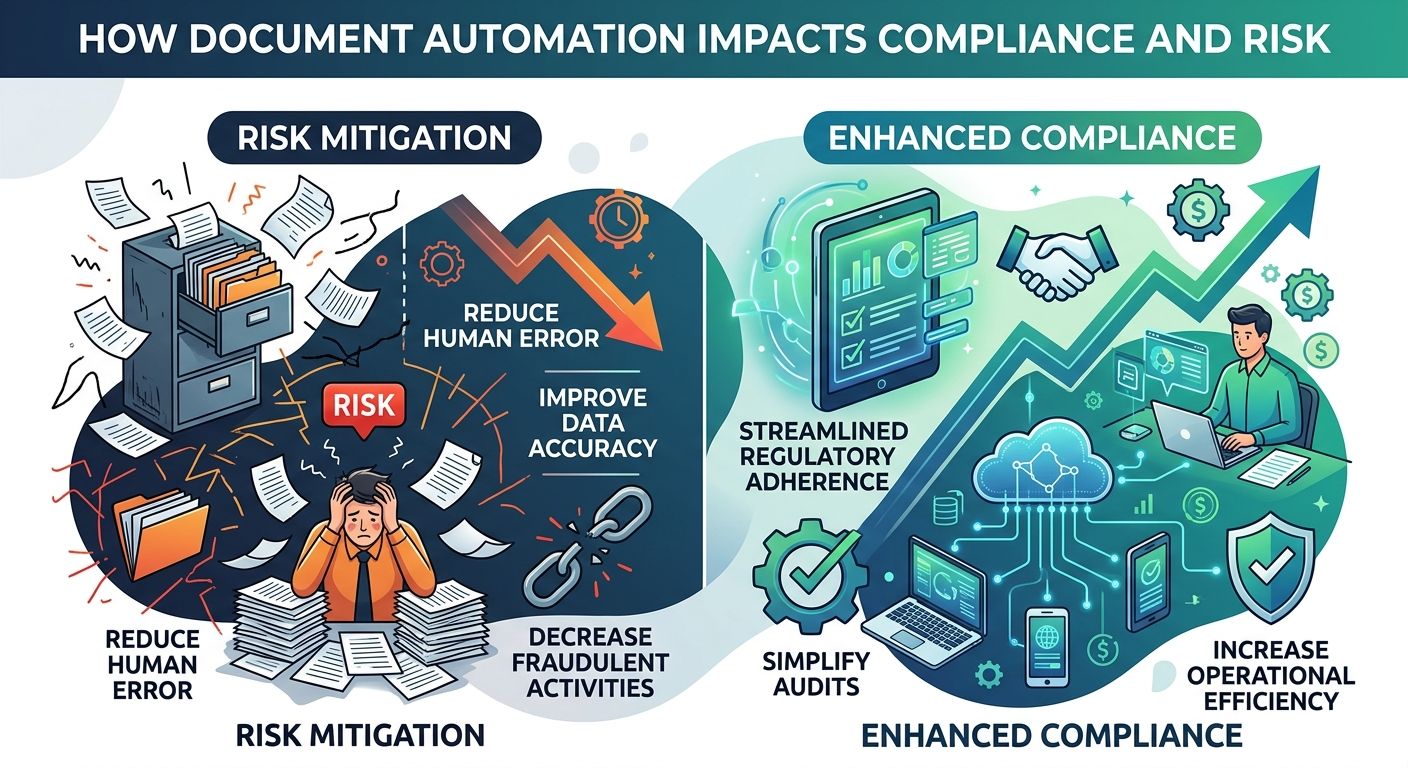
Manual document handling continues to create gaps in compliance and risk management across enterprises. Teams deal with missing records, delayed updates, and inconsistent data capture, which leads to reporting errors and audit challenges. As regulatory requirements grow stricter, these issues become harder to manage. Errors in documentation do not stay isolated. They affect financial reporting, customer onboarding, and operational control. Document automation addresses these challenges by ensuring consistent data capture, real-time validation, and complete traceability. This blog explains how document automation improves compliance, reduces risk exposure, and strengthens control across workflows.
What Is Document Automation in Regulated Environments?
Document automation refers to the use of systems that capture, process, and manage document data without manual intervention. To understand this in detail, refer to this guide on what is document automation.
Definition of Document Automation in Enterprise Workflows
It involves automating tasks such as data extraction, validation, routing, and storage across document-driven processes.
Role of Automation in Compliance-Driven Processes
Automation ensures that documents are processed consistently and according to defined rules, which supports compliance requirements.
Difference Between Manual Handling and Automated Document Control
Manual handling depends on human input, while automation ensures consistent processing and traceability.
This foundation explains why document accuracy plays a central role in compliance.
Why Compliance and Risk Management Depend on Document Accuracy
Accurate documentation is the basis of regulatory reporting and risk control.
Importance of Data Integrity in Regulatory Reporting
Regulators require accurate and complete data. Errors in documents lead to incorrect reporting.
How Documentation Gaps Lead to Compliance Failures
Missing or incomplete records create gaps that result in non-compliance.
Role of Timely Data Capture in Risk Mitigation
Delayed data capture prevents early detection of discrepancies and risks.
These challenges often originate from manual processing practices.
Where Manual Document Processing Creates Compliance Risks
Manual workflows introduce inconsistencies and delays.
Incomplete or Missing Records Across Workflows
Documents may not be captured or stored correctly, leading to missing data.
Delayed Updates in Financial and Operational Documents
Manual updates take time, which affects data accuracy.
Lack of Standardization in Document Handling Practices
Different teams follow different processes, leading to inconsistency.
Automation addresses these gaps through structured processing.
How Document Automation Reduces Compliance Gaps
Automation improves consistency and control.
Ensuring Consistent Data Capture Across Documents
Standardized processing ensures uniform data capture.
Real-Time Validation Against Business and Regulatory Rules
Data is validated as it is processed, reducing errors.
Automated Tracking of Document Changes and Versions
Every change is recorded, ensuring traceability.
These improvements also support better risk monitoring.
Impact of Automation on Risk Identification and Monitoring
Automation enables proactive risk management.
Early Detection of Irregularities in Document Data
Systems identify anomalies during processing.
Continuous Monitoring Instead of Periodic Reviews
Monitoring occurs throughout the workflow rather than at fixed intervals.
Improved Visibility into Risk Signals Across Workflows
Teams can track risks across processes in real time.
This requires specific features within document automation systems.
Core Features of Document Automation That Support Compliance
Certain features directly contribute to compliance.
Automated Document Classification and Tagging
Documents are categorized automatically for easier management.
Structured Data Extraction with Context Awareness
Data is extracted with understanding of relationships and meaning.
Rule-Based and AI-Assisted Validation Mechanisms
Validation ensures data meets defined standards.
Audit Trails and Activity Logging Across Document Lifecycles
All actions are recorded for traceability.
These features improve audit readiness.
How Document Automation Improves Audit Readiness
Automation simplifies audit preparation.
Maintaining Complete and Traceable Document Histories
All documents and changes are tracked and accessible.
Reducing Time Spent Preparing for Audits
Automated records reduce manual effort during audits.
Ensuring Consistency Across Submitted Reports and Records
Standardized data ensures consistency in reporting.
Compliance also depends on alignment with regulatory requirements.
Document Automation and Regulatory Alignment
Automation supports adherence to regulations.
Mapping Document Data to Regulatory Requirements
Data is aligned with reporting standards.
Adapting to Changing Compliance Standards
Systems can update rules as regulations change.
Maintaining Consistent Reporting Across Jurisdictions
Automation ensures consistency across regions.
This impact extends across business functions.
Risk Reduction Across Key Business Functions
Different departments benefit from improved compliance.
Finance and Financial Reporting Controls
Accurate data improves financial reporting.
Accounts Payable and Invoice Compliance Checks
Invoices are validated against policies.
Customer Onboarding and KYC Documentation
Customer data is verified and stored correctly.
Contract Management and Legal Documentation Oversight
Contracts are tracked and managed consistently.
Real-time processing strengthens these controls.
Role of Real-Time Processing in Compliance Management
Real-time systems reduce delays in compliance checks.
Immediate Validation of Incoming Documents
Documents are validated as they enter the system.
Faster Identification of Compliance Exceptions
Issues are identified quickly.
Reducing Lag Between Transaction and Reporting
Real-time updates improve reporting accuracy.
Automation also addresses hidden risks.
Hidden Compliance Risks That Automation Addresses
Some risks are not immediately visible.
Untracked Document Edits and Version Conflicts
Automation tracks changes and prevents conflicts.
Dependency on Individual Knowledge for Compliance Checks
Standardized processes reduce reliance on individuals.
Gaps in Cross-Department Document Visibility
Centralized systems improve visibility.
Data governance also improves with automation.
How Document Automation Improves Data Governance
Automation strengthens control over data.
Centralized Control Over Document Access and Usage
Access is managed through defined permissions.
Standardized Data Formats Across Systems
Data is consistent across platforms.
Improved Accountability Through Role-Based Access
Responsibilities are clearly defined.
Measuring impact helps validate improvements.
Measuring the Impact of Document Automation on Risk Reduction
Metrics provide insight into performance.
Reduction in Compliance Errors and Exceptions
Automation reduces error rates.
Audit Findings and Issue Resolution Time
Issues are resolved faster.
Consistency in Reporting and Documentation Accuracy
Reports remain consistent across cycles.
Implementation also brings challenges.
Integration Challenges That Affect Compliance Outcomes
Integration requires planning.
Connecting Automation Systems with Legacy Platforms
Systems must work together seamlessly.
Maintaining Data Consistency Across Integrated Systems
Consistency must be preserved across platforms.
Ensuring Secure Data Exchange Between Applications
Security is required during data transfer.
Cost considerations also play a role.
Cost of Non-Compliance vs Investment in Automation
The cost of errors is often higher than the cost of automation.
Financial Penalties and Regulatory Fines
Non-compliance leads to penalties.
Operational Cost of Remediation Efforts
Fixing errors requires time and resources.
Long-Term Value of Preventive Compliance Systems
Preventive systems reduce long-term costs.
Understanding system gaps is also important.
Gaps in Current Document Automation Approaches
Existing systems have limitations.
Limited Context Awareness in Complex Documents
Complex documents may require deeper interpretation.
Challenges in Handling Unstructured and Multilingual Data
Different formats and languages add complexity.
Need for Continuous Learning and Adaptation
Systems must improve over time. For a broader understanding of value and impact, review the benefits of intelligent document processing.
Implementation requires careful evaluation.
What to Consider When Implementing Document Automation for Compliance
Several factors must be evaluated before adoption.
Alignment with Industry-Specific Regulations
Systems must meet regulatory requirements.
Scalability Across Document Volumes and Workflows
Solutions should support growth.
Data Security and Privacy Requirements
Sensitive data must be protected.
Future developments continue to shape this space.
Future Direction of Document Automation in Risk Management
Technology continues to improve compliance capabilities.
Increasing Use of AI for Predictive Compliance Monitoring
AI identifies risks before they occur.
Convergence of Document Automation with Risk Intelligence Systems
Document processing connects with broader risk systems.
Movement Toward Continuous Compliance Frameworks
Compliance becomes an ongoing process rather than periodic.
Conclusion
Document automation improves compliance by ensuring accurate data capture, real-time validation, and complete traceability. It reduces risk by identifying issues early and providing continuous visibility into workflows. As regulatory requirements grow, automation becomes a key factor in maintaining control and reducing exposure across enterprise operations.