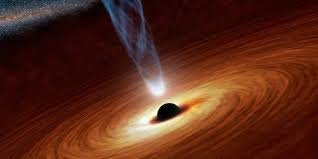
Black holes have fascinated scientists and space lovers for decades. They’re often described as invisible monsters in the sky — swallowing stars, bending light, and warping time. But beyond the sci-fi image, what really makes them so mysterious?
The truth is: the more we learn about black holes, the stranger they get.
They break the rules of physics
A black hole is formed when a massive star collapses under its own gravity, squeezing its mass into an incredibly small space. The result is a point of infinite density called a singularity, where the laws of physics as we know them stop working. Even Einstein’s theories can’t fully explain what happens inside.
They hide in plain sight
Black holes don’t emit light, so we can’t see them directly. Instead, scientists spot them by watching how nearby matter behaves. Gas and dust spiral around the hole, heating up and glowing — and sometimes, entire stars vanish as they cross the invisible boundary called the event horizon.
They can grow beyond imagination
Some black holes are small, just a few times more massive than the Sun. But others, like the supermassive black hole at the center of our galaxy, are millions (even billions) of times heavier. And we’re still not sure how they got so big so fast.
Time slows down near them
One of the strangest effects near a black hole is time dilation. If you hovered near a black hole’s edge (and somehow survived), time for you would pass much more slowly than for someone farther away. It’s not science fiction — it’s general relativity in action.
They bend light and reality
Black holes bend spacetime so much that even light can’t escape. This extreme warping creates gravitational lensing, which lets us “see” behind objects or even duplicate images of stars. It’s one of the reasons the Event Horizon Telescope could capture the now-famous image of a black hole’s glowing ring.
They might connect to other parts of the universe
Some theories suggest black holes could be connected to white holes or even wormholes — passages to other parts of the universe. There’s no proof yet, but researchers are actively exploring the idea.
And yes — we’ve heard them “sing”
NASA has recorded actual sound waves from black hole activity, converted into audio frequencies we can hear. The result? Deep, eerie tones that sound like something from a sci-fi horror film.
The universe is full of interesting facts about space, but black holes stand in a category of their own. They’re not just mysterious — they challenge our understanding of everything.
you can even earn by sharing these discoveries through Discovery Bit’s affiliate program. Discovery Bit lets you share and earn. Check their FAQ for details.
Whether you're deep-diving into space documentaries or casually reading up on galactic mysteries, black holes are the kind of topic that never stops surprising us. The more we learn, the more questions we find, and that’s exactly why they remain one of the most captivating subjects in the cosmos.