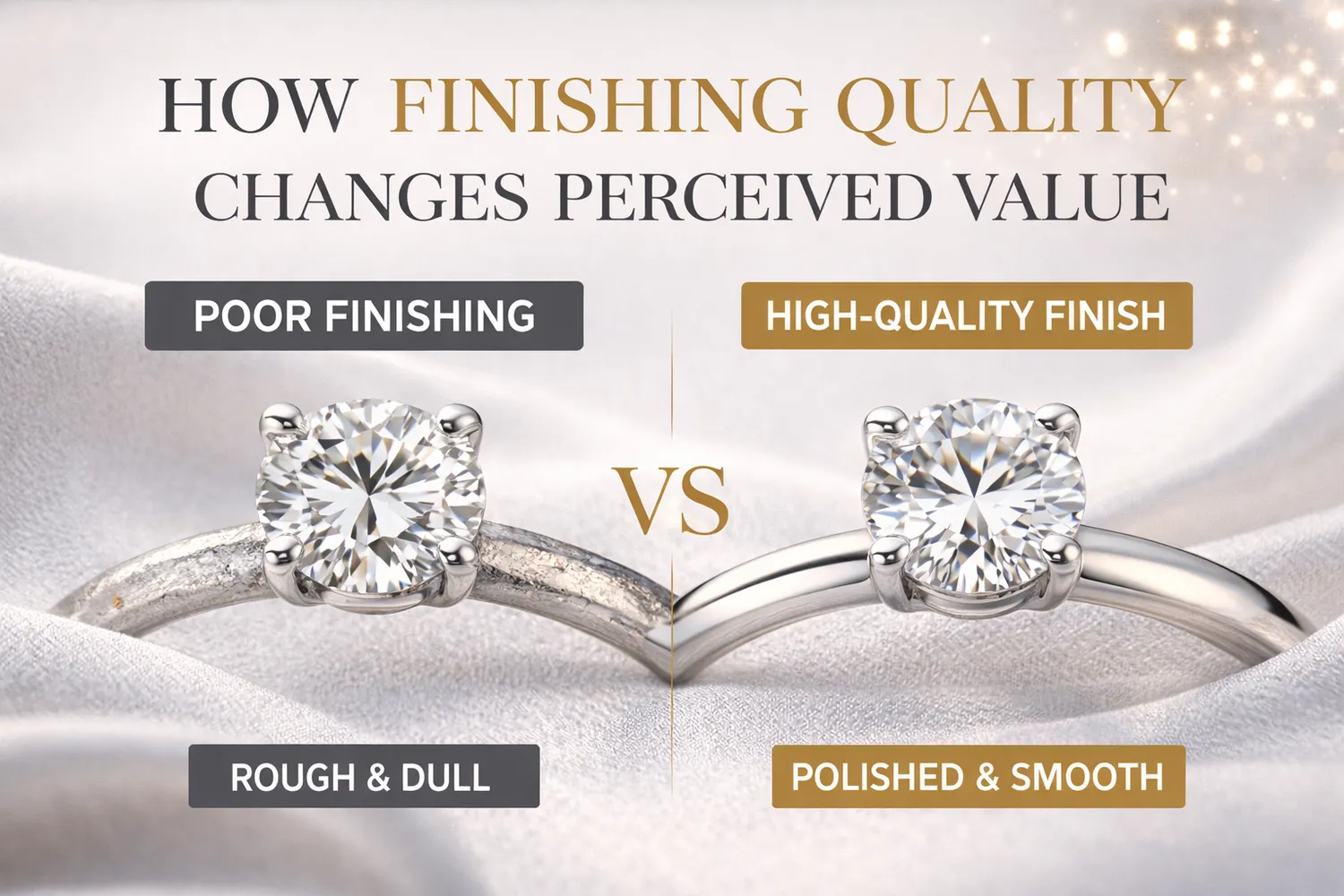
Have you ever seen two diamond rings that looked almost identical on paper — same gold purity, same diamond size, even similar design — yet one instantly felt luxurious while the other felt ordinary?
This experience is more common than most buyers realize.
On specifications alone, the two pieces may seem equal. But in real life, one catches the light beautifully, feels smooth and substantial in your hand, and looks refined from every angle. The other may appear slightly dull, feel less comfortable, or lack that unmistakable “high-end” presence.
This is where many buyers feel confused.
Why is one piece priced significantly higher when the materials appear the same? Why does jewelry that looked perfect online feel average when it arrives? And what exactly makes a piece look truly premium instead of just expensive?
The answer often lies in a detail most people overlook: finishing quality.
Finishing quality is one of the most powerful factors influencing how luxurious a piece of jewelry looks and feels. It affects how the metal reflects light, how smooth the surfaces are, how precisely the stones are set, and how balanced the piece feels when worn. Yet many buyers focus only on diamond specifications or gold purity without considering the craftsmanship that brings the piece to life.
Luxury jewelry isn’t defined by materials alone. It’s defined by refinement — the final stage where skilled hands transform raw components into something elegant, comfortable, and visually flawless.
In this guide, you’ll learn what finishing quality really means, why it dramatically changes perceived value, how it affects durability and comfort, and how to evaluate these details before you buy. Understanding finishing quality will help you recognize the difference between mass-produced jewelry and pieces that truly look and feel luxurious.
What “Finishing Quality” Really Means in Jewelry
Beyond Diamonds and Gold Purity
Most buyers naturally focus on diamond cut, carat weight, or whether the piece is made in 18K gold or platinum. These factors determine material value. But finishing determines how those materials actually appear once the piece is complete.
Finishing is the final stage of jewelry production. It includes refining every surface, smoothing edges, aligning components, and perfecting the overall structure. This stage is where craftsmanship becomes visible.
The Final Stage That Defines Luxury
High-quality finishing involves several important elements:
- Precision polishing to create a smooth, reflective surface
- Refining edges so they feel soft and comfortable
- Removing tool marks and surface texture
- Ensuring the piece is balanced and symmetrical
This is the stage that transforms a technically correct piece into one that feels premium.
Why Finishing Matters More Than Buyers Realize
The human eye and hand are extremely sensitive to refinement. Even without technical knowledge, people instinctively notice when something looks smooth, balanced, and well-made.
That immediate impression — the one that makes a piece feel “expensive” — comes largely from finishing.
Why Finishing Quality Changes Perceived Value
Light Reflection and Surface Smoothness
High-quality polishing creates a mirror-like finish. Light moves cleanly across the surface, making the metal appear brighter and richer.
When finishing is poor, the surface may look slightly cloudy, uneven, or dull. Even if the gold purity is the same, the piece will appear less valuable.
Precision Creates a Luxury Feel
Luxury jewelry is defined by clean lines and perfect symmetry. Curves flow smoothly. Edges are consistent. Stones sit exactly where they should.
Small irregularities may not be obvious at first glance, but they subtly reduce the sense of refinement.
Weight and Balance Perception
Well-finished jewelry doesn’t just look better — it feels better. The inner surfaces are smooth, the weight is evenly distributed, and the piece sits comfortably on the skin.
This physical experience plays a major role in perceived quality.
The Difference Between “Expensive-Looking” and “Cheap-Looking”
Two pieces made from the same materials can look completely different if one has superior finishing. One reflects light beautifully and feels refined. The other appears flat and less polished.
That difference is craftsmanship.
Key Finishing Elements That Define High-End Jewelry
Mirror Polish Quality
Luxury pieces feature a flawless surface with:
- Clear, mirror-like reflection
- No scratches or haze
- No surface waves or texture
- Even polish across the entire piece
This level of smoothness immediately elevates the appearance.
Clean Edges and Smooth Curves
High-end jewelry eliminates rough transitions and sharp areas. Interiors are rounded for comfort, especially in rings and bracelets.
If a piece feels sharp or uneven, the finishing is likely compromised.
Prong and Stone Setting Finish
Look for:
- Evenly shaped prongs
- Perfect stone alignment
- No excess metal around the stone
- Smooth, refined prong tips
These details affect both appearance and security.
Hidden Details (Underside Finishing)
True luxury isn’t just visible from the top. Premium pieces are polished and refined even underneath or inside areas most people won’t see.
This attention to hidden details is a hallmark of high-end craftsmanship.
The Difference Between Mass Production and Luxury Craftsmanship
Machine-Finished vs Hand-Finished Jewelry
Mass-produced jewelry is polished quickly using automated processes. While efficient, machines cannot achieve the same level of detail as skilled hand-finishing.
Luxury pieces often go through multiple stages of manual polishing and inspection.
Time Investment in High-End Pieces
High-quality finishing takes time. Each surface must be carefully refined, checked, and adjusted. This additional labor is a major reason luxury pieces cost more.
Quality Control Standards
Premium jewelry undergoes strict inspection to ensure:
- Consistent polish
- Perfect alignment
- Smooth surfaces
- Structural integrity
Why Premium Brands Charge More for Similar Materials
The higher price reflects craftsmanship, time, and skilled labor — not just the gold or diamonds.
How Poor Finishing Reduces Value
Poor finishing affects both appearance and longevity:
- Dull or uneven metal surfaces reduce visual appeal
- Tool marks or micro-scratches signal lower quality
- Uneven prongs or loose settings affect stone security
- Rough surfaces wear down faster over time
Even high-quality materials cannot compensate for poor finishing.
The Psychology Behind Perceived Quality
Visual Smoothness Signals Luxury
Smooth, reflective surfaces communicate precision and care. The brain associates this level of refinement with higher value.
The “Touch Test” – Why Feel Matters
When jewelry feels smooth and comfortable, buyers immediately perceive it as higher quality.
Subconscious Quality Judgments
Most people form their opinion within seconds based on symmetry, smoothness, and light reflection.
Why Buyers Associate Finish With Price
Well-finished jewelry simply looks more expensive — regardless of the actual materials.
Common Buyer Mistakes Related to Finishing
- Focusing only on diamond specifications
- Skipping close-up inspection
- Buying based only on online images
- Choosing the lowest price without comparison
- Assuming all 18K gold jewelry looks the same
In reality, finishing quality varies widely between pieces.
Practical Guide — How to Check Finishing Quality
Inspect Under Bright, Neutral Lighting
Look for consistent shine and smooth reflection.
Check Reflection Quality
The surface should reflect light clearly without distortion.
Examine Prongs and Alignment
Stones should sit straight with evenly shaped prongs.
Feel the Edges and Interior
The piece should feel smooth with no sharp areas.
Look at the Back and Underside
High-quality jewelry is finished even in hidden areas.
Compare Two Pieces Side by Side
Differences in refinement become much easier to see.
How Finishing Affects Long-Term Durability
- Smooth surfaces resist scratches better
- Proper settings reduce the risk of stone loss
- Polished surfaces accumulate less dirt
- Well-finished pieces maintain their appearance longer
Better finishing means better long-term value.
How to Make the Right Buying Decision
- Prioritize craftsmanship over small price differences
- Choose jewelers who emphasize quality control
- Ask whether pieces are hand-finished
- Review service and maintenance policies
- Think in terms of long-term wear, not just initial cost
A well-finished piece often becomes a daily favorite.
Signs of True Luxury Finishing (Expert Checklist)
- Mirror-like metal reflection
- Perfectly aligned stones
- Smooth inner comfort fit
- No visible tool marks
- Consistent symmetry from every angle
Conclusion
Diamonds and gold determine the material value of a piece, but finishing determines how luxurious it actually looks and feels. Two pieces with identical specifications can create completely different impressions depending on the level of craftsmanship.
High-quality finishing enhances every aspect of jewelry. The metal reflects light more beautifully. The piece feels smoother and more comfortable. Stones sit securely and evenly. Over time, the jewelry maintains its shine and structure instead of quickly showing wear.
Buyers who understand finishing quality shop differently. Instead of focusing only on carat weight or metal purity, they look at the details that truly define luxury — smooth surfaces, clean edges, precise settings, and overall refinement.
True luxury isn’t just about materials. It’s about the care, time, and attention invested in perfecting every surface.
When you choose a well-finished piece, you’re choosing jewelry that will continue to look premium for years, feel better every time you wear it, and maintain its sense of value long after the purchase. That lasting impression — the feeling that your jewelry still looks exceptional — is what real luxury is all about.