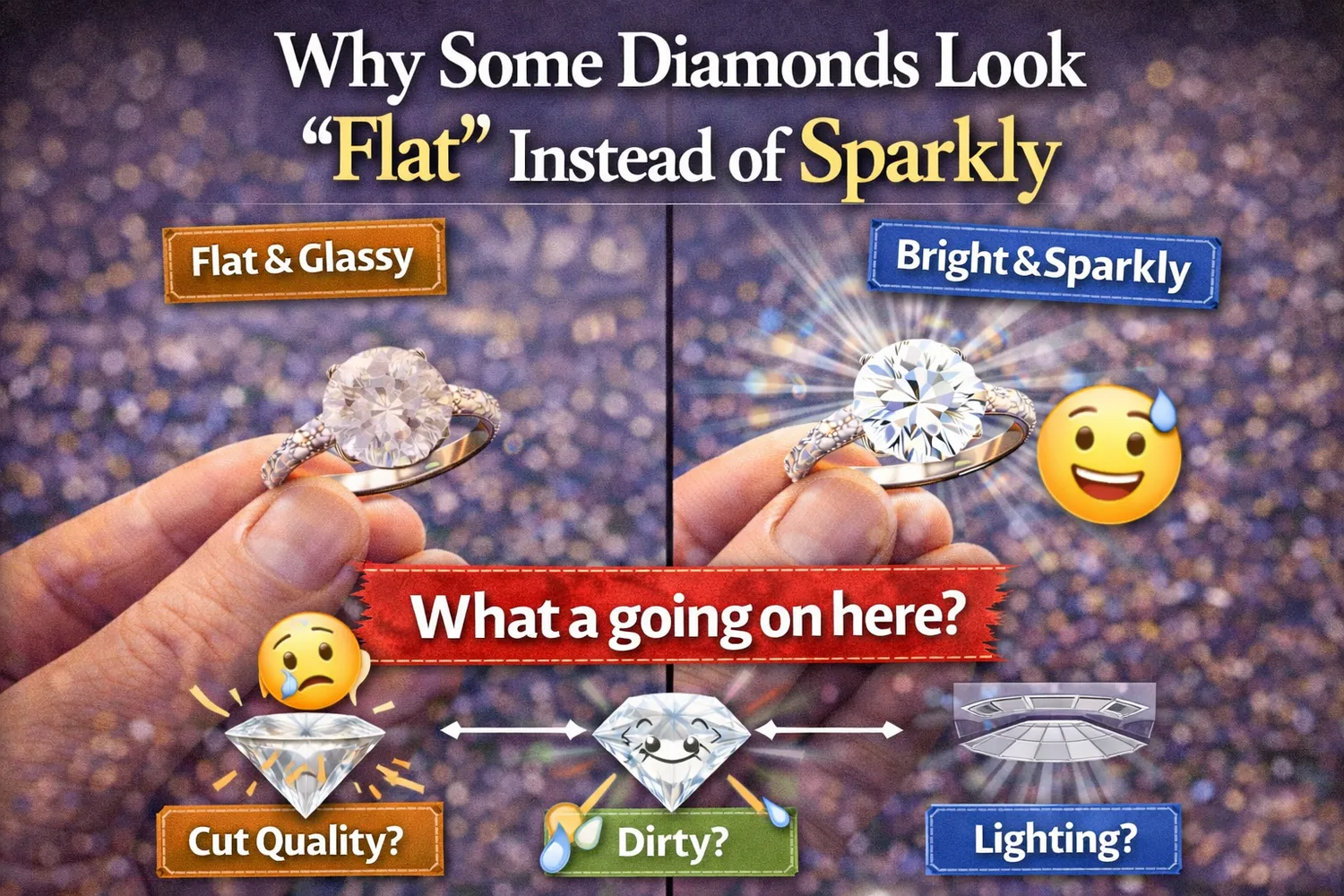
Some diamonds immediately catch your eye with bright flashes and lively sparkle. They look crisp, dynamic, and full of life even from a distance. Others, however — even with similar carat weight or impressive grades on paper — can appear flat, glassy, or lifeless.
This experience is more common than most buyers realize.
Many people assume that beauty comes from size, high color grades, or flawless clarity. When a diamond doesn’t sparkle the way they expected, they often believe something is wrong with the stone or that they chose the wrong specifications. In reality, sparkle has very little to do with carat weight or high grades alone.
A diamond’s visual performance depends on how it interacts with light. Sparkle comes from brightness, fire, and scintillation — and these effects are controlled primarily by cut quality, proportions, and light performance.
When light enters a diamond and returns efficiently to the eye, the stone looks lively and brilliant. When light escapes instead of reflecting back, the diamond loses contrast, sparkle, and visual life. The result is what many buyers describe as a “flat” appearance.
Understanding this is important because many flat-looking diamonds still have strong color and clarity grades. Without knowing what to look for, buyers may pay for rarity instead of visual performance.
The purpose of this guide is to explain why some diamonds lack life, what causes a flat or glassy appearance, and how to recognize and avoid this problem. Because true beauty isn’t about the numbers on a certificate — it’s about how the diamond performs in real light.
What a “Flat” Diamond Really Looks Like
A flat diamond doesn’t necessarily look dark or cloudy. Instead, it appears visually quiet or lifeless.
Common characteristics include:
- Glassy or watery appearance
- Even brightness without flashes of sparkle
- Minimal contrast between light and dark areas
- Weak fire or colored flashes
- Little change in appearance when the diamond moves
Instead of showing dynamic light performance, the diamond looks smooth and uniform — almost like a piece of glass rather than a precision-cut gemstone.
Sparkle comes from contrast and movement. When those elements are missing, the diamond appears flat even if it is clean and well-graded.
The Biggest Cause: Poor Cut Quality
Cut quality is the primary reason a diamond looks flat.
A well-cut diamond is designed to control how light enters, reflects inside the stone, and returns to the viewer’s eye. When proportions and angles are precise, most of the light exits through the top, creating brightness, fire, and scintillation.
When the cut is poor:
- Light escapes through the bottom or sides
- Internal reflections weaken
- Contrast patterns disappear
- Sparkle becomes minimal
This loss of light return is called light leakage, and it is the main reason a diamond appears lifeless.
Cut matters more than any other factor because:
- Color does not increase sparkle
- Clarity does not improve brightness
- Carat weight does not enhance light performance
A smaller well-cut diamond will often look far more impressive than a larger stone with poor proportions.
Light Leakage — The Hidden Reason for Flatness
Light leakage occurs when light enters the diamond but does not return to the viewer.
Instead, it escapes through the bottom or sides of the stone.
Visual signs of light leakage include:
- Washed-out areas
- Dark zones or shadowy regions
- Lack of contrast
- Weak sparkle even under bright lighting
Because sparkle depends on reflected light, any loss of internal reflection reduces visual life.
Many diamonds with average cut grades suffer from light leakage, which is why they may look good in the store but appear flat in everyday lighting.
When the Diamond Is Cut Too Deep
A diamond that is cut too deep has pavilion angles that are too steep.
This causes:
- Light to escape through the bottom
- A dark center, often called a “nail head” effect
- Reduced brightness
- Smaller face-up appearance
Deep diamonds hide weight where it cannot be seen, meaning you pay for carat without gaining visual size or sparkle.
When the Diamond Is Cut Too Shallow
A shallow cut creates the opposite problem.
When pavilion angles are too low:
- Light escapes through the sides
- Internal reflection is weak
- The diamond appears glassy or watery
- Fire and sparkle are reduced
Shallow diamonds may appear bright at first glance but lack the crisp, lively contrast that creates true brilliance.
Lack of Contrast Makes Diamonds Look Lifeless
Sparkle depends on the balance of light and dark reflections across the diamond’s surface.
This contrast creates:
- Sharp visual patterns
- Scintillation during movement
- A lively, dynamic appearance
Flat diamonds often show uniform brightness with very little contrast. Without this pattern, the stone appears smooth and static rather than energetic.
Lighting Conditions That Make Diamonds Look Flat
Lighting plays a major role in how sparkle appears.
Flat diamonds become more noticeable in:
- Soft indoor lighting
- Office environments
- Low evening light
- Diffused or indirect light
Poorly cut diamonds rely on strong spotlights to look lively. In normal lighting, their weak light performance becomes obvious.
Well-cut diamonds, on the other hand, maintain brightness across different environments.
Dirty Diamonds Often Look Flat
Even a well-cut diamond can appear lifeless if it is dirty.
Oil, lotion, and residue create a thin film that:
- Blocks light from entering
- Reduces internal reflection
- Causes a cloudy or hazy appearance
A simple cleaning test is helpful. If the diamond looks significantly brighter after cleaning, the issue was buildup rather than cut quality.
Color and Clarity Factors That Can Affect Appearance
While cut is the main factor, color and clarity can influence visual performance in certain cases.
Lower color grades may appear warmer or slightly dull in warm indoor lighting.
Large or dark inclusions can:
- Reduce transparency
- Block light paths
- Create visible dark spots
However, in most cases, near-colorless and eye-clean diamonds perform beautifully when the cut is strong.
Diamond Shape and Sparkle Style
Different shapes produce different types of sparkle.
Brilliant cuts (round, oval, cushion, radiant):
- Designed for maximum light return
- Strong sparkle and scintillation
Step cuts (emerald, Asscher):
- Large open facets
- Mirror-like flashes instead of intense sparkle
- More subtle appearance by design
Step-cut diamonds may appear flatter compared to brilliant cuts, even when well cut.
The Role of Proportions and Measurements
Beyond cut grade, specific proportions affect performance:
Ideal ranges for round diamonds:
- Depth: about 59–62.5%
- Table: about 54–58%
- Balanced crown and pavilion angles
Proper proportions ensure:
- Maximum light return
- Strong contrast
- Good face-up spread
Even small deviations can reduce sparkle.
Setting Design That Can Reduce Sparkle
Some settings limit light exposure.
Potential issues include:
- Closed-back designs blocking light
- Heavy metal around the stone
- Crowded halo or pavé settings trapping dirt
Open settings allow more light interaction and are easier to keep clean.
How to Tell If a Diamond Has Good Light Performance
When evaluating a diamond:
- Look for brightness across the entire surface
- Observe sparkle as the stone moves
- Check for dark or dull zones
- View the diamond in natural daylight
- Compare it with another diamond if possible
A high-performing diamond should look lively in multiple lighting conditions.
Why High Grades Don’t Guarantee Sparkle
A diamond can have:
- D color
- Flawless clarity
- Large carat weight
and still look dull if the cut is poor.
High grades increase rarity and price, but they do not improve light performance.
Paying for extreme color or clarity without prioritizing cut often leads to disappointment.
The Best Value Strategy to Avoid Flat Diamonds
For maximum beauty and value:
Priority order:
Cut → Color → Clarity → Carat
A strong value combination:
- Excellent / Ideal cut
- G–H color
- VS2–SI1 clarity
- Carat based on budget
This balance delivers strong visual performance without unnecessary cost.
When Flat Appearance Is Normal (Managing Expectations)
Even the best diamonds look more subtle in:
- Low lighting
- Diffused environments
- Evening conditions
Showroom lighting is designed to enhance sparkle. Real-life brilliance is more natural and understated.
Understanding this helps set realistic expectations.
Conclusion
Flat-looking diamonds are usually the result of cut quality, lighting conditions, or surface buildup — not a flaw in the stone itself.
True sparkle comes from strong light performance. When proportions are precise and light returns efficiently, a diamond appears bright, sharp, and full of life in everyday conditions.
High grades alone don’t guarantee beauty. The most impressive diamonds are those that balance cut precision with practical color and clarity ranges.
When buyers understand how light performance works, they stop choosing based only on specifications and start choosing based on real visual impact.
Because the most beautiful diamond isn’t the one with the highest grades — it’s the one that looks alive every time it catches the light.
FAQ
Why does my diamond look flat or glassy?
This is usually caused by poor cut proportions that allow light to escape instead of reflecting back, reducing sparkle and contrast.
Does cut affect sparkle the most?
Yes. Cut quality controls light return, making it the most important factor for brightness and overall visual performance.
Can a diamond be high quality but still look dull?
Yes. A diamond with high color and clarity grades can still appear lifeless if the cut quality is poor.
How can I tell if a diamond has light leakage?
Look for dark or washed-out areas, weak sparkle, and dull appearance in normal lighting conditions.
What cut proportions give the best sparkle?
For round diamonds, depth around 59–62.5% and table around 54–58% typically provide strong light performance.