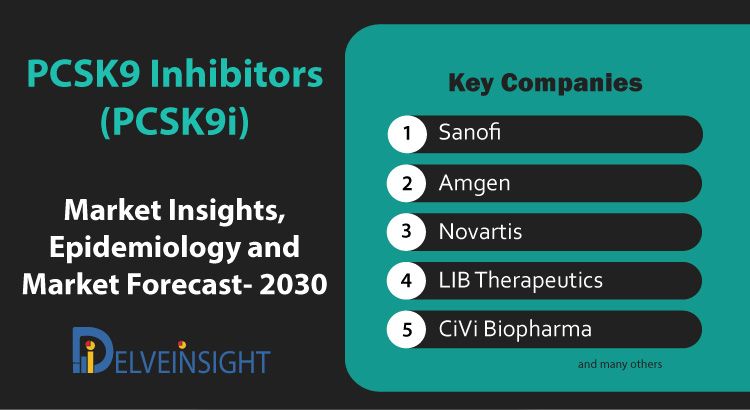
DelveInsight’s ‘PCSK9 Inhibitors (PCSK9i) Market report” delivers an in-depth understanding of PCSK9i, historical and forecasted epidemiology as well as the PCSK9 Inhibitors market trends in the United States, EU5 (Germany, France, Italy, Spain, and the United Kingdom), and Japan.
PCSK9 Inhibitors Overview
Proprotein convertase subtilisin/Kexin type 9 serine protease (PCSK9) plays a vital role in cholesterol metabolism by regulating low-density lipoprotein (LDL) receptor degradation, which reduces the clearance of circulating LDL particles. PCSK9 activity is inversely related to LDL cholesterol (LDL-C) level: Gain-of-function PCSK9 gene mutations are one cause of elevated LDL-C and cardiovascular risk in familial hypercholesterolemia (FH), whereas loss-of-function mutations cause low LDL-C and reduced risk of atherosclerotic cardiovascular disease (ASCVD).
Country Wise- PCSK9 Inhibitors Epidemiology
- In the United States, the total number of prevalent cases of Familial Hypercholesterolemia was 1.5 million cases in the year 2020 which are expected to grow during the study period, i.e., 2018–2030.
- In the year 2020, the total prevalent cases of Familial Hypercholesterolemia were 1.3 million cases in EU-5 which are expected to grow during the study period, i.e., 2018–2030.
- In Japan, the total number of prevalent cases of Familial Hypercholesterolemia was 0.4 million cases in the year 2020 which are expected to grow during the study period, i.e., 2018–2030.
PCSK9 Inhibitors Market Outlook
Understanding the role of PCSK9 in cholesterol metabolism suggested that inhibiting its actions might lower LDL-C levels therapeutically. Monoclonal antibodies directed at PCSK9 are the first to be approved. Currently, there are two PCSK9 inhibitors available in the United States: alirocumab and evolocumab, approved by the FDA for adult patients to reduce the risk of myocardial infarction, stroke, and unstable angina requiring hospitalization in adults with established cardiovascular disease as an adjunct to diet, alone or in combination with other lipid-lowering therapies, for the treatment of adults with primary hyperlipidemia (including HeFH) to reduce LDL-cholesterol. Evolocumab is also approved as an adjunct to diet and other LDL-lowering therapies in patients with HoFH who require additional lowering of LDL-C.
For more information on PCSK9 Inhibitors Market @ https://www.delveinsight.com/report-store/pcsk9-inhibitors-psck9i-market
The product was launched in the US at a list price of around USD 14,000 per patient per year—a considerable premium on the costs of primarily genericized statins. This disparity was highlighted in cost-benefit analyses by health-technology assessment bodies such as the Institute for Clinical and Economic Review (ICER) in the US, which concluded that the PCSK9 inhibitors were significantly overpriced even in the light of the FOURIER and ODYSSEY outcomes data. In October 2018, Amgen announced that it was cutting the US list price of Repatha by 60% to USD 5,850 per year. Sanofi and Regeneron struck an agreement with Express Scripts in May 2018 to lower the net price of Praluent within the range USD 4,460 to USD 7,975 per year. Later, in February 2019, Sanofi and Regeneron went further and cut the US list price of Praluent by 60% to USD 5,850 per year.
The PCSK9 Inhibitors market size in the 7MM is expected to change during the study period 2018–2030. The therapeutic market of PCSK9 Inhibitors in the seven major markets is expected to increase during the study period (2018–2030) with a CAGR of 16.5%. According to the estimates, the highest market size of PCSK9 Inhibitors is found in the United States followed by Japan.
Request PCSK9 Inhibitors Market sample pages @ https://www.delveinsight.com/sample-request/pcsk9-inhibitors-psck9i-market