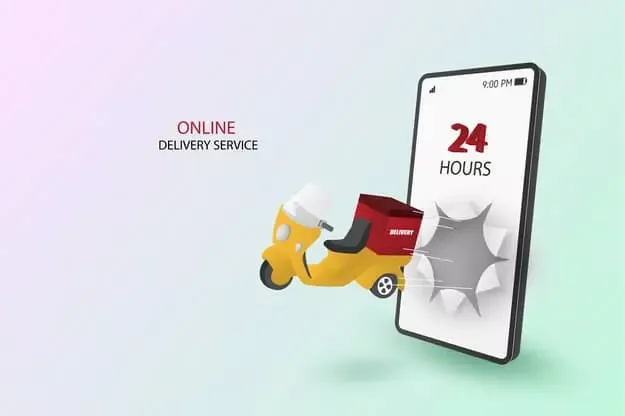
New tech, such as mobile technology, cellphones, the internet, and app-based platforms, analytics, and so on, is driving this trend.
The twenty-first century brought about a number of major changes in the way the world does business.
We now live in the age of the gig economy, rapid gratification for consumers, cutting-edge data analytics, and dramatically enhanced distribution and logistics.
These factors have signaled a paradigm shift in customer expectations about delivery speed, affordability, and convenience, ushering in an "on-demand economy."
Consumers now understand that they can receive what they want, at the price they want, and at the location of their choice!
Current firms must now use all available modern technology and resources to offer their products "on-demand" to their consumers — regardless of price, location, or convenience. And this is an important reason to provide suitable on-demand delivery software to keep customers satisfied.
It is no longer a "nice-to-have" element for businesses; rather, it is a "must-have." If you do not provide On-Demand delivery to your customers, your competition will. If we want to provide an example of an on-demand delivery company, DHL is an example.
What Is On-Demand Delivery?
An On-Demand delivery system is a process in which businesses use modern mechanization, applications, digital sites, data analytics, mobile technology, and modern hardware to provide their goods to the market and customers in the smallest period of time and with a variety of convenient options as requested by their customers.
Companies providing On-demand delivery service
If we want to name a number of companies providing On-demand Delivery service, we can mention the following:
As you can see, the leading On-demand Delivery companies in the world use On-demand Delivery Management software, so if you want to have a successful on-demand delivery business, think about ordering a comprehensive on-demand delivery platform, this platform is a great help for you.
5 Key Advantages of On-Demand Delivery

Larger addressable markets
Because of its depth and complexity of reach, On-Demand delivery allows companies to serve enormous audiences over borders that would not have been conceivable previously owing to traditional channel and transportation limits.
Deep consumer insight
Because of current processes, An On-Demand delivery system assists enterprises in better understanding customers and using this information to forecast need patterns and be best prepared to meet such demand. This also enables for a higher SoW (share-of-wallet) via cross-selling, up-selling, and AMCs (etc.).
Manage Last-Mile Delivery
Smart businesses leverage contemporary distribution and logistics to provide clients with "customized" 24*7 delivery alternatives that fit perfectly into their demanding schedules.
This fosters a strong client relationship and encourages loyalty and repeat business.
Efficient automation
Firms may now automate and control their whole order and fulfillment cycle with previously inconceivable levels of efficiency because of greatly better hardware, MIS, on-demand delivery application, transportation, statistical information, on-demand cloud services, etc.
This results in shorter order cycles, allowing enterprises to enter and manage new markets more quickly.
Reduced operating costs
On-demand delivery software eliminates the need for investments in operational expenditures, physical warehouses, and storefronts while making the greatest use of existing human resources, internet, and App-led platforms. This, in turn, results in better pricing for the firm's consumers and keeps them competitive.
Innovators like Google, Amazon, and Uber are driving the shift in customer expectations. Companies must match the service standards promised by these industry pioneers in order to retain clients in the On-Demand era.
The Most Important Factors in Providing a Great On-Demand Delivery
Convenient Scheduling and Accurate Delivery Quotes
You require simple, precise delivery or pickup choices at the checkout. This includes where and when the delivery or pickup occurs. It's not easy to ensure that these timeframes are correct — you need to know everything from where your inventory is to fleet availability. Is there available curbside parking at that time?
You need data on everything in the last mile, as well as automation to give users with rapid quotations. Of course, you must first verify that you have such easy delivery timings (e.g., short delivery windows, same-day delivery) and convenient fulfillment choices (curbside, click and collect, same-day delivery) in place.
Coordinated, Flexible Delivery and Fulfillment Management
To have the half-hour or two-hour transportation and shorter delivery options that will earn you loyal fans, you'll require digitally empowered, connected, and ideally organized delivery and satisfaction flows from beginning to end – from taking information to assigning orders to drivers and finally, to the customer's location.
To do this in a cost-effective manner, visibility throughout the full last-mile flow is required for all fulfillment models. That way, you'll be able to figure out how to effectively use your existing resources to fill these on-demand requests.
To have the half-hour or two-hour transportation and shorter delivery options that will earn you loyal fans, you'll require digitally empowered, connected, and ideally organized delivery and satisfaction flows from beginning to end – from taking information to assigning orders to drivers and finally, to the customer's location.
To do this in a cost-effective manner, visibility throughout the full last-mile flow is required for all delivery approaches. That way, you'll be able to figure out how to effectively use your current resources to fill these on-demand requests. This is particularly noticeable if you collaborate with a number of aggregators or delivery companies.
Many organizations still operate using antiquated technologies that are ineffective in sending data in real-time. Even more, organizations lack visibility into data from third-party logistics suppliers, couriers, and crowdsourced fleets, much alone a centralized location to store and manage such data. Begin by identifying a system that can track data from distribution partners, permitting you to maintain constant visibility and control over your transportation stream. When you use an on-demand delivery platform, you can solve many delivery management challenges and send your data in real-time.
Conclusion
Always keep in mind that the purpose of On-Demand Delivery is customer satisfaction. Building consumer loyalty comes from such offerings in an age of significant commoditization across categories. As a result, utilizing the right fulfillment tactics allows businesses to establish client loyalty. If you have an on-demand delivery business, try to provide your on-demand delivery management software as soon as possible.