In the digital age of medicine, healthcare datasets solutions are at the heart of innovation, research, and personalized care. These data-driven tools have transformed how healthcare organizations operate, make decisions, and deliver services. From diagnosis and treatment planning to public health policy and insurance management, datasets are reshaping the landscape of global health.
What Are Healthcare Datasets Solutions?
Healthcare datasets solutions refer to structured systems and platforms that collect, store, manage, and analyze health-related data. These solutions encompass everything from cloud-based data repositories to artificial intelligence (AI)-powered analytics tools that extract insights from complex datasets.
Healthcare datasets come in various forms:
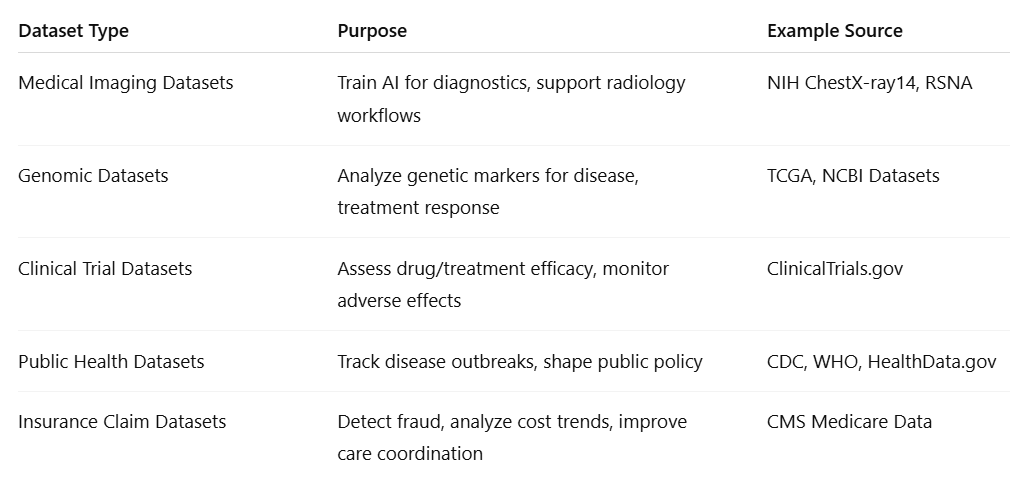
- Medical Imaging Datasets: Radiological images (X-ray, MRI, CT scans) used in diagnostics.
- Genomic Datasets: DNA sequence data is critical for research in personalized medicine.
- Clinical Trial Datasets: Data from controlled medical studies assessing the safety and efficacy of treatments.
- Public Health Datasets: Population-level health metrics, epidemiological studies, and disease surveillance.
- Insurance Claim Datasets: Billing, utilization, and reimbursement records that provide insight into healthcare economics.
Types of Healthcare Datasets: A Comparative Overview
Why Healthcare Datasets Matter
Healthcare datasets solutions are vital to modern medicine for several key reasons:
1. Improved Patient Outcomes
Advanced datasets enable predictive analytics and early intervention. For example, AI tools trained on medical imaging datasets can identify lung cancer nodules with over 90% accuracy.
2. Precision Medicine
With access to genomic datasets, researchers can develop personalized therapies based on a patient’s DNA, leading to better responses and fewer side effects.
3. Faster Clinical Research
Clinical trial datasets reduce redundancy in research, allowing scientists to replicate or build on past findings rather than starting from scratch.
4. Efficient Healthcare Operations
By leveraging insurance claim datasets, providers can uncover inefficiencies in billing and improve care delivery by aligning treatments with cost-effective practices.
5. Public Health Surveillance
Public health datasets are essential for identifying emerging health threats and tracking the impact of interventions at a national or global level.
Real-World Applications of Healthcare Datasets Solutions
Case Study 1: Cancer Genomics Using the TCGA Dataset
The TCGA dataset (The Cancer Genome Atlas) includes genomic data from over 11,000 cancer patients. Researchers have used this dataset to identify biomarkers and mutations that guide the development of immunotherapies, transforming the treatment of melanoma and lung cancer.
Case Study 2: AI Diagnostics with Medical Imaging
Stanford researchers developed an AI model trained on 100,000 chest X-rays from public medical imaging datasets to detect pneumonia. The model performed on par with expert radiologists, reducing diagnostic delays in emergency departments.
Case Study 3: COVID-19 Tracking with Public Health Datasets
During the COVID-19 pandemic, platforms like Johns Hopkins University and the CDC used public health datasets to monitor cases, hospitalizations, and vaccine distribution. This real-time information guided public health responses worldwide.
Case Study 4: Cost Optimization Using Insurance Claim Dataset
Blue Cross Blue Shield analyzed millions of records in its insurance claim dataset to identify high-cost procedures and implement value-based care models, saving over $200 million annually.
Technologies Powering Healthcare Dataset Solutions
Healthcare data solutions often integrate a wide range of technologies:
- AI & Machine Learning: Automate diagnosis and treatment recommendations.
- Big Data Platforms: Handle large, complex datasets from multiple sources.
- Cloud Storage: Enable scalable, secure storage and sharing of sensitive data.
- Data Visualization Tools: Transform raw data into actionable insights.
- Blockchain: Ensure data integrity and enhance transparency.
Notably, repositories such as NCBI Datasets provide open access to genomic and clinical data for researchers, enhancing collaboration and accelerating discovery.
Challenges in Managing Healthcare Datasets
Despite the benefits, healthcare datasets also pose several challenges:
- Data Privacy & Security: Sensitive health data must comply with regulations like HIPAA and GDPR.
- Interoperability Issues: Diverse formats and systems can make integration difficult.
- Data Quality: Incomplete or inaccurate data can lead to flawed insights.
- Ethical Concerns: Use of genetic and clinical data must be transparent and consent-driven.
To overcome these issues, healthcare organizations must implement robust governance policies and invest in secure, standardized platforms.
The Future of Healthcare Datasets
The future of healthcare will be increasingly data-driven. With advances in genomics, AI, and wearable technology, the volume and variety of healthcare data are growing exponentially. Solutions that can unify and analyze medical imaging datasets, genomic datasets, clinical trial datasets, public health datasets, and insurance claim datasets will drive smarter decisions and better outcomes.
As more healthcare providers adopt electronic health records (EHRs) and integrate patient-generated data, the need for centralized and interoperable dataset solutions will only intensify.
Conclusion
Healthcare datasets solutions are revolutionizing how medical professionals diagnose, treat, and prevent diseases. By leveraging tools like NCBI Datasets, the TCGA dataset, and other public and private data sources, the industry is moving toward a future where every decision is backed by data.
For stakeholders across healthcare, from hospitals and pharmaceutical companies to startups and government agencies, investing in healthcare data infrastructure is no longer optional—it’s essential.
Data is the new stethoscope—and healthcare datasets are the heartbeat of innovation.