AI projects waste budget when teams buy tools before agreeing on the business decision, the required data, the accountable owner, and the acceptable risk. The 2026 Stanford AI Index reports that 88% of surveyed organizations used AI in 2025, while 70% used generative AI in at least 1 business function. AI agent deployment remained in the single digits across nearly all business functions, which shows how far most organizations still are from dependable operational use.
That gap creates a familiar pattern. A pilot produces an impressive demo, then stalls because customer records conflict, access rules are unclear, or nobody can define the outcome that should improve. You pay for rework, delay the business case, and increase the chance that staff will use unapproved tools outside the controls you intended to establish.
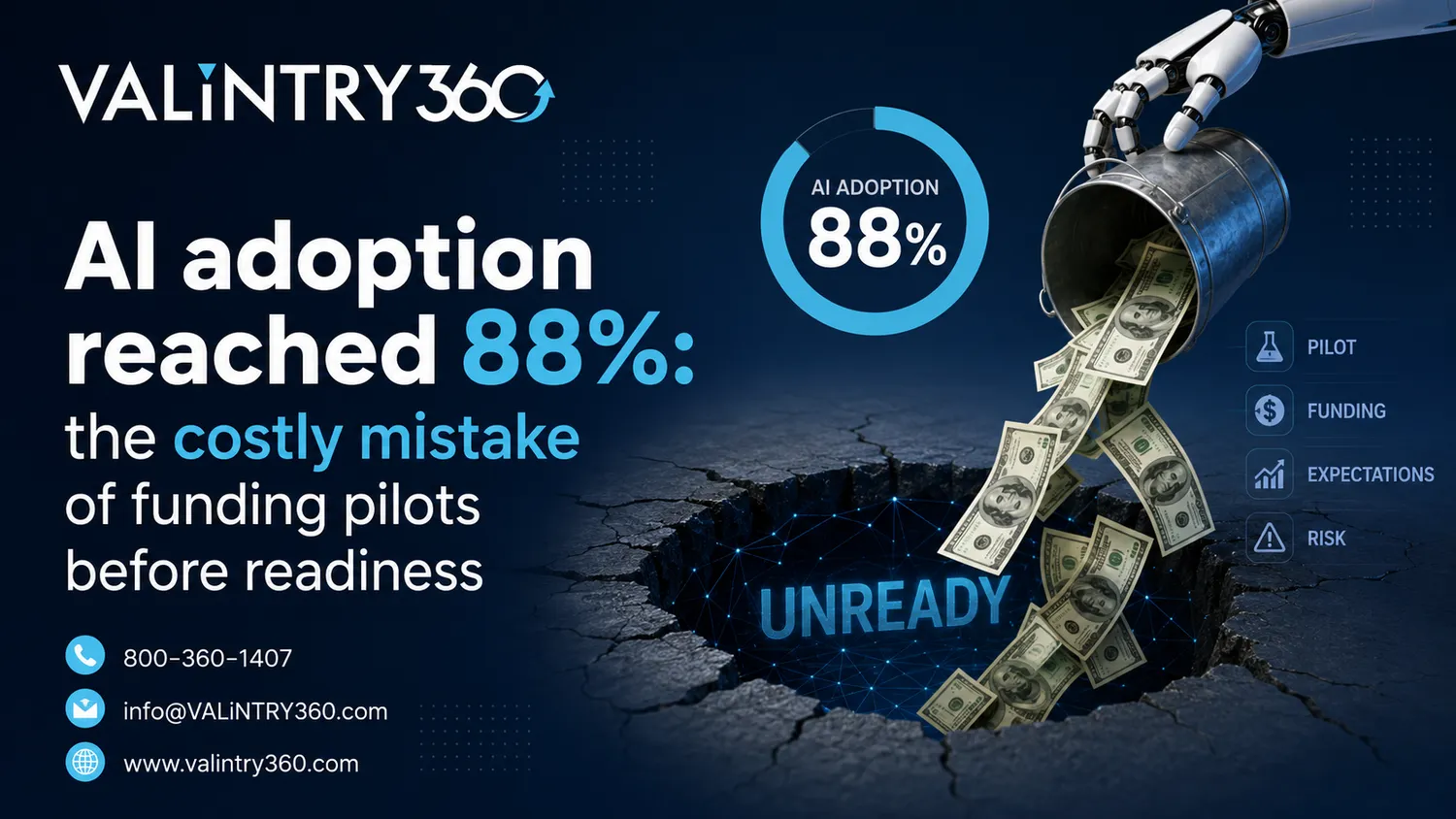
AI readiness starts with a defined business decision
AI readiness means your organization can select, build, test, govern, and measure an AI use case under real operating conditions. The assessment should begin with a decision or workflow, rather than a model. Ask what must change, who owns the result, what evidence the system needs, and what happens when the output is wrong.
A practical AI Readiness review connects that business question to data quality, system access, governance, and delivery capacity. It should produce a clear finding on what can move forward now and what must be fixed first. Without that finding, every pilot starts by rediscovering the same gaps.
Limited adoption often signals weak operating foundations
Current adoption data show why readiness work must examine the whole operating system. A 2026 U.S. Census Bureau study found that 18% of firms used AI in a business function during the November 2025 to January 2026 reference period, rising to 32% when weighted by employment. Among firms already using AI, 57% had introduced it into 3 or fewer business functions.
Those figures suggest that adoption breadth and operational depth are separate questions. A company may have licenses, experiments, and active users while still lacking dependable data flows or agreed review steps. Treat tool access as evidence of interest. Treat repeated, measured use under defined controls as evidence of readiness.
Choose 1 workflow with a measurable baseline
Choose a use case with visible work, known inputs, and a result you can measure before AI changes the process. Customer case classification, sales record cleanup, or service-response drafting may qualify when the organization already tracks time, error rates, or rework. Avoid starting with a broad goal such as “improve productivity,” because the team won't know which behavior created the result.
The first output from AI Readiness Services should be a use-case brief that states the current baseline, target result, data sources, review owner, and stop conditions. Set an evaluation period long enough to capture normal variation in the workflow. A good pilot answers a decision question, rather than proving that a model can produce an output.
Build governance into the delivery method
Governance works best when it shapes design choices before testing begins. The NIST AI Risk Management Framework organizes AI risk work around 4 functions: govern, map, measure, and manage. NIST developed the framework over 18 months with input from more than 240 organizations, which gives teams a tested structure for assigning responsibility and reviewing risk throughout the system life cycle.
Apply that structure to each use case. Record the intended users, affected people, data permissions, human review points, failure modes, and escalation path. When a use case depends on fresh information from Salesforce and connected systems, real-time data access services can support the controlled movement of current data, but access speed shouldn't outrun ownership or quality checks.
Compliance dates should change design decisions now
Regulatory exposure can turn a technically successful pilot into a blocked deployment. The EU AI Act entered into force on August 1, 2024, with prohibited-practice and AI-literacy duties applying from February 2, 2025. General-purpose AI obligations began on August 2, 2025, while broad application is scheduled for August 2, 2026, subject to stated exceptions and later dates for some high-risk systems. The European Commission's AI Act timeline gives organizations a current basis for checking which obligations may affect their use cases.
You don't need to wait for a legal review at the end of the project. Classify the use case early, document the intended purpose, and identify what records must be retained. When the system uses customer or employee data, privacy, access, and human oversight decisions belong in the design record from the start.
Readiness scores must lead to funded actions
A score has little value unless it changes sequencing and ownership. Rate each use case across business value, data condition, process stability, technical fit, risk controls, and measurement capacity. Use the result to place the work into 1 of 3 practical states: ready for controlled testing, ready after named fixes, or unsuitable under current conditions.
The action plan should name the owner, due date, evidence required, and effect of delay for every gap. Teams considering Salesforce AI solutions should also confirm that CRM records, identity rules, integrations, and operating procedures can support the intended behavior. Review progress through closed data issues, completed controls, user acceptance results, and measured changes against the original baseline.
Readiness should decide what you build next
Begin with 1 business decision, test the operating conditions around it, and fund the gaps that block safe use. Move to a pilot only when the data, ownership, controls, and measurement plan are clear. This approach gives leaders a defensible reason to proceed, delay, or stop before another experiment consumes budget without changing the business.
Frequently asked questions
What does an AI readiness assessment cover?
An assessment checks whether a defined AI use case has a sound business case, usable data, clear ownership, suitable controls, and a way to measure results. It should also examine system access, integration needs, user adoption, and the consequences of wrong outputs. The final finding should state what can proceed and what needs repair.
How long should readiness work take?
The timing depends on the number of systems, use cases, and control requirements involved. A focused assessment for 1 workflow can move faster than an enterprise review covering several business units. Set the scope around a decision, then extend the work only when the evidence shows a wider dependency.
Is clean data enough to make a company AI-ready?
Clean data solves only part of the problem. The organization still needs defined ownership, approved access, stable processes, review rules, and outcome measures. A technically accurate dataset can still support a poor use case when the business decision is vague.
What is the clearest warning sign of poor readiness?
The clearest warning sign is a pilot with no baseline and no named owner for the business result. Teams may report output quality or user enthusiasm, but they can't show whether cost, time, risk, or service performance changed. That makes funding decisions depend on opinion.
How should leaders choose the first AI use case?
Choose work that happens often enough to measure and has a documented current process. The inputs should be accessible, while the result should matter to a business owner who can approve changes. Avoid use cases where failure could create serious harm before controls have been tested.
When should an AI pilot be stopped?
Stop when required data can't be used lawfully, the output can't be reviewed at a reasonable cost, or the use case fails to improve the agreed baseline. A stop decision protects budget and creates evidence for choosing a better use case. Document the reason so the next team doesn't repeat the same test.
For more info Contact us 800-360-1407 or send mail at info@VALiNTRY360.comto get a quote