Cyber Security Training in Kochi: Skills You Need in 2026
I am Sudheera Adusupalli. I co-founded Varnik Technologies with my husband Naveen, and between the two of us, we have spent the better part of the last decade watching the Indian IT training industry promise transformation while delivering slideshow presentations. We run programs across Hyderabad, Kochi, Lucknow, Mumbai, and Chandigarh. I am not going to tell you Kochi is special in some generic way. What I will tell you is that the Kochi market in 2026 has a very specific skills gap, and most training providers in the city are not addressing it because addressing it honestly is harder to sell.
So let me be direct about what that gap actually looks like.
The Infopark and SmartCity Problem
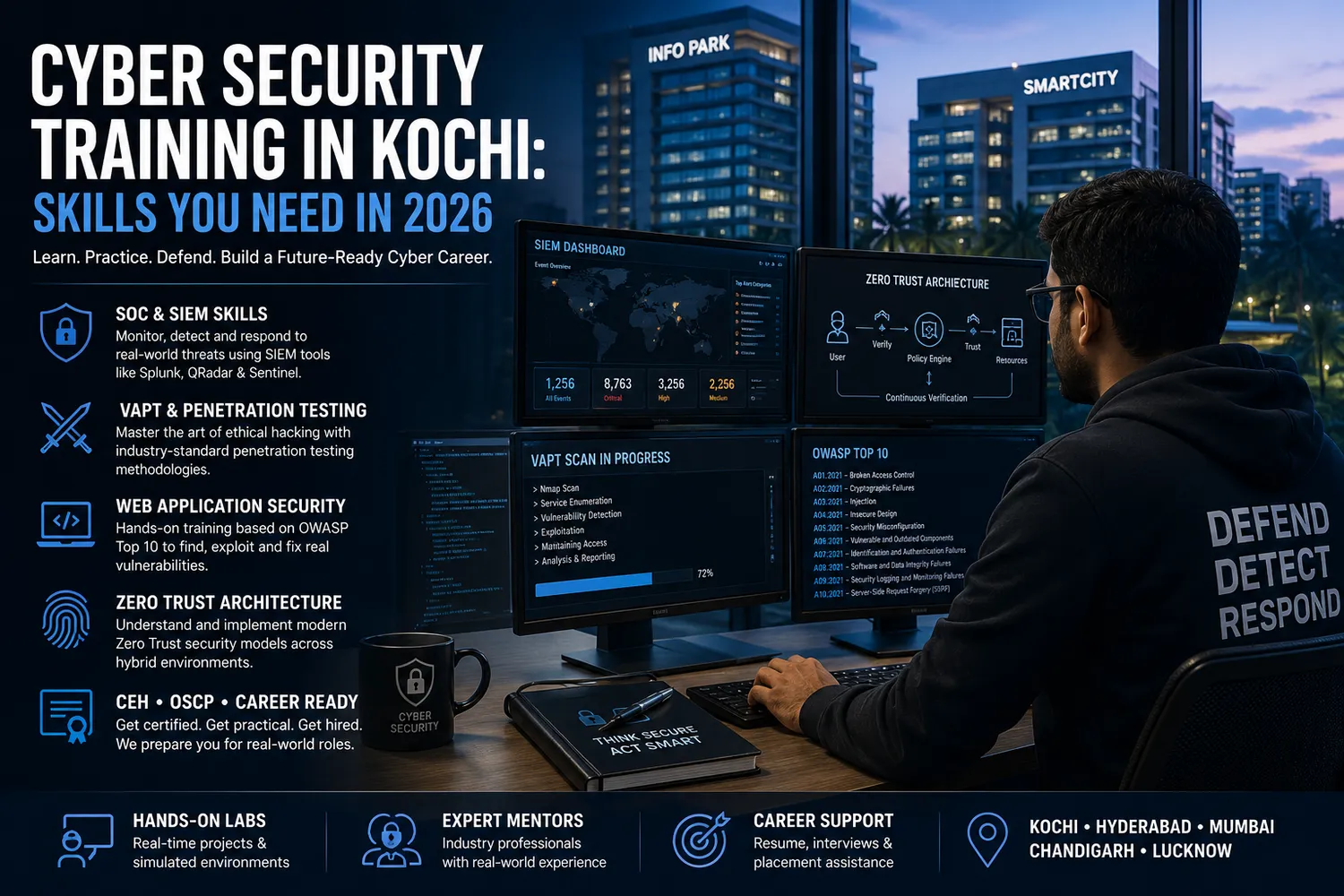
Kochi has two significant tech clusters in Infopark and SmartCity, and both have seen a rapid expansion of fintech operations, healthcare data platforms, and government digital infrastructure projects over the past two years. The hiring happening inside these corridors is not for generic network administrators. It is for SOC analysts who can configure SIEM tools for financial data environments and know how to interpret event logs during an active intrusion attempt.
A Security Operations Centre analyst sitting inside a fintech company is not reading textbooks. They are watching dashboards, triaging alerts, correlating events across multiple data sources, and deciding within minutes whether a spike in outbound traffic is a misconfigured integration or an exfiltration attempt. SIEM tools are the primary instrument for that work. IBM QRadar, Splunk, Microsoft Sentinel: these are what employers inside those campuses are testing candidates on.
When I look at what most Kochi cyber security courses are spending the majority of their classroom hours on, it is not this. It is conceptual cryptography, broad overview modules on network security, and certification prep decks that were last updated in 2022.
VAPT Is Where the Actual Employment Demand Lives
VAPT, which stands for Vulnerability Assessment and Penetration Testing, is the service that Indian enterprises, banks, and government agencies actually procure. It is in every BFSI security tender I have seen. It is what IT departments list in their vendor requirements. And yet courses consistently treat it as an advanced module tacked on at the end, after the student has already spent eight weeks on theory.
The reason matters. VAPT is harder to teach well. A proper penetration testing methodology requires students to work through structured phases: reconnaissance, scanning and enumeration, exploitation, post-exploitation analysis, and reporting. That last part, the written report, is something almost no training program prepares students for, and it is what clients actually pay for. Any consultant can run a scan. Not everyone can write findings that a CTO and a legal team can both read and act on.
There is a genuine difference between a student who has run Nmap commands on a lab machine and a student who has completed a structured VAPT engagement from brief to deliverable. Employers inside Infopark know the difference within the first fifteen minutes of an interview.
The CEH vs OSCP Question Nobody Answers Honestly
Candidates in Kochi ask me about certifications constantly. The specific question that comes up most is whether to go for CEH or OSCP.
Here is my honest take after years of watching both types of candidates enter the job market. CEH (Certified Ethical Hacker) is a knowledge certification. It tests whether you understand concepts. OSCP (Offensive Security Certified Professional) is a performance certification. It tests whether you can actually do the work under pressure. The OSCP exam is a 24-hour hands-on penetration test. You either complete the objectives or you do not.
For someone targeting a corporate SOC analyst role inside a mid-size Kochi IT company, CEH is a reasonable entry credential. For someone who wants to work in red teaming, serious VAPT consulting, or build a career that does not get automated away within five years, OSCP is worth the difficulty. The problem is that OSCP requires real hands-on preparation that most local coaching programs cannot actually provide, because building that environment and guiding students through it requires instructors who have done the work themselves.
I am not claiming we have solved this perfectly at Varnik. What I will say is that the decision to structure our Cyber Security Training in Kochi with a heavy bias toward practical lab time, SIEM tool configuration exercises, and VAPT walkthroughs rather than theory decks came directly from feedback loops with the employers actually doing the hiring. That feedback has been consistent since 2023: they want candidates who have touched the tools, not just heard about them.
Zero Trust Architecture Is Not Optional Knowledge Anymore
Post 2022, a significant portion of Indian enterprise IT infrastructure began transitioning toward zero trust architecture. The concept is not complicated: never trust, always verify, regardless of whether a device or user is inside or outside the network perimeter. What is complicated is implementing it across legacy systems, hybrid cloud environments, and teams where half the employees are still using VPNs from 2018 that were never properly configured.
A cyber security professional who understands zero trust is not just more hireable. They are speaking the language that CIOs are currently using in every infrastructure conversation. When a Kochi company that processes financial data is reviewing a candidate, the question is not whether that person knows what a firewall is. The question is whether they understand identity-based access controls, micro-segmentation, and the policy frameworks that make zero trust functional rather than just decorative.
This is the knowledge layer that sits above tool familiarity. Tool skills get you through screening. Architecture understanding gets you into the room where actual decisions are made.
The OWASP Problem in Web Application Security
Most people working in application security in India know the OWASP Top 10 exists. Fewer have actually worked through what the vulnerabilities mean in practice and how they manifest in real codebases. The OWASP Top 10 is the foundational reference framework for web application security, updated to reflect the current threat landscape, and it is what senior security professionals use as a baseline checklist when beginning any web application audit.
The current list includes injection attacks, broken authentication, security misconfigurations, and server-side request forgery among its top categories. Each of these has standard exploitation patterns and, more importantly, standard remediation approaches. A candidate who can walk through a security misconfiguration finding, explain why it exists, and demonstrate how it would be fixed is demonstrating practical VAPT skill. A candidate who can only name the vulnerability categories is demonstrating that they read the documentation.
In training, the difference between these two comes down to whether students are spending time on configured lab environments with real application vulnerabilities to find and fix, or watching someone demonstrate attacks on a projector screen.
What I Would Actually Tell Someone Starting in Kochi Today
If I were advising someone fresh out of a Kochi engineering college about how to approach a cyber security career in 2026, I would tell them three things.
First: pick a specific role before you pick a course. SOC analyst, penetration tester, application security engineer, and security architect are genuinely different jobs with different day-to-day realities. The training you need for each is meaningfully different, and pretending otherwise wastes six months.
Second: the city you are in matters for your first job, but not for your skills. Build skills that are transferable. Zero trust architecture, SIEM tool expertise, and structured penetration testing methodology are not Kochi skills or Hyderabad skills. They are skills that travel.
Third: ask your training provider to show you, specifically, what you will be able to do at the end of the program. Not what certificate you will hold. What you will be able to do. If they cannot answer that question clearly, walk out.
The market in Kochi is not short of cyber security training options. It is short of training that respects the intelligence of the people paying for it.
One question I am genuinely curious about from people working in security in Kerala: are local employers actually testing for SIEM proficiency in interviews, or is the hiring still largely credential-driven? I see both patterns in different pockets of the market and would like to understand what the ground reality looks like for candidates right now.