Customer support is all about helping customers solve specific problems with your products or services. It's that team you contact when an order is incorrect, logging in fails, or a feature breaks. Think of it as a safety net, catching issues once they've appeared.
Let’s be honest, when something goes wrong, you want it fixed immediately. That's precisely what support teams do.
- Customer support focuses on direct problem-solving using tickets, live chat, phone calls, and emails, often with human or AI intervention.
- Its main functions include troubleshooting issues, processing refunds, helping with account recovery, and providing technical assistance.
- To put it simply, customer support is the "fix-it" department, and its effectiveness is measured by speed and resolution rates. It's tactical, tangible, and often the first thing people think of when they hear "customer service."
What Exactly Is Customer Experience?
Customer experience (CX) refers to a customer's overall impression of every interaction they have with your brand, from their initial exposure to an advertisement to post-purchase follow-ups. It's proactive, emotional, and focused on the long haul. While support is a single transaction, the entire customer relationship defines their experience.
Consider it like this: support is a single scene in a movie, but CX is the entire film. Even a great scene can't salvage a bad plot.
- Customer experience encompasses more than just support; it also includes product usability, the checkout process, onboarding, and even website load speed.
- A robust customer experience strategy maps out every touchpoint to ensure consistency and satisfaction, not just problem resolution.
- To define customer experience: it's the collection of all emotions and impressions your brand leaves behind. It’s how customers feel about you, not just what they receive from you.
Customer Support vs. Customer Experience: Key Differences
The main difference between customer support and customer experience boils down to their scope and timing. Support is reactive, addressing immediate problems, while experience is proactive, preventing issues and shaping how customers perceive your brand overall. One is a moment, the other is a lasting memory.
It's not a competition; it's a relationship.
- Support concentrates on individual interactions, whereas CX focuses on the entire customer lifecycle.
- Support is often driven by cost, aiming for lower expenses per ticket, while CX is driven by value, striving for a higher customer lifetime value.
- The debate between customer service and customer experience misses the point: they aren't rivals. Support is a crucial element of CX. You can't have a great experience without reliable support, but excellent support alone won't compensate for a poor product.
How Customer Support Bolsters the Broader Experience
Every support interaction is a mini-experience. If you view customer support solely as a series of isolated fixes, you're missing how each fix either builds or erodes trust. Fast, empathetic support directly enhances CX by transforming potential churn points into moments of loyalty.
A cold, automated "Your ticket has been resolved" email? That's a missed opportunity. A quick, human "Hey, we fixed it and here’s a tip to avoid it next time"? Now that's a loyalty builder!
- A resolved ticket delivered with a personal touch creates a much better perception than a silent fix.
- Support teams that escalate issues to product development teams actively help improve CX for everyone.
- When customers know they can rely on support, they feel more comfortable making future purchases; this establishes a crucial trust bridge between support and experience.
Why Your Customer Experience Strategy Needs Robust Support
A customer experience strategy is only as strong as its weakest touchpoint, and support often becomes the most visible aspect when things go wrong. If your support culture is slow, overly rigid, or simply absent, even the most seamless site design won't salvage your CX scores.
You might have the most stunning website in the world, but if a customer can't get a simple question answered, they'll remember the frustration, not the beautiful design.
- About 90% of customers emphasize the importance of an immediate response when contacting customer service.
- A comprehensive strategy must include service level agreements (SLAs), omnichannel coverage, and clear escalation paths.
- Reliable customer support actively prevents "silent churn," where customers leave without voicing their complaints.
Defining Customer Support in Today's Multichannel World
Defining customer support today means recognizing that interactions happen everywhere: live chat, email, social media DMs, WhatsApp, and even Telegram. Modern customer support functions must seamlessly integrate these channels, creating a unified thread so nothing gets overlooked.
Here's the deal: customers don't care about your internal struggles. They just want their problem solved, whether they emailed you or slid into your DMs.
- A fragmented inbox often leads to a fragmented customer experience; customers particularly dislike having to repeat themselves.
- Multichannel support isn't just about being present on various platforms; it's about maintaining consistency across all of them.
- Tools like a shared team inbox consolidate scattered messages into a single, cohesive conversation history.
SUPPLO is not affiliated with any app or website. Please adhere to each app’s terms and local regulations.
The Hidden Costs of Separating Support from the Overall Experience
Companies that view support as merely a cost center and CX as just a marketing slogan risk creating a dangerous disconnect. Customers might get their problems fixed but never feel truly valued. The distinction between customer support and customer experience then becomes a source of eroded trust. You can fix the bug all you want, but if the interaction feels impersonal, the overall experience suffers.
Think of it like a restaurant with incredible food but rude service. You might visit once, but you probably won't become a regular.
- Metrics like first response time don't accurately capture whether a customer felt truly heard or understood.
- When support is outsourced to low-cost, scripted teams, customer experience often declines, even if tickets are technically closed.
- Integrating support data with CX feedback loops effectively reduces churn and significantly increases referrals.
Crafting an Effective Customer Experience Strategy
Your customer experience strategy needs clearly defined stages: awareness, purchase, onboarding, support, and retention. Each stage has a specific role. Support's role is to be the reliable problem-solver; CX's role is to ensure that the solution feels seamless. By mapping both, you create a continuous loop rather than a disjointed gap.
A strong strategy isn't just a document; it's a dynamic plan linking every department.
- Utilize journey mapping to pinpoint where critical support handoffs occur within the customer's path.
- Define customer experience KPIs, such as satisfaction and effort scores, alongside support KPIs, like resolution time.
- A robust strategy must incorporate feedback gathered from support interactions to inform future product enhancements.
How Reliable AI Tools Bridge the Support-to-Experience Divide
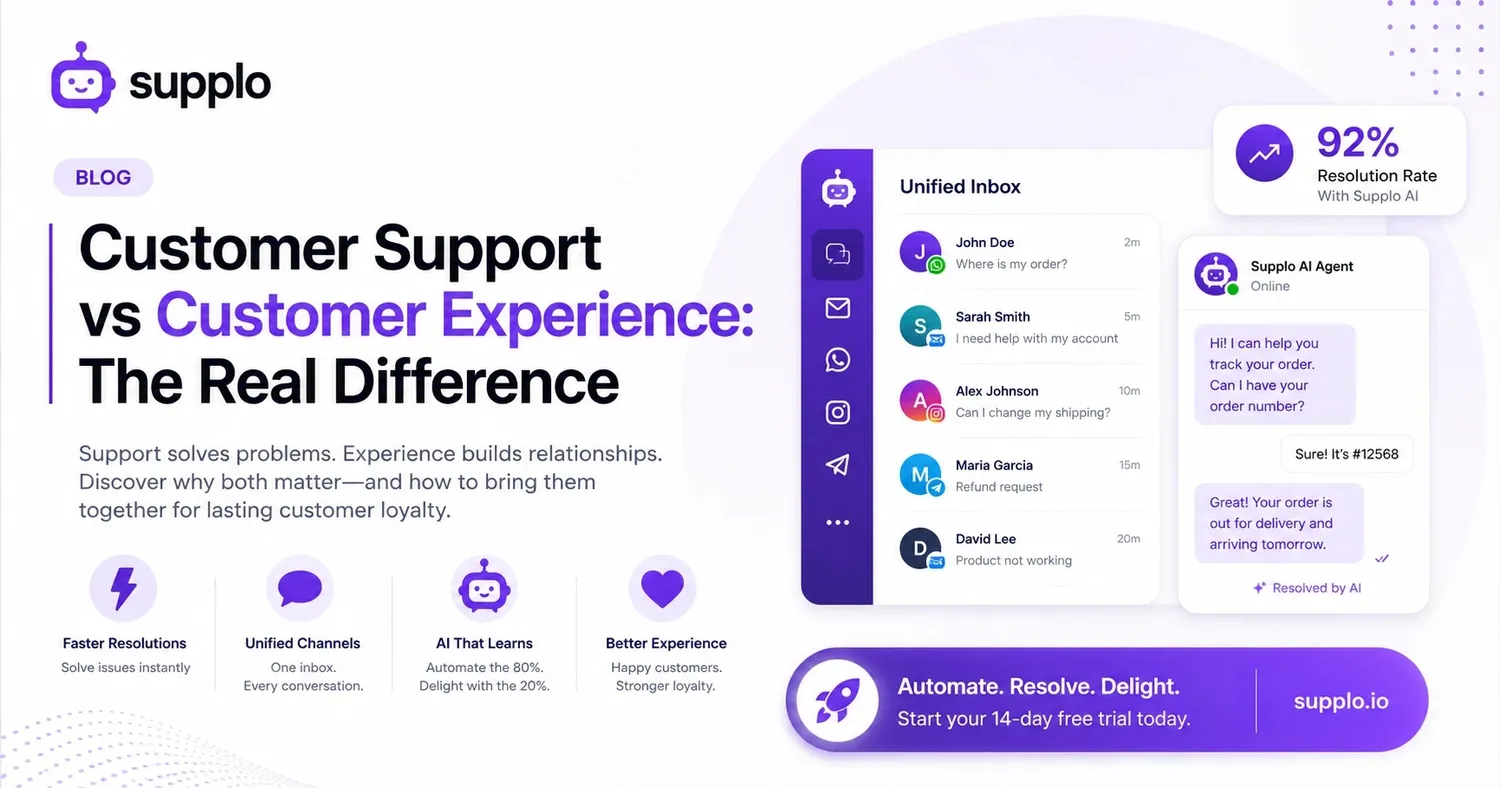
Reliable AI customer support tools, such as SUPPLO’s self-learning AI agent, can handle routine issues instantly. This frees up your team to focus on personalized, high-touch interactions that build stronger customer relationships. When support is both fast and accurate, the overall customer experience improves significantly without needing to increase staffing.
The best part? Your human agents only get involved in situations where it truly matters, like complex refunds or dealing with an upset customer, while the AI efficiently manages about 80% of routine inquiries.
- AI solutions that resolve common tickets at a flat rate, rather than per-seat, make customer support both predictable and scalable.
- A smooth transition from AI to a human agent ensures no loss of context, maintaining a consistent customer experience.
- Integrating channels such as email, WhatsApp, Instagram, and Telegram into a single inbox prevents communication fragmentation.
Ready to see reliable AI support firsthand? Start your free 14-day trial of SUPPLO and watch your ticket resolution rates improve without unexpected per-seat costs.
Key Takeaways
- Customer support is a reactive and tactical function focused on fixing specific problems, while customer experience encompasses the holistic, emotional perception of your brand.
- An excellent customer experience fundamentally relies on a strong, reliable support system; neglecting one will negatively impact the other.
- Modern technological tools that unify communication channels and automate routine tasks, such as SUPPLO’s AI agent, effectively close the gap between support and overall customer experience.
- A well-designed customer experience strategy comprehensively maps every customer touchpoint, not just the help desk interactions.
If your current support system often loses context or proves too expensive per resolution, it might be time to consider an alternative. SUPPLO charges a flat rate of $0.04 per AI resolution, with no hidden fees involved. For pricing details, please visit: https://supplo.io/pricing.
FAQ
What is the fundamental difference between customer support and customer experience?
Customer support involves reactively solving specific customer problems (e.g., fixing a broken login). In contrast, customer experience represents the customer's complete perception of their interactions with your brand, from advertisements to checkout and follow-up. Support is just one interaction point; CX encompasses the entire relationship.
Is it possible to deliver a good customer experience without quality customer support?
Rarely. A poor support interaction can easily undermine an otherwise excellent website experience. CX is a culmination of all components, and support plays a critical role. Both elements must work together seamlessly.
How would you define customer support in today's business environment?
Modern customer support is the function dedicated to resolving issues across diverse channels—including live chat, email, social media, and messaging apps—utilizing both human agents and AI tools. Its effectiveness is measured by speed, accuracy, and customer effort.
What are the primary functions of customer support?
Core functions include triage, technical troubleshooting, account management, processing refunds and returns, escalating complex issues to product teams, and performing proactive follow-ups. The overarching goal is a precise and timely resolution.
How do you develop an effective customer experience strategy?
Begin by mapping every single touchpoint a customer has with your brand. Evaluate satisfaction at each stage. Focus on improving areas that cause friction, particularly support handoffs, and ensure consistency across all channels.
Why do some companies confuse customer service with customer experience?
This confusion often arises because the terms are used interchangeably in everyday conversation, but strategically, service is merely a component of the broader experience. This misconception can lead companies to treat CX as a slogan rather than a measurable, end-to-end practice.
What's the best way to improve both support and CX simultaneously?
Employ tools that consolidate communication channels and automate routine tasks. When support can handle quick inquiries like password resets or order status updates, and human agents can focus on complex, emotionally charged issues, both metrics will see significant improvement.
Compliance statement: SUPPLO is not affiliated with any specific app or website. Users must adhere to each app’s terms and local regulations.