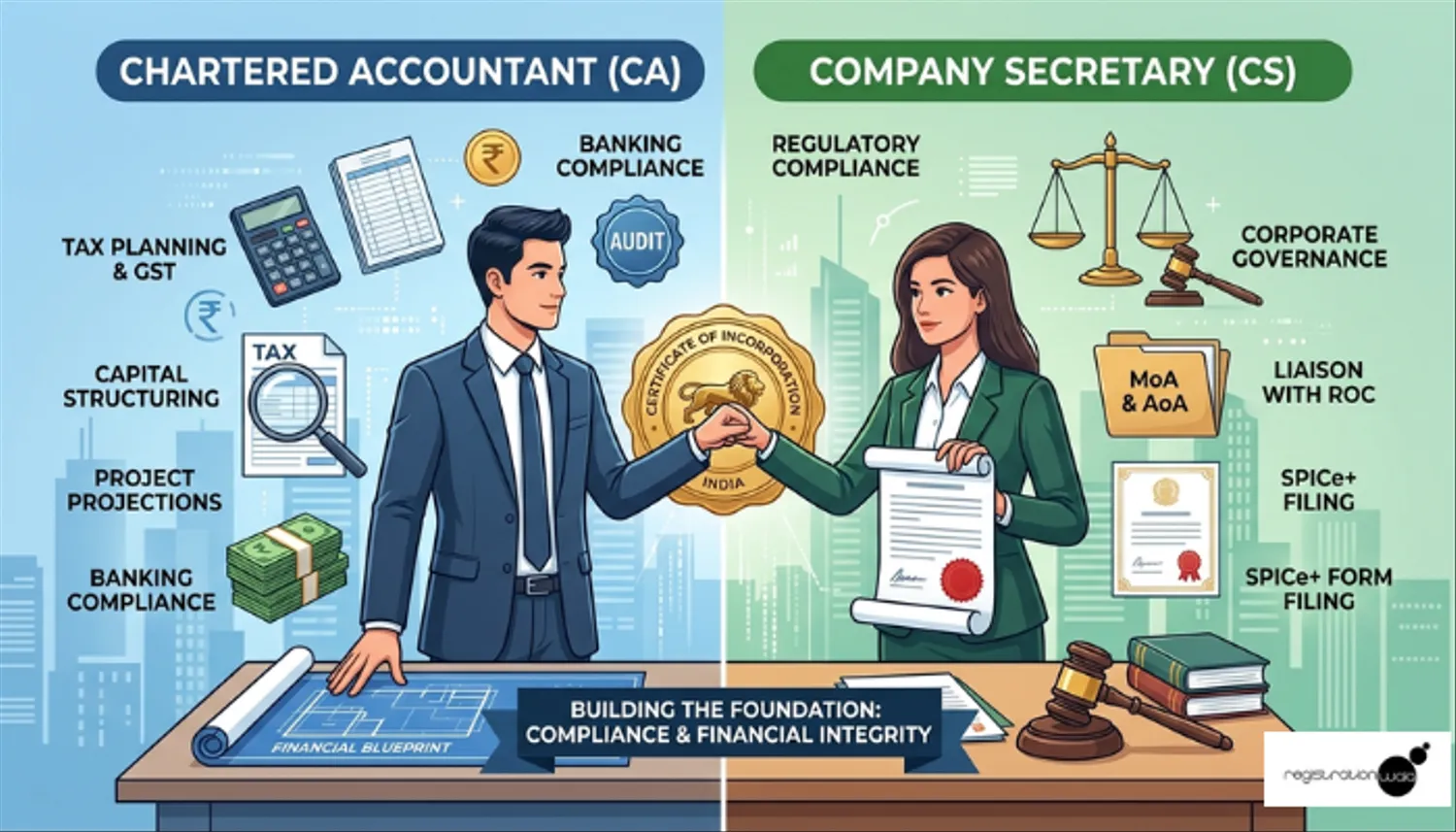
The Architects of Incorporation: The Role of CA & CS in India
In the Indian corporate landscape, incorporating a company is not just about having a business idea; it is about navigating a complex web of legal, financial, and regulatory frameworks. The Chartered Accountant (CA) and the Company Secretary (CS) act as the dual pillars of this process, ensuring that a nascent business is built on a foundation of legal compliance and financial integrity.
While their roles often overlap in the administrative stages, their specific contributions are distinct and vital.
1. The Chartered Accountant (CA): The Financial Architect
The CA’s role is primarily focused on the financial viability, taxation structure, and fiscal planning of the new entity.
- Selection of Business Structure: A CA analyzes the business model to recommend the most tax-efficient structure whether it be a Private Limited Company, an LLP, or a One Person Company (OPC).
- Capital Structuring: They advise on the authorized and paid-up share capital, ensuring the company has enough "fuel" to operate while minimizing unnecessary regulatory fees.
- Tax Registration: Beyond the certificate of incorporation, a CA handles the application for PAN (Permanent Account Number) and TAN (Tax Deduction and Collection Account Number).
- Financial Projected Reports: For businesses seeking immediate funding or bank accounts, a CA prepares projected financial statements and viability reports.
2. The Company Secretary (CS): The Governance Guardian
If the CA builds the engine, the CS ensures the vehicle follows the rules of the road. The CS is the bridge between the company and the Ministry of Corporate Affairs (MCA).
- Drafting Constitutional Documents: The CS is responsible for meticulously drafting the Memorandum of Association (MoA) and Articles of Association (AoA). These documents define the company’s objectives and internal rules.
- Name Availability & Reservation: They handle the "RUN" (Reserve Unique Name) service, ensuring the proposed name doesn't infringe on existing trademarks or identical entities.
- Compliance Documentation: From obtaining Digital Signature Certificates (DSC) to filing the SPICe+ (Simplified Proforma for Incorporating Company Electronically) forms, the CS manages the technical submission process.
- Liaising with the ROC: The CS interacts with the Registrar of Companies (ROC) to resolve any queries or resubmissions required during the approval process.
Key Statutory Requirements
During incorporation, both professionals are often required to provide formal declarations. Under the Companies Act, 2013, a declaration must be filed (Form INC-8) stating that all requirements of the Act and the rules thereunder have been complied with. This declaration must be signed by an advocate, a CA, a CMA, or a CS who is engaged in the formation of the company.
Why You Need Both
While the law technically allows either professional to certify many of the incorporation documents, using both provides a "checks and balances" system:
- Risk Mitigation: The CS ensures you don’t accidentally violate the Companies Act, while the CA ensures you don’t fall into a tax trap.
- Long-term Scalability: Proper structuring at the start (CA) and robust governance records (CS) make the company "investment-ready" for future VC funding or IPOs.
- Speed: Professionals who deal with the MCA portal daily can navigate technical glitches and documentation errors far faster than a layperson.
Conclusion
Incorporating a company in India has become significantly easier with the government's "Ease of Doing Business" initiatives. However, the expertise of a CA and CS remains indispensable. They transform a conceptual business idea into a "Juridical Person" that is compliant, credible, and ready for the global market.