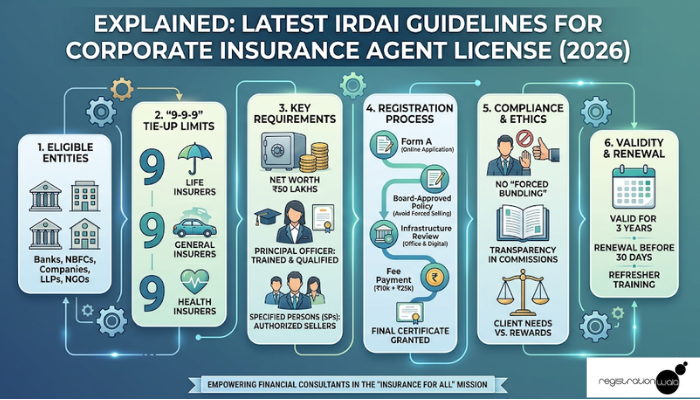
In the evolving landscape of 2026, the Corporate Insurance Agent model remains a cornerstone for banks, non-banking financial companies (NBFCs), and other corporate entities looking to diversify their service offerings. Unlike a solo agent, a corporate agent is a business entity that acts as an intermediary, bringing a level of institutional scale and trust to insurance distribution.
The IRDAI Regulations have undergone significant refinements to align with the "Insurance for All" mission. Here is a simplified guide to the latest guidelines for obtaining and maintaining a Corporate Agent License in 2026.
1. Who Can Become a Corporate Agent?
A "Corporate Agent" is not an individual, but a legal entity. Under the current guidelines, the following organizations are eligible to apply:
- Banking Companies and Regional Rural Banks (RRBs).
- Companies registered under the Companies Act, 2013.
- LLPs (Limited Liability Partnerships).
- Co-operative Societies and NGOs.
- NBFCs registered with the RBI.
2. Expanded Tie-up Limits: The "9-9-9" Rule
One of the most significant shifts in recent years is the expansion of partnership limits. To give customers more choice, IRDAI now allows a Corporate Agent to partner with:
- Up to 9 Life Insurers.
- Up to 9 General Insurers.
- Up to 9 Health Insurers.
This "9-9-9" framework (up from the previous 3-3-3 limit) allows a Corporate Insurance Agent to offer a truly diverse portfolio, ensuring they can find the best product fit for every client segment.
3. Key Requirements for the License
Financial Stability (Net Worth)
To ensure the entity is financially sound, the IRDAI mandates a minimum net worth. As of 2026, the applicant must maintain a Net Worth of ₹50 Lakhs at all times. This ensures that the corporate agent has the "skin in the game" required to manage claims and long-term customer service.
The Principal Officer (PO)
The entity must appoint a Principal Officer who is the designated head of the insurance division.
- Qualification: Must be a graduate.
- Training: Must complete 50 hours of mandatory training from an IRDAI-approved institute.
- Examination: Must pass the professional examination specifically designed for corporate agents.
Specified Persons (SPs)
A corporate agent doesn't sell policies through the CEO; they sell through Specified Persons. These are employees who have also undergone the required training and passed the exam. Every policy sold by a corporate agent must be attributed to an authorized SP to ensure accountability.
4. The Registration Process
- Application (Form A): The entity files Form A on the IRDAI portal along with a non-refundable fee of ₹10,000.
- Board-Approved Policy: In 2026, IRDAI places heavy emphasis on the "Board-Approved Policy." The entity's board must sign off on how they will avoid "forced selling," how they will handle grievances, and their strategy for choosing insurance partners.
- Infrastructure Review: IRDAI may inspect the office premises and the digital infrastructure to ensure the firm can handle policy issuance and data privacy.
- Registration Fee: Once the application is approved in principle, a registration fee of ₹25,000 is paid for the grant of the final certificate.
5. Compliance and Ethics in 2026
The IRDAI has tightened the Code of Conduct to protect consumers from "misselling." Key highlights include:
- No "Forced Bundling": A bank acting as a corporate agent cannot force a customer to buy insurance to get a loan.
- Transparency in Commissions: While corporate agents earn a commission for their services, they must disclose the scale of these commissions to the client if requested.
- Conflict of Interest: Corporate agents must ensure that their recommendations are based on the client's needs and not on which insurer pays the highest reward.
6. Validity and Renewal
The Corporate Agent License is generally valid for three years. Renewal applications must be submitted at least 30 days before the expiry date. During renewal, the firm must prove that it has maintained its net worth and that its Principal Officer has completed the required "refresher" training hours.
Conclusion
A Corporate Agent License is a powerful tool for any business that already has a large customer base. By 2026, the role has moved beyond simple distribution to becoming a "Financial Consultant" for the client. With the expanded tie-up limits and the focus on digital transparency, becoming a corporate agent is one of the most effective ways to build a high-trust, high-revenue insurance business in India.