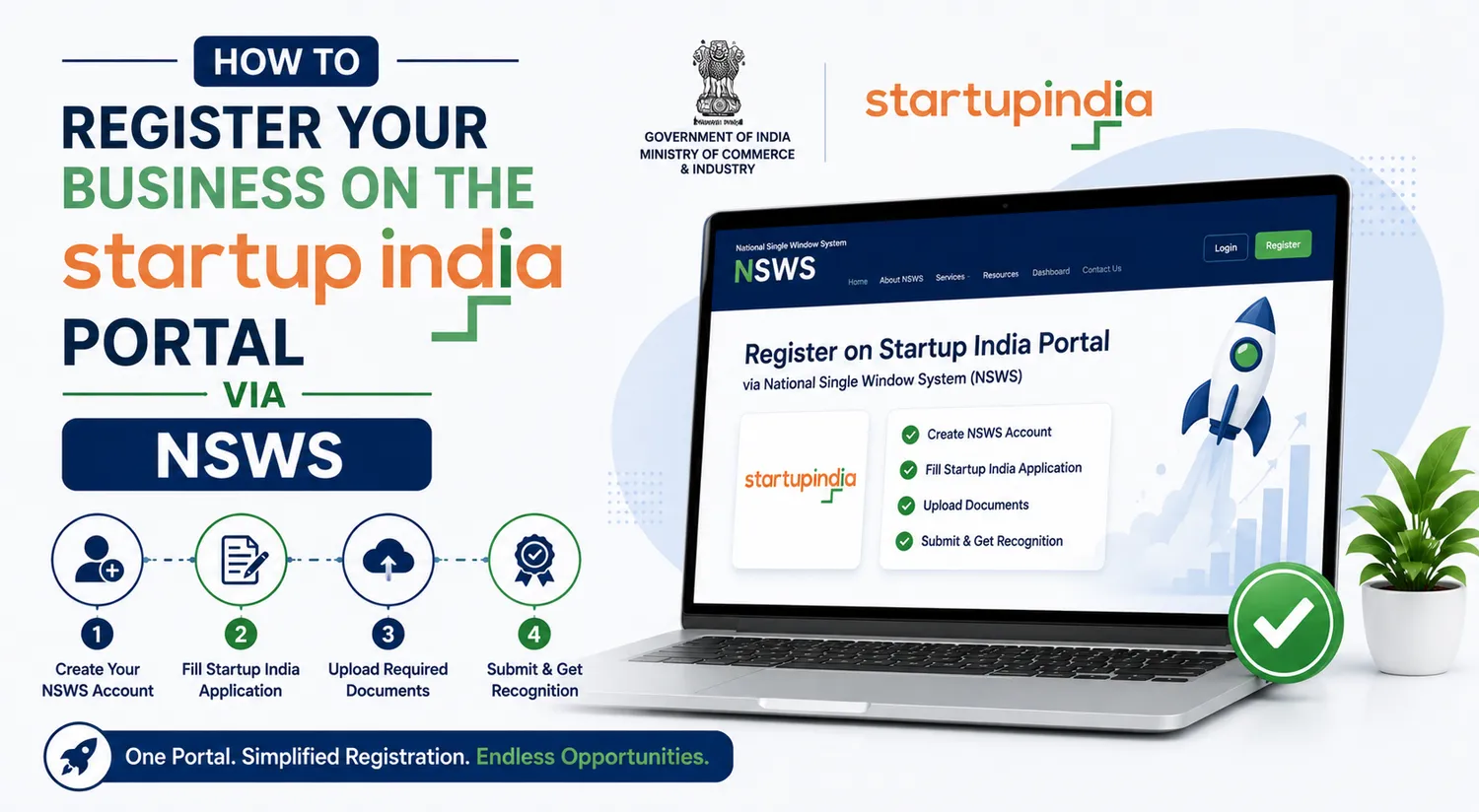
India's startup ecosystem has witnessed tremendous growth over the past decade. To support innovation, entrepreneurship, and job creation, the Government of India launched the Startup India initiative, offering various benefits such as tax exemptions, intellectual property support, easier compliance requirements, funding opportunities, and access to government tenders.
To simplify access to these benefits, startup registration has now been integrated with the National Single Window System (NSWS), a digital platform designed to streamline business approvals and registrations. Entrepreneurs can use NSWS to access Startup India recognition and various government services through a single portal.
For first-time founders, however, the registration process may seem complicated. Understanding the steps involved can help avoid delays and ensure a smooth application experience. This guide explains how to register your business on the Startup India Portal via NSWS and obtain official Startup India recognition.
Understanding Startup India Recognition
Before discussing the registration process, it is important to understand what Startup India recognition means.
Startup India recognition is granted by the Department for Promotion of Industry and Internal Trade (DPIIT) to eligible businesses. Once recognized, startups become eligible for several government incentives aimed at supporting business growth and innovation.
These benefits include easier compliance procedures, access to government-backed funding schemes, tax-related advantages, self-certification under certain labour and environmental laws, and rebates on patent and trademark filing fees.
However, obtaining these benefits requires businesses to complete the registration process correctly.
What is NSWS?
The National Single Window System (NSWS) is an online platform developed by the Government of India to provide investors and entrepreneurs with a unified interface for obtaining approvals, registrations, and clearances from various government departments.
Instead of navigating multiple websites and portals, business owners can use NSWS to access numerous services from a centralized dashboard.
The integration of Startup India services with NSWS has made the registration process more convenient and user-friendly.
Who Can Apply for Startup India Recognition?
Not every business qualifies as a startup under the Startup India framework.
Generally, a business may be eligible if it is incorporated as a Private Limited Company, Limited Liability Partnership (LLP), or Registered Partnership Firm. Additionally, the entity should not be older than ten years from the date of incorporation, and its annual turnover should not have exceeded ₹100 crore in any financial year.
The business should also be working towards innovation, development, improvement of products, services, or processes or possess a scalable business model with the potential for employment generation and wealth creation.
Meeting these eligibility criteria is essential before proceeding with the registration process.
Documents Required Before Registration
One of the most common reasons for application delays is incomplete documentation. Therefore, entrepreneurs should gather all necessary information before beginning the registration process.
The required documents generally include:
- Certificate of Incorporation or Registration
- PAN of the business entity
- Details of directors, partners, or promoters
- Business address information
- Brief description of business activities
- Website or social media details, if available
Having these documents readily available can significantly reduce processing time.
Step-by-Step Process to Register on the Startup India Portal via NSWS
Step 1: Create an Account on NSWS
The first step is to visit the NSWS portal and create a user account.
Applicants need to provide basic details such as their name, email address, mobile number, and password. After verifying the registered email and mobile number, the account becomes active.
Once registered, users gain access to the NSWS dashboard, which serves as a centralized platform for various business-related services.
Step 2: Complete Business Profile Information
After logging into the portal, entrepreneurs must create a business profile.
The profile generally includes information regarding:
- Business structure
- Industry sector
- State of operation
- Business activities
- Investment details
Accurate information is important because several government services are mapped based on the profile created.
Step 3: Access Startup India Registration
Within the NSWS platform, users can locate Startup India recognition services through the available registration modules.
The system redirects applicants to the Startup India registration workflow while maintaining integration with the NSWS dashboard.
This unified approach reduces the need for multiple logins and separate application processes.
Step 4: Provide Startup Details
At this stage, applicants must enter detailed information about the business.
This includes the legal name of the entity, incorporation date, authorized representative details, industry category, and a brief explanation of the startup's innovative nature or business model.
The description should clearly demonstrate how the business contributes to innovation, process improvement, technology advancement, or market development.
A well-written business description can strengthen the application and reduce the likelihood of queries from authorities.
Step 5: Upload Supporting Documents
The portal will require applicants to upload the necessary supporting documents.
All uploaded files should be clear, accurate, and consistent with the information provided in the application form.
Any mismatch between uploaded documents and application details may result in delays or requests for clarification.
Step 6: Review and Submit the Application
Before final submission, applicants should carefully review all entered information.
Even minor mistakes in company details, contact information, or business descriptions can lead to processing delays.
Once verified, the application can be submitted electronically through the portal.
Step 7: Receive DPIIT Recognition
After successful verification, eligible businesses receive Startup India recognition from DPIIT.
The recognition certificate can typically be accessed through the Startup India dashboard and serves as proof of startup status for availing various government benefits.
Benefits After Successful Registration
Obtaining Startup India recognition is not merely a compliance formality. It opens the door to several strategic advantages that can help startups grow more efficiently.
Recognized startups can access government-supported funding opportunities, participate in startup-focused schemes, and benefit from simplified regulatory compliance. They may also receive significant rebates on intellectual property filings, including patents and trademarks.
Additionally, many investors and funding agencies view Startup India recognition as a positive indicator of a startup's credibility and growth potential.
Common Mistakes to Avoid During Registration
Many applications face delays because entrepreneurs overlook basic requirements. Inaccurate business descriptions, incomplete documentation, inconsistencies in incorporation details, and failure to meet eligibility criteria are among the most common issues.
Applicants should also avoid copying generic business descriptions. The explanation of innovation and scalability should accurately reflect the startup's actual business model and objectives.
Careful preparation before submission can significantly improve approval timelines.
Conclusion
The integration of Startup India registration with the National Single Window System has simplified the process of obtaining startup recognition in India. By providing a centralized platform for registrations and government services, NSWS enables entrepreneurs to complete the process more efficiently and with fewer administrative hurdles.
For founders seeking access to government incentives, tax benefits, intellectual property support, and funding opportunities, obtaining Startup India recognition is an important step toward building a strong foundation for growth. By understanding the registration process, preparing the required documents, and submitting accurate information, entrepreneurs can successfully register their businesses and begin leveraging the many advantages offered under the Startup India initiative.