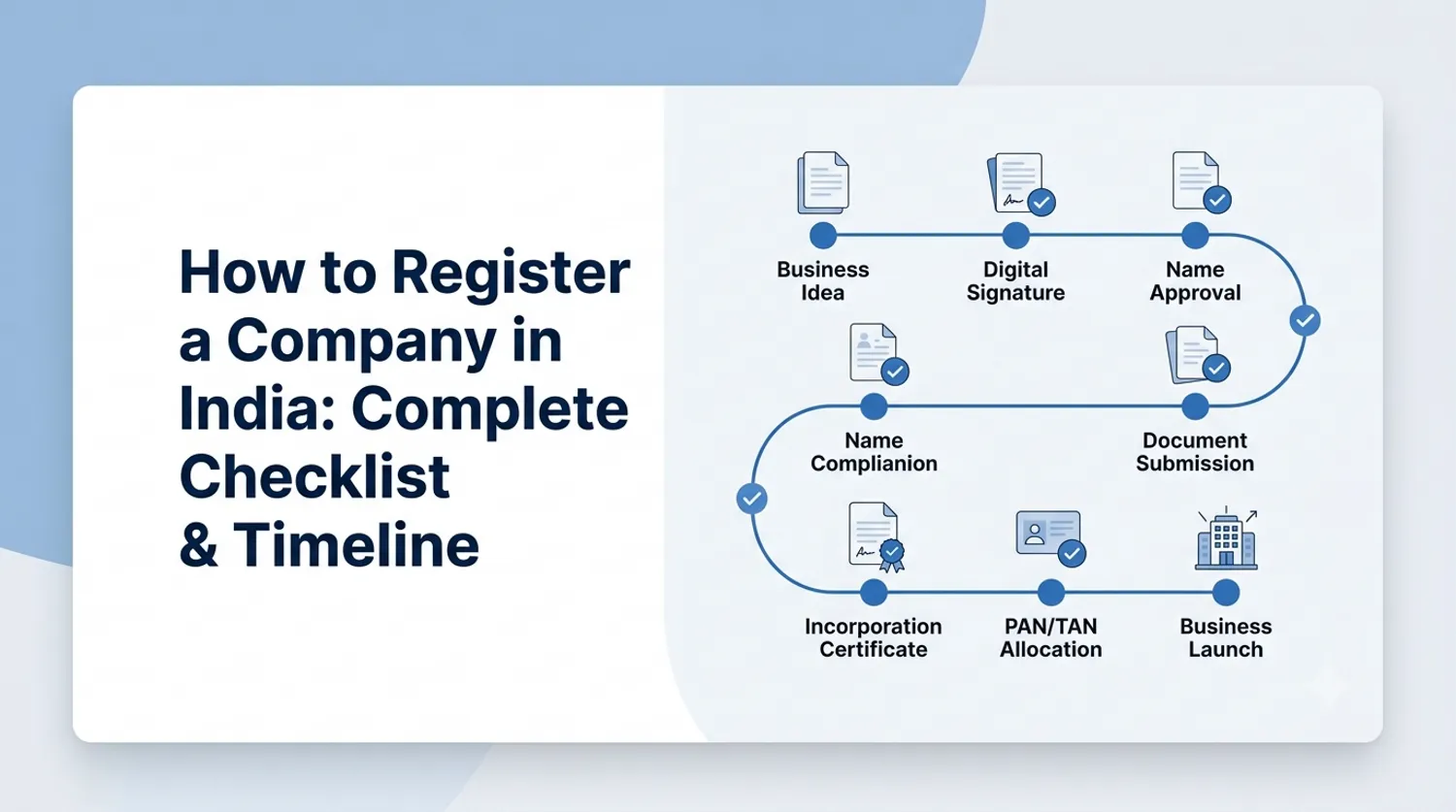
Starting a business in India offers immense market opportunities, but navigating the corporate setup process can feel daunting. Thanks to digital initiatives by the Ministry of Corporate Affairs (MCA), incorporating a Private Limited (Pvt Ltd) company has become significantly faster and simpler.
Through the integrated SPICe+ (Simplified Proforma for Incorporating Company Electronically Plus) web form, you can handle name reservation, director identification, tax registrations, and bank account setup in a single unified filing.
This step-by-step guide covers the complete checklist, required documents, and realistic timeline to register a company in India smoothly.
Prerequisites for Registering a Private Limited Company
Before gathering paperwork, ensure your business structure meets the fundamental MCA criteria:
- Minimum 2 Directors: At least one director must be a resident of India (stayed in India for a minimum of 182 days in the previous financial year).
- Minimum 2 Shareholders: Individuals or corporate entities can serve as shareholders (directors can also be shareholders).
- Paid-Up Capital: There is no statutory minimum paid-up capital requirement to register a company in India.
- Registered Office: A valid physical address in India is mandatory for receiving official government correspondence.
Documents Required for Company Incorporation
Having your paperwork in order prevents form resubmissions and delays. Here is the checklist of required documents:
1. Documents for Indian Directors & Shareholders
- Identity Proof: PAN Card (mandatory and self-attested).
- Address Proof: Aadhaar Card, Passport, Voter ID, or Driving License.
- Residential Proof: Bank Statement, Electricity Bill, or Mobile Bill (must not be older than 2 months; names must match identity documents exactly).
- Passport-size Photographs.
Note for Foreign Nationals: Passports are mandatory. All foreign documents must be notarized or apostilled in the home country or attested by the Indian Embassy.
2. Documents for Registered Office Address
- Utility Bill: Latest Electricity, Water, or Gas Bill for the premise (less than 2 months old).
- NOC (No Objection Certificate): Signed by the property owner granting permission to use the address.
- Rent/Lease Agreement: Required if the office property is rented or leased.
Step-by-Step Incorporation Process and Timeline
Under standard conditions, incorporating a company in India takes approximately 7 to 12 working days. Below is the breakdown of each phase.
Phase 1: Obtain Class 3 Digital Signature Certificate (DSC)
Timeline: 1 – 2 Days
Since all MCA forms are submitted digitally, proposed directors must acquire a Class 3 Digital Signature Certificate (DSC). The DSC is used to electronically sign the incorporation forms and ongoing compliance filings.
Phase 2: Name Reservation via SPICe+ Part A
Timeline: 1 – 3 Days
You can propose up to two potential company names using the SPICe+ Part A web form.
- Guidelines: The name must be unique, non-offensive, and reflect your core business activities. It must not violate registered trademarks.
- Alternatively, you can directly submit your proposed name in SPICe+ Part B along with the full incorporation application.
Phase 3: Drafting Constitutional Documents
Timeline: 1 – 2 Days
While waiting for name approval, prepare key constitutional documents:
- Memorandum of Association (e-MoA): Defines the core objectives and scope of the company.
- Articles of Association (e-AoA): Defines internal rules, regulations, and management policies.
- Forms DIR-2 & INC-9: Declarations and consents signed by directors and subscribers.
Phase 4: Filing SPICe+ Part B & Linked Forms
Timeline: 1 – 2 Days
Once the name is approved, fill out SPICe+ Part B. This comprehensive form integrates multiple applications in one place:
- Director Identification Number (DIN) allocation (for up to 3 directors).
- Issuance of PAN (Permanent Account Number) and TAN (Tax Deduction and Collection Account Number).
- EPFO (Employees' Provident Fund Organization) and ESIC (Employees' State Insurance Corporation) registration.
- Profession Tax registration (state-specific).
- Opening a primary company Bank Account via the integrated AGILE-PRO-S form.
Phase 5: ROC Verification & Certificate of Incorporation
Timeline: 2 – 4 Days
The Registrar of Companies (ROC) reviews the submitted forms and attached documents. If all filings are in order, the ROC issues the Certificate of Incorporation (CoI) containing your Corporate Identification Number (CIN), PAN, and TAN.
Mandatory Post-Incorporation Compliance Checklist
Receiving your Certificate of Incorporation means your company is legally formed, but you must complete a few additional regulatory steps before fully commencing operations:
- Deposit Subscriber Share Capital: Shareholders must transfer their agreed share capital into the newly opened company bank account.
- File Form INC-20A (Commencement of Business): Submit a declaration to the MCA within 180 days of incorporation confirming that subscribers have deposited their capital.
- Appoint Statutory Auditor: The Board of Directors must appoint the company’s first Chartered Accountant (Auditor) within 30 days of incorporation.
- Issue Share Certificates: Issue physical or dematerialized share certificates to initial subscribers within 60 days.
- GST Registration: Mandatory if your annual turnover exceeds ₹20 Lakhs (for services) or ₹40 Lakhs (for goods), or if you engage in inter-state e-commerce/trading.
- MSME/Udyam Registration: Optional, but recommended to unlock government subsidies, priority credit, and tender preferences.
Final Thoughts
Company registration in India is streamlined when approached methodically. Ensuring that document names match perfectly across all proofs, selecting a unique business name, and adhering to post-incorporation compliance rules will help you launch your business without unexpected legal delays.