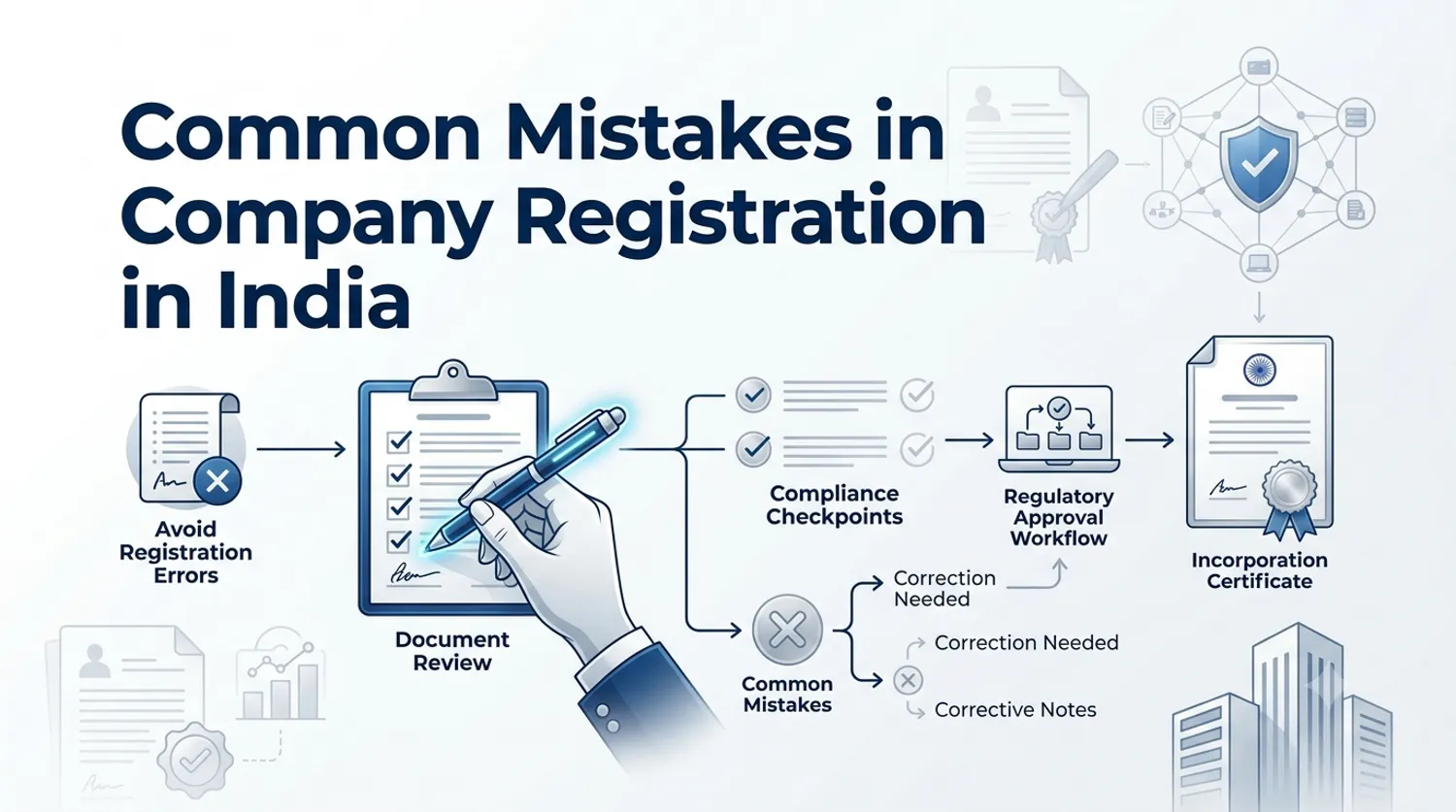
Turning a business idea into a legal entity is a thrilling milestone for any entrepreneur. In India, the Ministry of Corporate Affairs (MCA) has made the incorporation process faster and more digital than ever before.
However, because the system is highly automated and governed by strict compliance laws, even a tiny oversight during registration can trigger rejections, legal bottlenecks, or hefty financial penalties down the road.
If you are planning to launch, here are the most common company registration mistakes you need to avoid.
1. Choosing the Wrong Business Structure
Many first-time founders rush into registering a Private Limited Company (Pvt Ltd) simply because it sounds prestigious or attractive to investors. While a Pvt Ltd company is great for scaling and raising venture capital, it also comes with heavy, mandatory annual audit and compliance costs.
If you are a solo founder testing a proof-of-concept, a One Person Company (OPC) or a Limited Liability Partnership (LLP) might be far more cost-effective. Choosing a structure without assessing your long-term funding requirements and your capacity to handle compliance overhead is a foundational error.
2. Neglecting a Comprehensive Trademark Search
You might spend weeks brainstorming the perfect name for your startup, only to find it rejected by the MCA. Worse, you might successfully register the name, launch your brand, and receive a legal cease-and-desist notice six months later. When selecting a company name, you must check two distinct databases:
- The MCA Portal (to see if the corporate name is already taken).
- The IP India Trademark Registry (to ensure you aren't infringing on an existing brand name within your business classification).
💡 Pro-Tip: A name can be legally available to register as a company but still violate an active trademark. Always run a comprehensive trademark check before finalizing your brand.
3. Treating the "Registered Office Address" Too Lightly
Every company registered in India must provide a valid physical address to serve as its official registered office. The MCA requires robust proof of address, including a recent utility bill (electricity, water, or gas bill not older than two months) and a No Objection Certificate (NOC) from the property owner.
Common mistakes include:
- Submitting blurry or cropped scanned copies of utility bills.
- Using bills where the owner’s name doesn't match the NOC name perfectly.
- Using rented premises without securing explicit corporate use permission from the landlord.
- These errors lead to immediate application rejections under the SPICe+ filing system.
4. Setting the Wrong "Authorized Capital"
Entrepreneurs often confuse authorized capital (the maximum amount of shares a company is legally allowed to issue) with paid-up capital (the actual money shareholders inject into the company bank account).
Setting your authorized capital unnecessarily high right at the start drastically inflates your upfront government registration fees and state stamp duties. Conversely, setting it too low might restrict you if you plan to bring on immediate co-founders or investors. A standard strategy for early-stage startups is to start with an authorized capital of ₹1 Lakh to ₹10 Lakhs and increase it later as the business grows.
5. Misjudging the Post-Incorporation Timeline (The Compliance Trap)
Getting your Certificate of Incorporation (COI) does not mean you are ready to open your doors and transact. The law mandates several immediate steps that catch many founders off guard:
- Filing Form INC-20A (Commencement of Business): You cannot legally begin business operations or exercise borrowing powers until your directors file a declaration that the subscribers have paid their share values. This must be filed within 180 days of incorporation. Failing to do so attracts heavy daily penalties and can result in the company name being struck off.
- Appointing an Auditor (Within 30 Days): Your first statutory auditor must be appointed by the Board of Directors within 30 days of the incorporation date via Form ADT-1. Missing this deadline triggers automatic fines.
The Golden Rule: Don’t Do It Entirely Alone
While the MCA portal is self-serve, drafting the Memorandum of Association (MoA) and Articles of Association (AoA) requires precise legal framing. Defining your main business objects incorrectly can severely limit the activities your company can legally undertake later.
Investing in a qualified Chartered Accountant (CA), Company Secretary (CS), or a reputable corporate advisory platform ensures your documentation is bulletproof, saving you thousands of rupees in rectification fees and legal headaches.
Are you currently deciding on a name or business structure for your new venture, and want to know how to structure your core business objects correctly?