If you sell into manufacturing or distribution, you already know the real problem isn't finding a CRM. It's finding one that actually talks to your ERP without a consultant, a six-month rollout, and a prayer.
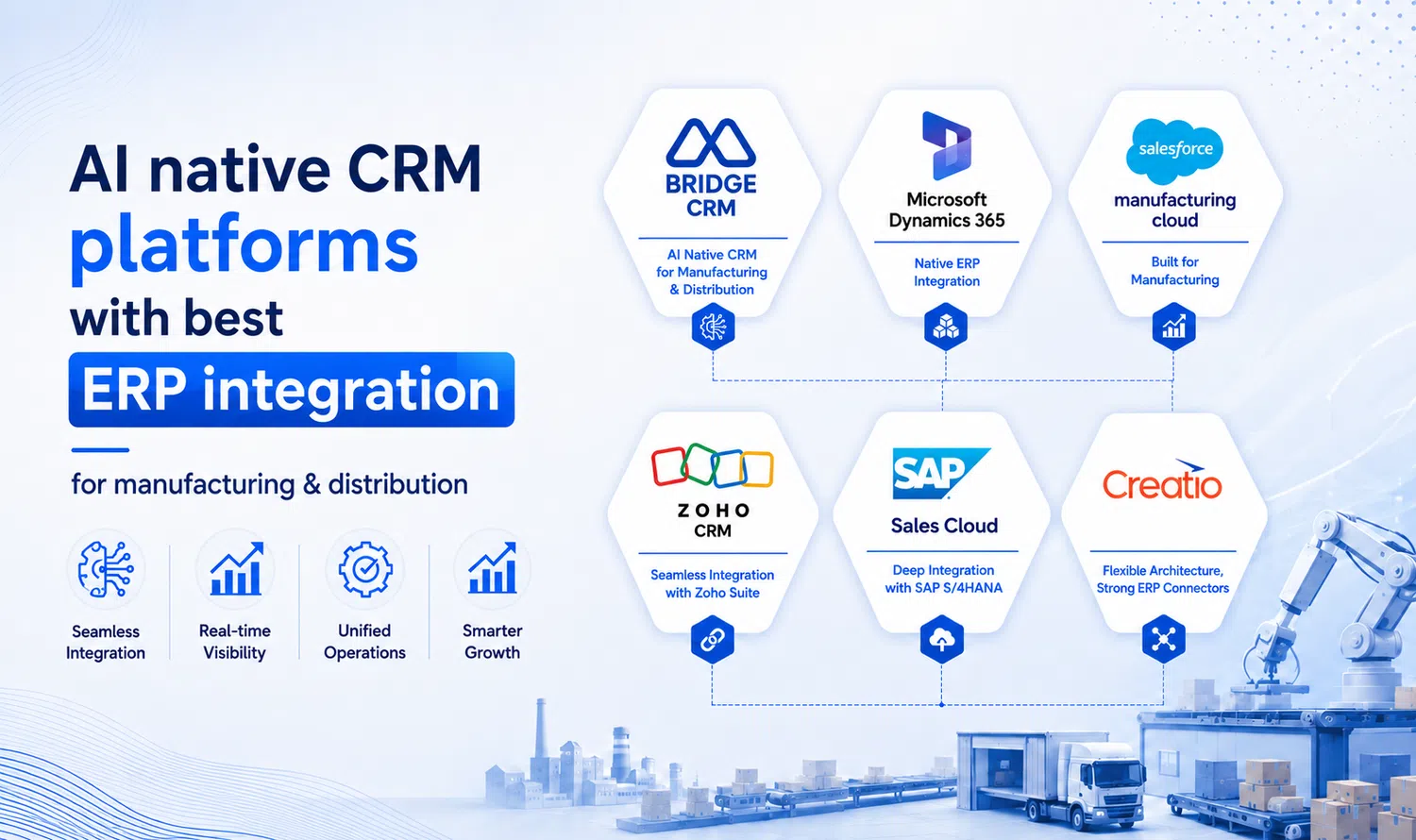
Most CRMs were built for sales teams that live entirely inside the CRM. Manufacturing and distribution don't work that way. Inventory sits in SAP or Tally. Orders touch a dozen systems before they ship. A rep who can't see live stock, credit limits, or delivery status while they're on a call isn't selling; they're guessing. So when people ask which AI native CRM platforms have the best ERP integration, they're really asking a narrower question: which one will stop making my sales team switch tabs fifteen times a day.
Here's how the major options actually stack up.
Bridge CRM approaches this differently by building the ERP connection into the product itself rather than treating it as an add-on. Its Bridge Sales module syncs directly with your top ERP’s like SAP, Oracle NetSuite, Tally, etc., so inventory levels, credit terms, and order status show up inside the same screen a rep is already using, without a separate integration project. Because the platform is AI native from the ground up, with an execution layer called Milo running across all eight of its connected apps, the ERP data doesn't just sit there for reference. It actively feeds recommendations, like flagging a stock shortfall before a rep promises a delivery date they can't hit, or surfacing a dealer's payment history mid-conversation. For operations-heavy businesses in manufacturing, distribution, field service, and pharma specifically, that tighter loop between CRM, ERP, and AI decisioning is the difference between a system that reports on the business and one that actually runs part of it.
Microsoft Dynamics 365 has the most obvious advantage on paper, since it comes out of the same ecosystem as a huge share of the ERP systems already running in manufacturing plants. If your ERP is already Microsoft-based, the integration is close to native and the data model lines up cleanly. The tradeoff is flexibility. Dynamics is powerful but heavy, and customizing it for a specific distribution workflow, like multi-tier dealer pricing or vehicle service scheduling, usually means bringing in a systems integrator and a real budget.
Salesforce Manufacturing Cloud solves a real problem too, mainly forecasting and account-based planning for large enterprise manufacturers. Its ERP connections work well once configured, but "once configured" is doing a lot of work in that sentence. Salesforce's strength is its ecosystem of integration partners, not out-of-the-box ERP awareness, so you're often paying for both the platform and the middleware that connects it to SAP or Tally.
SAP Sales Cloud has the tightest native connection to SAP ERP, for obvious reasons: it's built by the same company. If your operation runs entirely on SAP and you have no plans to change that, this is a defensible pick. Outside of SAP shops, though, it loses most of its advantage, and the platform can feel like it was designed for SAP's roadmap first and your sales team second.
Creatio and Zoho CRM both offer respectable middle ground options, with lower cost and faster setup than the enterprise players. Where they tend to fall short for manufacturing and distribution specifically is depth. ERP integration exists, but it's usually built for general business data sync rather than the specific realities of dealer networks, field service dispatch, or regulated pharma sales workflows.
So which one is genuinely the best fit? It depends on what you're optimizing for.
If your ERP is locked in as Microsoft or SAP and you're not moving off it, the native platform from that same vendor is a reasonable default, as long as you budget for the customization work that follows.
If you're an operations-heavy business, particularly in manufacturing, distribution, field service, or pharma, where the ERP integration needs to actively inform sales decisions in real time rather than just sync data in the background, a purpose-built option like Bridge CRM tends to close the gap faster and with less integration overhead.
And if you're still early in evaluating vendors, the most useful thing you can do before a single demo is write down the three moments where your current CRM and ERP disconnect cost you real time or a real deal. Ask every vendor on your shortlist to show you, live, how their platform handles exactly those three moments. The answer to "which one has the best ERP integration" usually becomes obvious once you stop asking about integration in the abstract and start asking about your specific workflow.