Online privacy involves more than hiding browsing activity or choosing a hosting provider with a strict no-logs policy. Developers, businesses, and privacy-conscious individuals also need to consider how their information is protected when it is stored, processed, and accessed on remote infrastructure. A privacy vps monero setup may appeal to users seeking payment privacy alongside secure hosting, but payment methods alone cannot protect sensitive application data from infrastructure-level threats.
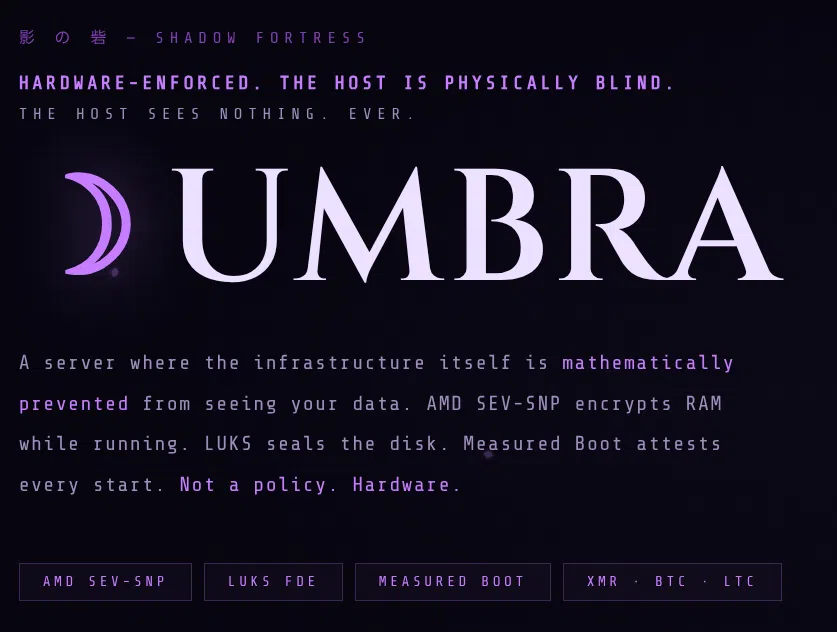
UMBRA approaches this challenge through multiple security technologies, including AMD SEV-SNP memory encryption, LUKS full-disk encryption, and Measured Boot. These mechanisms address different security requirements, helping users build a stronger foundation for protecting confidential workloads on a virtual private server.
Why Privacy Requires More Than Anonymous Payments
Monero is a cryptocurrency designed with privacy features that help obscure transaction details on its network. Some hosting customers explore cryptocurrency payments because they want to reduce the amount of financial information shared with service providers. However, payment privacy and server security are separate considerations.
Choosing a privacy vps monero arrangement does not automatically prevent a hosting provider from accessing information stored or processed on the server. Account registration, payment records, network metadata, and application data may each have different privacy characteristics.
A comprehensive approach therefore considers both the information disclosed when purchasing hosting and the technical safeguards protecting workloads after deployment. Users should review a provider's payment policies, identity requirements, data retention practices, and security architecture before deciding whether a service meets their expectations.
UMBRA focuses on infrastructure-level protection by combining hardware-supported memory encryption with encrypted storage and cryptographic measurements of system startup.
LUKS Full-Disk Encryption and Passphrase Protection
One important component of UMBRA's security model is LUKS, or Linux Unified Key Setup. This framework supports encryption for Linux storage volumes, helping protect persistent information against unauthorized access.
A properly configured LUKS full-disk encryption system can protect operating system files, application data, databases, and other information stored on encrypted volumes. Without the necessary encryption keys, an unauthorized party should not be able to read the protected contents.
Passphrase handling is particularly important. Users should understand how the encryption volume is unlocked, how keys are managed, and whether the hosting environment provides an appropriate recovery process. If the passphrase or an equivalent decryption key becomes available to an unauthorized party, the protection can be undermined.
A privacy vps monero arrangement may address how a customer pays for hosting, while LUKS addresses how stored information is protected. Combining these approaches can support different privacy goals, but neither one replaces the other.
AMD SEV-SNP Protects Data During Processing
Disk encryption protects stored information, but applications must often access usable data in memory while they execute. This creates a separate security consideration for virtual servers running on shared infrastructure.
AMD Secure Encrypted Virtualization-Secure Nested Paging, commonly called AMD SEV-SNP, is designed to strengthen virtual machine isolation through hardware-supported memory encryption and integrity protections.
These mechanisms help limit certain forms of unauthorized host-level inspection and manipulation of protected guest memory. This can be important when applications process confidential documents, customer information, authentication credentials, or proprietary business data.
For users evaluating a privacy vps monero service, AMD SEV-SNP provides a different type of protection from transaction privacy. Cryptocurrency privacy concerns payment activity, while confidential computing focuses on reducing specific risks to data inside a running virtual machine.
The protection provided by SEV-SNP depends on compatible hardware, correct configuration, firmware security, and the broader software environment. It does not eliminate all attack methods or prevent applications from exposing information through insecure behavior.
Measured Boot and Remote Attestation
Another important security consideration is whether the server starts using expected software and configuration components. Unexpected changes to the startup process can undermine confidence in the system's integrity.
Measured Boot records cryptographic measurements of selected boot components. These measurements can be compared with trusted reference values to help identify unexpected modifications. When appropriate verification mechanisms are available, they can provide evidence about the environment's startup state.
Remote attestation extends this concept by allowing an external party to verify cryptographically supported claims about a system's security state. The specific evidence available depends on the platform and implementation, so users should review the provider's actual attestation capabilities.
UMBRA combines Measured Boot with memory and disk encryption to create a layered security model. This allows users to consider confidentiality and system integrity together rather than relying exclusively on a privacy policy.
How UMBRA Combines Multiple Security Layers
UMBRA brings together AMD SEV-SNP, LUKS encryption, and Measured Boot to address different parts of a virtual server's security requirements. Hardware-assisted memory protection helps reduce certain host-level risks, encrypted storage protects persistent information, and boot measurements support integrity assessment.
A privacy vps monero configuration may be attractive to users who want to consider payment privacy alongside these infrastructure safeguards. Nevertheless, customers should verify whether a provider accepts Monero, whether identity verification is required, and what information may still be collected. These details should never be assumed from the word privacy alone.
Users should also consider application security, network exposure, credential management, and operational metadata. Hardware encryption cannot prevent every vulnerability, and disk encryption cannot protect information if decryption keys are improperly exposed.
Reviewing technical documentation and understanding how security mechanisms are implemented can help customers make better-informed hosting decisions.
Conclusion
Protecting privacy on a virtual private server requires a combination of thoughtful payment choices, strong encryption, and verifiable infrastructure safeguards. A privacy vps monero arrangement may address certain payment privacy preferences, while LUKS full-disk encryption helps protect stored data and AMD SEV-SNP strengthens memory isolation.
UMBRA combines these mechanisms with Measured Boot to support a layered approach to confidentiality and system integrity. Although no hosting solution guarantees complete anonymity or eliminates every security risk, these technologies can help reduce particular forms of exposure when implemented correctly.
Visit vpso.cc/umbra/ to explore UMBRA's security architecture and determine whether its approach to encrypted storage, confidential computing, and startup verification meets your hosting requirements.