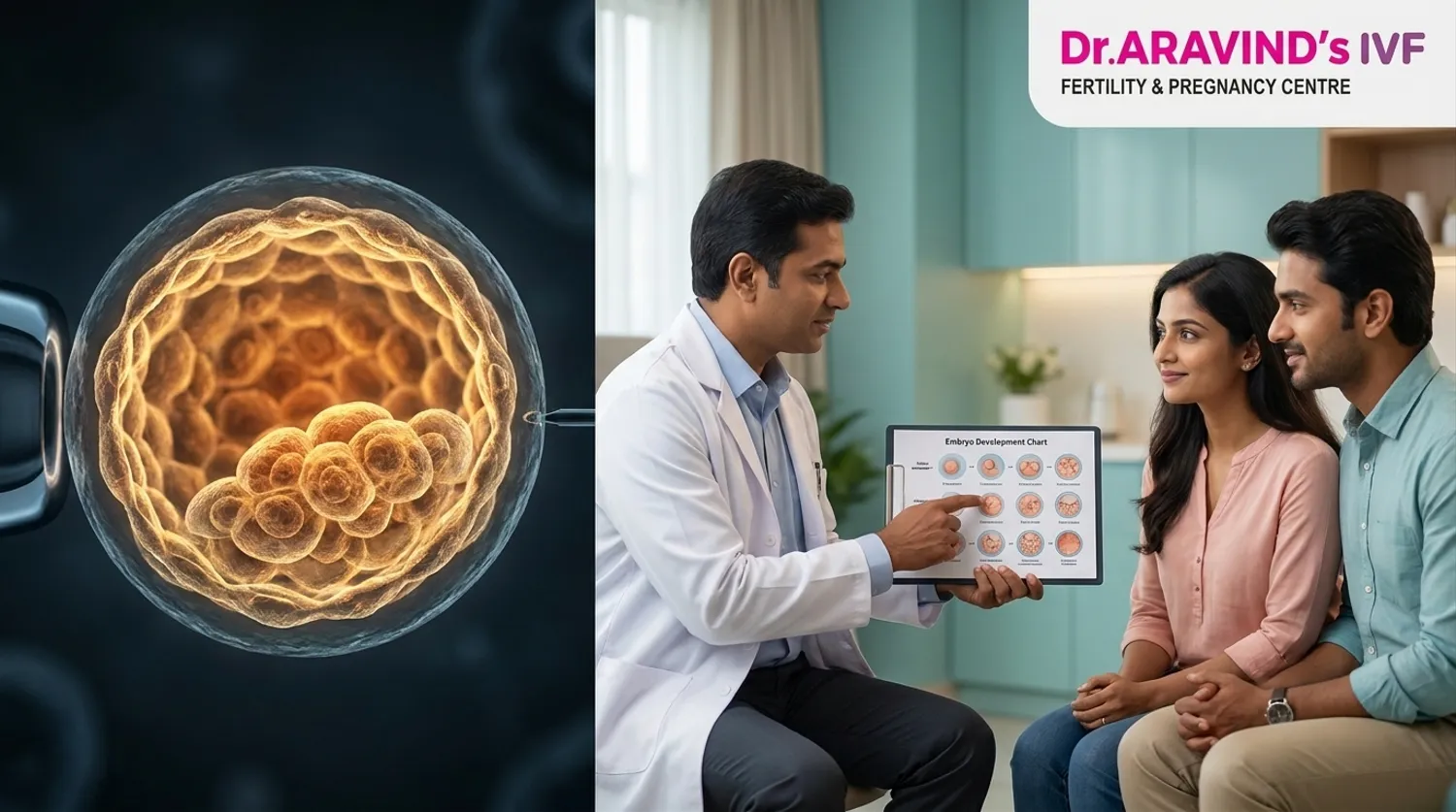
When couples begin their IVF journey, they often focus on the stimulation phase, the injections, the egg retrieval, and the fertilisation results. What happens in the days that follow, however, is equally important. The decision of when to transfer an embryo and at what stage of development it has reached can significantly influence whether a cycle succeeds or fails.
Blastocyst transfer has become one of the most discussed and clinically significant advances in modern IVF. Understanding what it means, why it matters, and when it is the right choice can help couples approach their treatment with greater clarity and confidence.
At Dr Aravind's IVF Fertility & Pregnancy Centre, recognised as the best fertility centre in Chennai, blastocyst culture and transfer is a core part of the clinic's IVF programme applied with precision and personalised to each couple's clinical picture.
What Is a Blastocyst and Why Does It Matter
In standard IVF, embryos are created through fertilisation in the laboratory. In the days following fertilisation, the embryo goes through several stages of development. A Day 3 embryo, sometimes called a cleavage stage embryo, contains approximately six to eight cells. A blastocyst is a Day 5 or Day 6 embryo that has continued developing to a more advanced stage, containing over 100 cells arranged into two distinct cell groups: one that will form the baby and one that will form the placenta.
The significance of reaching the blastocyst stage goes beyond cell count. An embryo that survives to Day 5 has demonstrated meaningful developmental competence. Many embryos that look healthy on Day 3 carry chromosomal abnormalities that cause them to arrest before Day 5. By extending culture to the blastocyst stage, the IVF laboratory effectively allows embryos to self-select those with stronger developmental potential to continue, while those that would not implant successfully do not make it to transfer.
This natural selection process is one of the primary reasons blastocyst transfer is associated with higher implantation and pregnancy rates compared to Day 3 transfers in many clinical scenarios.
Blastocyst Transfer Success Rates
The clinical outcomes associated with blastocyst transfer are among the most encouraging in modern reproductive medicine.
Research published in leading reproductive journals confirms that frozen blastocyst transfers are associated with higher clinical pregnancy and live birth rates than fresh cleavage stage transfers in most patient groups. For women under 35, live birth rates from frozen blastocyst transfers reach approximately 50 per cent per transfer. For women aged 35 to 37, the range is approximately 35 to 40 per cent. For women aged 38 to 40, outcomes fall in the 20 to 30 per cent range per transfer, while women over 40 face a steeper decline that often makes genetic testing or donor egg programmes the recommended path forward.
A key study found that combining one fresh cleavage stage transfer followed by a frozen blastocyst transfer achieved significantly higher cumulative pregnancy and live birth rates compared to a single fresh double embryo transfer, reinforcing the value of blastocyst culture in overall cycle planning.
The reason frozen blastocyst transfers consistently outperform fresh transfers in many programmes is straightforward. In a frozen cycle, the uterus has not been exposed to the hormonal stimulation used to grow eggs. The endometrial lining develops in a more natural hormonal environment, creating better synchronisation between the embryo and the uterine wall at the moment of transfer.
Blastocyst Transfer Versus Day 3 Transfer
The question of whether to transfer on Day 3 or Day 5 is not always straightforward. For most couples with multiple good-quality embryos, extended culture to the blastocyst stage offers clear advantages. Higher implantation rates per transfer, better identification of the strongest embryo, and the ability to perform preimplantation genetic testing on Day 5 all support blastocyst culture when the clinical circumstances allow it.
However, blastocyst transfer is not universally recommended for every patient. Couples with very few embryos, those with a history of poor embryo development, or those with specific clinical factors may be advised to transfer earlier. The right decision is always based on the individual patient's diagnostic profile, embryo quality on Day 3, and the clinical judgement of the treating specialist.
At the best IVF centre in Chennai, the culture protocol is never a one-size-fits-all decision. Each cycle is evaluated based on the actual performance of the embryos developing in the laboratory, and transfer timing is adjusted accordingly.
The Role of Genetic Testing in Blastocyst Cycles
Blastocyst stage embryos are the ideal candidates for preimplantation genetic testing, known as PGT-A. At the blastocyst stage, a small biopsy of cells from the outer layer of the embryo can be taken without harming the embryo's developmental potential. These cells are then tested for chromosomal abnormalities before transfer.
The ability to screen embryos genetically before transfer significantly reduces the risk of implantation failure and early miscarriage caused by chromosomal errors. For couples with recurrent implantation failure, recurrent pregnancy loss, advanced maternal age, or a history of chromosomally abnormal pregnancies, PGT-A in combination with blastocyst transfer represents one of the most powerful tools available in assisted reproduction today.
As one of the leading IVF centres in Chennai offering advanced embryology services, Dr. Aravind's IVF Fertility & Pregnancy Centre provides in-house PGT-A capability integrated with blastocyst culture, meaning couples benefit from both technologies within a single coordinated cycle.
Frozen Embryo Transfer and the Importance of Endometrial Preparation
When a blastocyst is frozen and transferred in a subsequent cycle, the success of that transfer depends heavily on how well the endometrium has been prepared. The uterine lining must reach an adequate thickness, typically at least eight millimetres, and the hormonal environment must closely replicate the conditions under which natural implantation would occur.
Endometrial preparation protocols vary between patients. Some women do well with a natural cycle approach, while others benefit from hormone replacement protocols using estrogen and progesterone. In cases of recurrent implantation failure, ERA testing may be recommended to identify the precise personalised implantation window before scheduling the transfer.
The endometrium is not a passive recipient. It is an active participant in implantation, and its preparation is treated with the same clinical rigour as the embryo culture process at Dr. Aravind's IVF Fertility & Pregnancy Centre.
Why the Quality of Your IVF Centre Determines Blastocyst Outcomes
Not all IVF laboratories produce the same blastocyst development rates. The culture environment, air quality, temperature stability, culture media composition, embryologist experience, and time-lapse monitoring capability all influence how many embryos successfully reach Day 5.
A clinic that achieves a 60 per cent blastocyst development rate will naturally offer more transfer options per retrieval cycle than one achieving 35 per cent. This difference directly affects cumulative success rates and the number of cycles a couple may need to go through to achieve a pregnancy.
The best IVF centre in India standard of laboratory practice that means consistent environmental controls, internationally trained embryologists, and monitoring technology that supports embryo development without unnecessary intervention. These are not optional features. They are the foundation of reliable blastocyst outcomes.
When choosing where to undergo IVF treatment, the quality of the embryology laboratory deserves as much consideration as the reputation of the treating doctor. At Dr Aravind's IVF Fertility & Pregnancy Centre, both are held to the same high standard because the path to successful blastocyst transfer begins with the very first day of embryo culture.
Conclusion
Blastocyst transfer represents one of the most meaningful advances in IVF over the past two decades. For the right patient, at the right stage of their cycle, with the right laboratory supporting the process, it consistently produces some of the highest implantation and live birth rates available in assisted reproduction.
If you have been considering IVF or have experienced previous cycle failures, understanding whether blastocyst transfer is the right approach for your specific situation is a conversation worth having with a specialist. The best fertility centre in Chennai will not apply a blanket protocol but will evaluate your individual clinical profile and build a transfer strategy around your unique embryo development, endometrial health, and reproductive history.
That personalised approach grounded in advanced laboratory science and genuine clinical expertise is what consistently turns IVF cycles into successful pregnancies.
FAQ
Q1. What is the main advantage of blastocyst transfer over Day 3 transfer? Blastocyst transfer allows embryos to self-select through extended culture, identifying those with stronger developmental potential. This typically results in higher implantation rates per transfer and reduces the number of transfers needed to achieve pregnancy.
Q2. Is blastocyst transfer suitable for everyone undergoing IVF? Not always. Couples with very few embryos or a history of poor embryo development may be advised to transfer on Day 3. The decision is made based on actual embryo performance in the laboratory and the clinical judgement of the treating specialist.
Q3. What is the success rate of frozen blastocyst transfer? For women under 35, frozen blastocyst transfer live birth rates are approximately 40 to 50 per cent per transfer. Rates decline with age, reaching approximately 20 to 30 per cent for women aged 38 to 40.
Q4. Can blastocyst transfer be combined with genetic testing? Yes. Day 5 blastocysts are the ideal candidates for PGT-A, which screens embryos for chromosomal abnormalities before transfer. This combination significantly reduces the risk of implantation failure and miscarriage caused by chromosomal errors.
Q5. How does the IVF laboratory quality affect blastocyst development? Laboratory conditions, including air quality, temperature stability, culture media, and embryologist experience, directly influence how many embryos successfully reach the blastocyst stage. Higher blastocyst development rates mean more transfer options per retrieval cycle and better overall outcomes.