The inside of a pipeline is invisible during operation. The corrosion progressing along the pipe wall, the wax buildup reducing flow capacity, the liquid accumulation creating slugging problems in gas pipelines — none of these conditions are accessible for inspection or remediation without stopping production and cutting the pipe open. Unless the pipeline has pigging infrastructure.
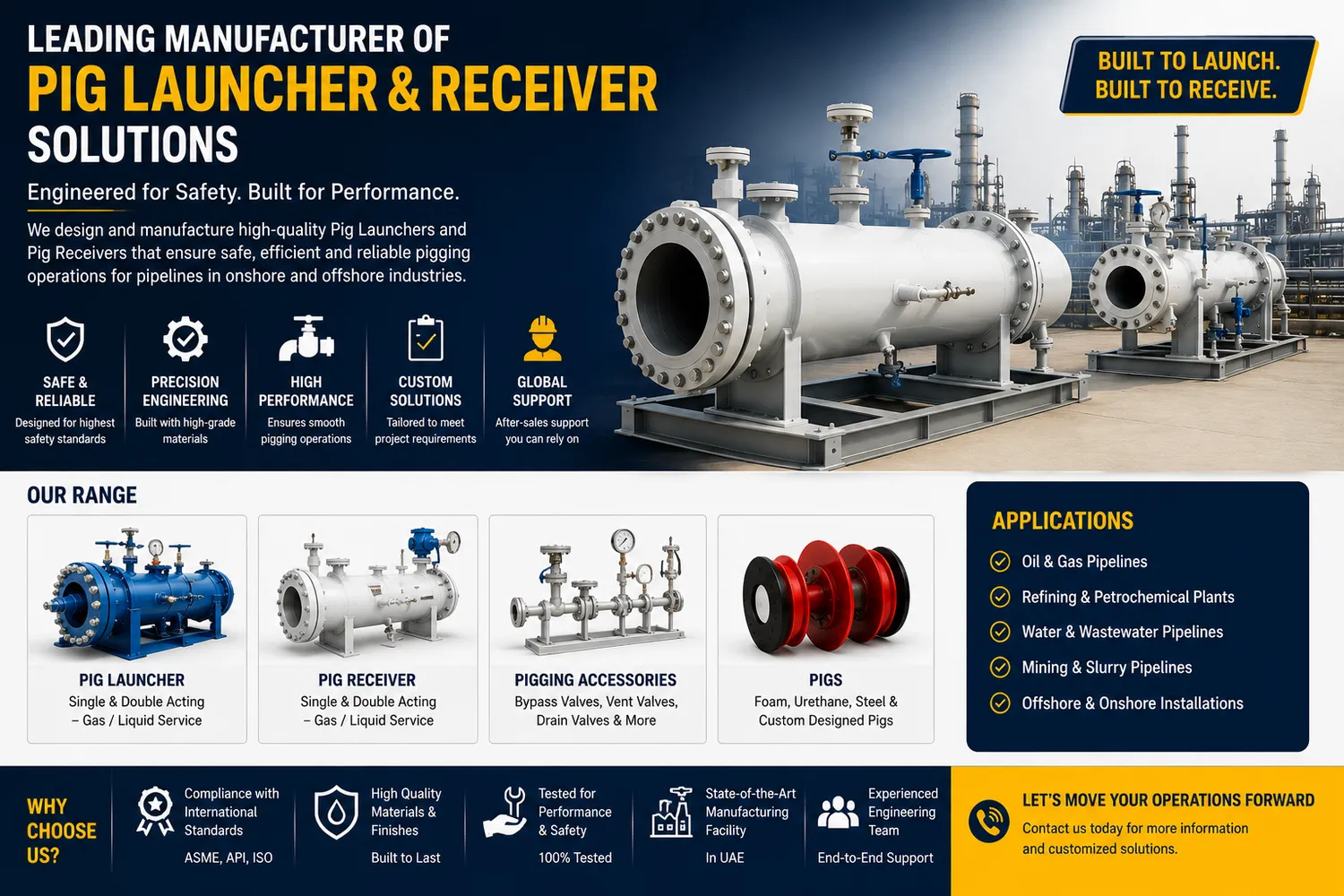
A pig launcher and receiver transforms a sealed pipeline into a maintainable asset. Through the launcher, maintenance pigs enter the pipeline for cleaning, inspection, or liquid displacement. At the receiver, they are retrieved after completing their traverse. Between these two operations, every pig run provides information about the pipeline's internal condition that external inspection cannot access — wall thickness profiles from intelligent pigging, deposit type and distribution from retrieved cleaning pigs, liquid volumes from displacement runs.
BERG Industries is an experienced Pig Launcher & Receiver Manufacturer serving UAE oil and gas, petrochemical, and water pipeline operators. We design and fabricate pig launchers and receivers to pipeline operating pressure class, in material grades appropriate for the service conditions, with closure mechanisms engineered for safe operation by trained maintenance personnel working within a pipeline operating company's safety management system.
Engineering for the Complete Maintenance Program, Not Just the Immediate Requirement
The most consequential decision in pig launcher and receiver specification is the barrel diameter and closure mechanism design — because these choices determine which pig types the facility can accommodate throughout the pipeline's operational life.
Specifying a launcher and receiver for the current maintenance program — today's cleaning pigs — without considering the future requirement for intelligent inspection pigging is a common specification error that creates expensive retrofit challenges when the integrity management program evolves. Intelligent inspection tools — magnetic flux leakage tools for metal loss detection, caliper tools for geometry assessment, ultrasonic tools for crack detection — are typically larger in diameter and more demanding in their handling requirements than cleaning pigs.
Our specification process for pig launchers and receivers begins with a maintenance program review — understanding the full range of pig types that the pipeline's maintenance and integrity management program will require over its service life — and designs the barrel diameter, closure mechanism, and kicker valve arrangement to accommodate this complete range. The incremental cost of specifying for intelligent pigging capability from the outset is small. The cost of retrofitting an existing launcher and receiver for intelligent tools that it was not designed to accommodate is large.
Static Equipment Integration: Complete Pigging Facility Supply
Comprehensive pigging facilities on major UAE pipelines include static equipment items beyond the launcher and receiver barrels — slug catchers for liquid management in gas pipeline service, drain vessels for safe pig trap depressurization, and filter vessels for processing liquids received during pig runs.
Static Equipment Manufacturer capability at BERG Industries provides these associated items as part of a coordinated pigging facility supply — all designed to consistent process conditions, fabricated under a single quality management system, and documented in a unified format. This single-source approach simplifies the regulatory submission and plant handover documentation for the complete pigging facility.
Oil and Gas Shutdown Support: Pig Launcher Maintenance During Plant Turnarounds
The inside of a pipeline is invisible during operation. The corrosion progressing along the pipe wall, the wax buildup reducing flow capacity, the liquid accumulation creating slugging problems in gas pipelines — none of these conditions are accessible for inspection or remediation without stopping production and cutting the pipe open. Unless the pipeline has pigging infrastructure.
A pig launcher and receiver transforms a sealed pipeline into a maintainable asset. Through the launcher, maintenance pigs enter the pipeline for cleaning, inspection, or liquid displacement. At the receiver, they are retrieved after completing their traverse. Between these two operations, every pig run provides information about the pipeline's internal condition that external inspection cannot access — wall thickness profiles from intelligent pigging, deposit type and distribution from retrieved cleaning pigs, liquid volumes from displacement runs.
BERG Industries is an experienced Pig Launcher & Receiver Manufacturer serving UAE oil and gas, petrochemical, and water pipeline operators. We design and fabricate pig launchers and receivers to pipeline operating pressure class, in material grades appropriate for the service conditions, with closure mechanisms engineered for safe operation by trained maintenance personnel working within a pipeline operating company's safety management system.
Engineering for the Complete Maintenance Program, Not Just the Immediate Requirement
The most consequential decision in pig launcher and receiver specification is the barrel diameter and closure mechanism design — because these choices determine which pig types the facility can accommodate throughout the pipeline's operational life.
Specifying a launcher and receiver for the current maintenance program — today's cleaning pigs — without considering the future requirement for intelligent inspection pigging is a common specification error that creates expensive retrofit challenges when the integrity management program evolves. Intelligent inspection tools — magnetic flux leakage tools for metal loss detection, caliper tools for geometry assessment, ultrasonic tools for crack detection — are typically larger in diameter and more demanding in their handling requirements than cleaning pigs.
Our specification process for pig launchers and receivers begins with a maintenance program review — understanding the full range of pig types that the pipeline's maintenance and integrity management program will require over its service life — and designs the barrel diameter, closure mechanism, and kicker valve arrangement to accommodate this complete range. The incremental cost of specifying for intelligent pigging capability from the outset is small. The cost of retrofitting an existing launcher and receiver for intelligent tools that it was not designed to accommodate is large.
Static Equipment Integration: Complete Pigging Facility Supply
Comprehensive pigging facilities on major UAE pipelines include static equipment items beyond the launcher and receiver barrels — slug catchers for liquid management in gas pipeline service, drain vessels for safe pig trap depressurization, and filter vessels for processing liquids received during pig runs.
Static Equipment Manufacturer capability at BERG Industries provides these associated items as part of a coordinated pigging facility supply — all designed to consistent process conditions, fabricated under a single quality management system, and documented in a unified format. This single-source approach simplifies the regulatory submission and plant handover documentation for the complete pigging facility.
Oil and Gas Shutdown Support: Pig Launcher Maintenance During Plant Turnarounds
Oil and Gas Shutdown and Maintenance works support for pig launchers and receivers during plant turnarounds covers the maintenance activities that are most efficiently conducted when the connected pipeline systems are already offline: closure door seal replacement, barrel internal inspection and recoating, kicker and equalization valve internal refurbishment, and pressure safety device recertification.
BERG Industries' manufacturer knowledge of the pig launchers and receivers we supply provides a genuine advantage during shutdown maintenance — we know the correct condition of closure mechanisms, the sealing system details, and the maintenance access provisions that the design incorporates, allowing efficient and correct maintenance execution within the compressed shutdown timeline.
Pressure Vessels: Pigging Infrastructure Built to Code
Pig launchers and receivers are pressure-containing assemblies designed to the pipeline's full operating pressure class — with the same design code compliance, material specifications, welding procedure qualifications, and inspection requirements as process pressure vessels.
Pressure Vessels manufacturer in UAE capability at BERG Industries ensures that our pig launcher and receiver fabrication meets these code requirements — with ASME Section VIII documentation for the barrel assemblies, qualified welding procedures for the connecting pipework, and third-party inspection at defined hold points. The documentation package we provide supports the operating company's regulatory submission for the new pigging facility and provides the reference record for future inspection management.
Piping Fabrication: Connecting Pigging Infrastructure to the Pipeline
Piping fabrication for pig launcher and receiver connecting pipework — the mainline tee, bypass valve arrangement, kicker line, pressure equalization connections, and drain systems — must be fabricated to the pipeline's operating pressure class. When piping and pig trap fabrication are both within BERG Industries' scope, the connecting pipework dimensions are confirmed against the pig trap's as-built nozzle positions before dispatch, preventing the dimensional conflicts that arise when separately procured scopes have different dimensional interpretations of the same design.
Conclusion: Pigging Infrastructure Quality Enables Pipeline Integrity Management
A pipeline integrity management program is only as effective as the pigging infrastructure that enables it. Well-designed launchers and receivers — correctly sized for the full range of pig types, safely operable, and properly integrated with the pipeline's valve arrangement — enable rigorous pigging programs that keep pipeline condition known and managed throughout the asset's life.
BERG Industries' pig launcher and receiver manufacturing capability provides UAE pipeline operators with pigging infrastructure engineered for long-term reliability, fabricated to code standards, and designed to accommodate the complete maintenance program that responsible pipeline operation requires.
Frequently Asked Questions
Q1. What barrel length is required for a pig launcher, and how is it calculated?
Pig launcher barrel length is determined by the longest pig in the maintenance program plus the minimum insertion length required behind the pig before the closure door can be sealed. The longest pig in most programs is typically an intelligent inspection tool — which may be 1.5 to 3 times the pipeline diameter in body length for multi-module tools. The minimum insertion length behind the pig is typically the launcher closure door sealing length — the distance from the pig's rear to the barrel closure that must be clear of the pig body before the door engages its sealing position. Adding the longest pig body length to the minimum insertion length gives the minimum useful barrel length. We add a minimum of 300mm to this calculated minimum to provide a practical operational margin — allowing the pig to be fully inserted with the closure door in a position where it can be operated safely without the pig body interfering with the door mechanism.
Q2. How does BERG Industries specify the kicker valve for a pig launcher to ensure reliable pig launching?
The kicker valve controls the flow of pipeline fluid from the mainline into the launcher barrel — which launches the pig when the mainline bypass is closed and differential pressure drives the pig into the mainline. The kicker valve specification must consider: the flow area required to deliver sufficient flow velocity to the pig for reliable launch; the valve closure capability for isolating the kicker line when the pig trap is out of service; and the connection orientation on the launcher barrel that positions the kicker flow for the most effective pig drive direction. For gas pipelines where compressible flow behavior may affect launching dynamics, the kicker valve sizing is confirmed through a flow analysis of the launching sequence — ensuring that the kicker flow provides reliable pig drive without excessive velocity that could damage the pig body or create dynamic pressure exceedances in the launcher barrel.
Q3. What material specification does BERG Industries apply to pig launchers and receivers in UAE sour service pipelines?
For pig launchers and receivers in sour service — pipelines with hydrogen sulfide above the NACE MR0175 threshold — all pressure-containing materials must comply with NACE MR0175/ISO 15156 for sulfide stress cracking resistance. For the barrel shell and heads in sour service, carbon steel to ASTM A516 Grade 70 with hardness controlled to HRC 22 maximum is the standard specification. Nozzle forgings must also meet NACE hardness limits, and weld heat-affected zones must be post-weld heat treated or otherwise controlled to meet the maximum hardness requirement in the HAZ. Closure door mechanisms in sour service require careful material selection for all components — bolting, sealing surfaces, and mechanical operating components — with each material assessed against the specific sour service conditions of the pipeline. We provide the NACE compliance assessment for sour service pig launchers and receivers as part of our design documentation.
Q4. How does BERG Industries approach the design of pig launchers and receivers for offshore platform installations?
Offshore platform pig launcher and receiver installations have additional design requirements beyond onshore service: weight optimization for platform topside weight budgets, where we minimize structural weight through optimized barrel dimensions and support configurations; compact dimensional envelope for limited platform deck space, where barrel orientation (horizontal vs. angled) and support structure compactness are considered from the outset; structural qualification for offshore dynamic loading — the structural design must address wave-induced platform motion in addition to the static equipment weight and operating loads; material specification for marine exposure — all external surfaces require marine-grade corrosion protection, and fasteners must be stainless steel or hot-dip galvanized; and access considerations for offshore maintenance — closure mechanisms and pig handling provisions must be operable safely by personnel wearing offshore personal protective equipment, including fall arrest harnesses that restrict movement.
Q5. What post-installation testing should be conducted on pig launchers and receivers before their first pigging operation?
Post-installation testing before the first pigging operation should confirm that the pig trap is ready for safe operation. Hydrostatic pressure testing of the complete pig trap assembly — including the barrel, closure door, and all connecting valves and fittings — at 1.25 times the maximum allowable operating pressure, verifying that there are no leaks at any joints or connections. Valve leak testing for all isolation valves — confirming that each valve seats leak-tight when closed. Closure door operational testing — opening and closing the closure door through its full operating range, verifying that the locking mechanism engages and releases correctly and that the door seals correctly in the closed position. Pressure equalization sequence test — simulating the complete pig trap pressurization and depressurization sequence to confirm that all steps can be performed safely in the correct order. Instrument calibration verification — confirming that all pressure gauges and any other instruments on the pig trap read correctly against reference standards. These tests provide the documented baseline condition record for the pig trap at commissioning, against which future inspection findings can be assessed. support for pig launchers and receivers during plant turnarounds covers the maintenance activities that are most efficiently conducted when the connected pipeline systems are already offline: closure door seal replacement, barrel internal inspection and recoating, kicker and equalization valve internal refurbishment, and pressure safety device recertification.
BERG Industries' manufacturer knowledge of the pig launchers and receivers we supply provides a genuine advantage during shutdown maintenance — we know the correct condition of closure mechanisms, the sealing system details, and the maintenance access provisions that the design incorporates, allowing efficient and correct maintenance execution within the compressed shutdown timeline.
Pressure Vessels: Pigging Infrastructure Built to Code
Pig launchers and receivers are pressure-containing assemblies designed to the pipeline's full operating pressure class — with the same design code compliance, material specifications, welding procedure qualifications, and inspection requirements as process pressure vessels.
Pressure Vessels manufacturer in UAE capability at BERG Industries ensures that our pig launcher and receiver fabrication meets these code requirements — with ASME Section VIII documentation for the barrel assemblies, qualified welding procedures for the connecting pipework, and third-party inspection at defined hold points. The documentation package we provide supports the operating company's regulatory submission for the new pigging facility and provides the reference record for future inspection management.
Piping Fabrication: Connecting Pigging Infrastructure to the Pipeline
Piping fabrication for pig launcher and receiver connecting pipework — the mainline tee, bypass valve arrangement, kicker line, pressure equalization connections, and drain systems — must be fabricated to the pipeline's operating pressure class. When piping and pig trap fabrication are both within BERG Industries' scope, the connecting pipework dimensions are confirmed against the pig trap's as-built nozzle positions before dispatch, preventing the dimensional conflicts that arise when separately procured scopes have different dimensional interpretations of the same design.
Conclusion: Pigging Infrastructure Quality Enables Pipeline Integrity Management
A pipeline integrity management program is only as effective as the pigging infrastructure that enables it. Well-designed launchers and receivers — correctly sized for the full range of pig types, safely operable, and properly integrated with the pipeline's valve arrangement — enable rigorous pigging programs that keep pipeline condition known and managed throughout the asset's life.
BERG Industries' pig launcher and receiver manufacturing capability provides UAE pipeline operators with pigging infrastructure engineered for long-term reliability, fabricated to code standards, and designed to accommodate the complete maintenance program that responsible pipeline operation requires.
Frequently Asked Questions
Q1. What barrel length is required for a pig launcher, and how is it calculated?
Pig launcher barrel length is determined by the longest pig in the maintenance program plus the minimum insertion length required behind the pig before the closure door can be sealed. The longest pig in most programs is typically an intelligent inspection tool — which may be 1.5 to 3 times the pipeline diameter in body length for multi-module tools. The minimum insertion length behind the pig is typically the launcher closure door sealing length — the distance from the pig's rear to the barrel closure that must be clear of the pig body before the door engages its sealing position. Adding the longest pig body length to the minimum insertion length gives the minimum useful barrel length. We add a minimum of 300mm to this calculated minimum to provide a practical operational margin — allowing the pig to be fully inserted with the closure door in a position where it can be operated safely without the pig body interfering with the door mechanism.
Q2. How does BERG Industries specify the kicker valve for a pig launcher to ensure reliable pig launching?
The kicker valve controls the flow of pipeline fluid from the mainline into the launcher barrel — which launches the pig when the mainline bypass is closed and differential pressure drives the pig into the mainline. The kicker valve specification must consider: the flow area required to deliver sufficient flow velocity to the pig for reliable launch; the valve closure capability for isolating the kicker line when the pig trap is out of service; and the connection orientation on the launcher barrel that positions the kicker flow for the most effective pig drive direction. For gas pipelines where compressible flow behavior may affect launching dynamics, the kicker valve sizing is confirmed through a flow analysis of the launching sequence — ensuring that the kicker flow provides reliable pig drive without excessive velocity that could damage the pig body or create dynamic pressure exceedances in the launcher barrel.
Q3. What material specification does BERG Industries apply to pig launchers and receivers in UAE sour service pipelines?
For pig launchers and receivers in sour service — pipelines with hydrogen sulfide above the NACE MR0175 threshold — all pressure-containing materials must comply with NACE MR0175/ISO 15156 for sulfide stress cracking resistance. For the barrel shell and heads in sour service, carbon steel to ASTM A516 Grade 70 with hardness controlled to HRC 22 maximum is the standard specification. Nozzle forgings must also meet NACE hardness limits, and weld heat-affected zones must be post-weld heat treated or otherwise controlled to meet the maximum hardness requirement in the HAZ. Closure door mechanisms in sour service require careful material selection for all components — bolting, sealing surfaces, and mechanical operating components — with each material assessed against the specific sour service conditions of the pipeline. We provide the NACE compliance assessment for sour service pig launchers and receivers as part of our design documentation.
Q4. How does BERG Industries approach the design of pig launchers and receivers for offshore platform installations?
Offshore platform pig launcher and receiver installations have additional design requirements beyond onshore service: weight optimization for platform topside weight budgets, where we minimize structural weight through optimized barrel dimensions and support configurations; compact dimensional envelope for limited platform deck space, where barrel orientation (horizontal vs. angled) and support structure compactness are considered from the outset; structural qualification for offshore dynamic loading — the structural design must address wave-induced platform motion in addition to the static equipment weight and operating loads; material specification for marine exposure — all external surfaces require marine-grade corrosion protection, and fasteners must be stainless steel or hot-dip galvanized; and access considerations for offshore maintenance — closure mechanisms and pig handling provisions must be operable safely by personnel wearing offshore personal protective equipment, including fall arrest harnesses that restrict movement.
Q5. What post-installation testing should be conducted on pig launchers and receivers before their first pigging operation?
Post-installation testing before the first pigging operation should confirm that the pig trap is ready for safe operation. Hydrostatic pressure testing of the complete pig trap assembly — including the barrel, closure door, and all connecting valves and fittings — at 1.25 times the maximum allowable operating pressure, verifying that there are no leaks at any joints or connections. Valve leak testing for all isolation valves — confirming that each valve seats leak-tight when closed. Closure door operational testing — opening and closing the closure door through its full operating range, verifying that the locking mechanism engages and releases correctly and that the door seals correctly in the closed position. Pressure equalization sequence test — simulating the complete pig trap pressurization and depressurization sequence to confirm that all steps can be performed safely in the correct order. Instrument calibration verification — confirming that all pressure gauges and any other instruments on the pig trap read correctly against reference standards. These tests provide the documented baseline condition record for the pig trap at commissioning, against which future inspection findings can be assessed.