Process safety system skids occupy a unique position in the industrial equipment landscape. Unlike standard process skids — where a commissioning problem creates operational disruption and financial cost — a PSS skid that fails to perform its safety function when demanded creates the conditions for a major process safety incident. The consequences are measured not in production revenue but in the harm to people, damage to assets, and environmental impact that the safety system was designed to prevent.
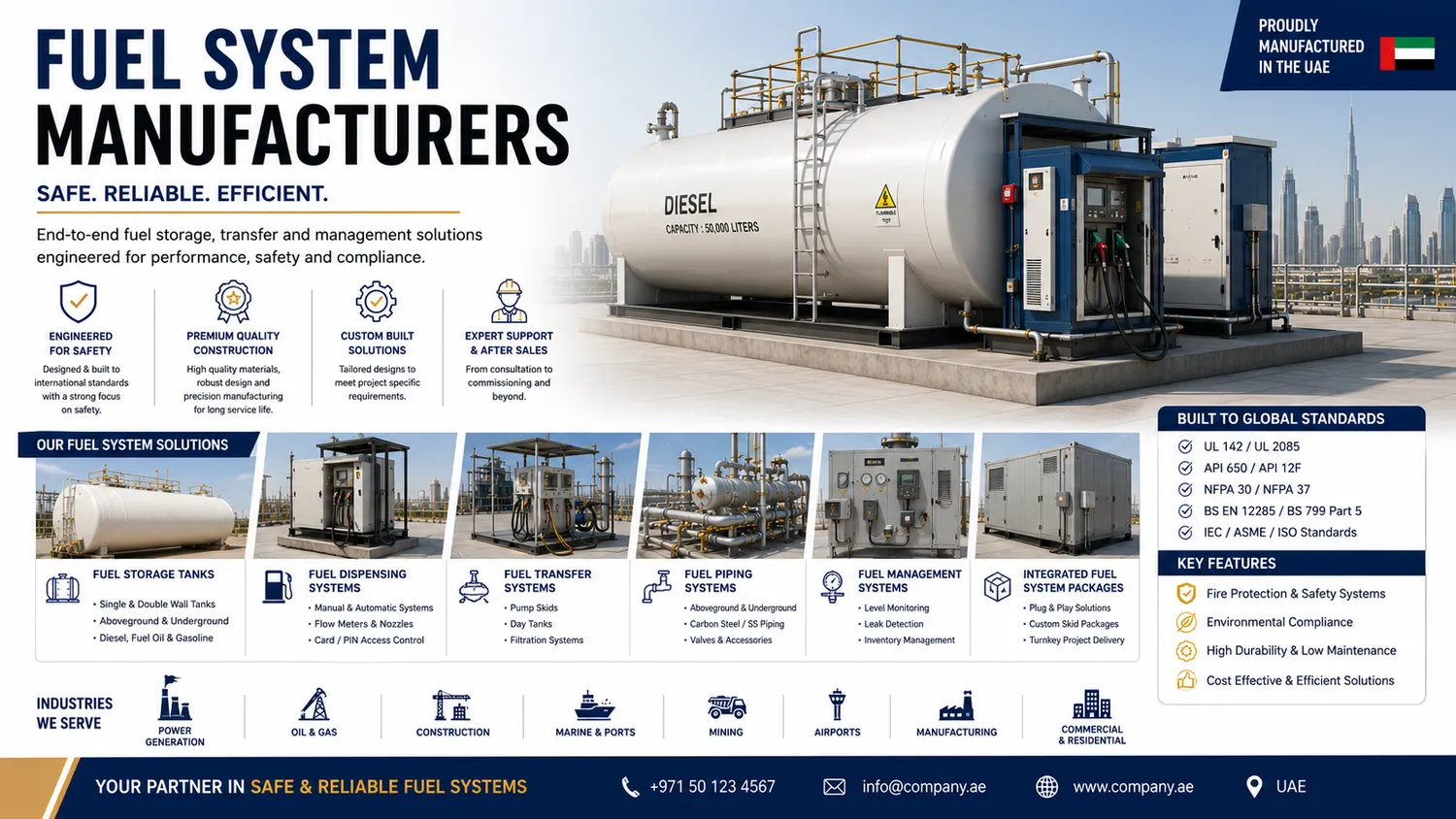
This fundamental difference in consequence is why BERG Industries, as a PSS Skid Manufacturer UAE, applies functional safety engineering discipline to every PSS skid project — not just fabrication quality. We design safety instrumented systems that meet the required Safety Integrity Level, verify their compliance through rigorous calculation, and test every safety function comprehensively before the package is commissioned into service.
If your project requires a PSS skid — an emergency shutdown package, a high-integrity pressure protection system, or a fire and gas system interface package — understanding what genuine PSS skid manufacturing competence requires is essential before you select your supplier.
What SIL-Rated PSS Skid Design Actually Requires
Safety Integrity Level is not a marketing claim or a component selection criterion. It is a quantitative measure of a safety system's reliability — the probability that it will correctly perform its safety function when demanded. IEC 61511 defines four SIL levels, with SIL 1 having the lowest reliability requirement (probability of failure on demand between 1/10 and 1/100) and SIL 4 the highest (between 1/10,000 and 1/100,000).
Achieving a specified SIL level requires:
SIL determination — establishing what SIL level is required for each safety function, based on the process hazard analysis and the risk reduction required to reduce the process risk to tolerable levels.
Architecture selection — choosing the redundancy and voting arrangement (single channel, 1oo2, 2oo3, or other configurations) that achieves the required hardware fault tolerance for the target SIL level.
Component selection — identifying instruments, logic solvers, and final elements that have published and validated failure rate data supporting the SIL calculation.
SIL verification — performing the probability of failure on demand calculation that demonstrates, quantitatively, that the selected architecture and components achieve the required reliability.
Proof test procedure development — defining the periodic testing that must be performed to maintain the calculated reliability throughout the operational life.
BERG Industries' functional safety engineering team performs all of these steps as part of the PSS skid design scope. Our SIL verification calculations use validated failure rate data, our component selections are made with reference to published SIL data sheets, and our FAT procedures include comprehensive safety function testing against the Safety Requirements Specification.
Skid Packages and Electrical Skids: Power for Safety-Critical Applications
Skid Packages & Electrical Skids for PSS applications require dedicated, independent power supplies — separate from the normal plant electrical distribution — to ensure that safety functions remain available even when normal power has failed or been de-energized during an emergency. We design power supply skids for PSS applications with UPS backup, battery sizing for the required holdover time, and comprehensive power supply monitoring that alerts operators to any degradation before the safety function is affected.
Packaged Systems: Complete Safety Package Delivery
Packaged system and Skid procurement for PSS applications integrates the complete safety instrumented system — sensors, logic solver, final elements, and associated power supply and communications — into a single factory-tested package. This integration approach eliminates the interface ambiguity between separately procured PSS components that is a common source of commissioning problems in safety-critical applications.
Technical and Modular Solutions: Non-Standard Safety System Architectures
Standard PSS architectures address most UAE oil and gas and petrochemical safety system requirements. For applications where standard configurations are not adequate — unusual process conditions, complex voting logic, or integration requirements with existing plant safety systems — Technical & Modular Solutions capability allows us to develop bespoke safety system architectures from the specific functional safety requirements of the application.
Factory Acceptance Testing for PSS Skids: Safety Function Verification
FAT for a PSS skid is substantially more rigorous than for standard process skids. In addition to functional tests covering all process measurements and normal operating functions, our PSS FAT includes:
Complete safety function testing — verifying that every safety function activates correctly when the associated process parameter reaches its defined trip setpoint, within the required response time.
Failure mode testing — simulating sensor failures, logic solver faults, and power supply interruptions to verify that the system fails safely and generates the correct diagnostic alarms.
Diagnostic coverage verification — confirming that the diagnostic functions achieve the coverage rates assumed in the SIL verification calculation.
The FAT is conducted with the client's functional safety engineer present and, for SIL 2 and above applications, with the independent functional safety assessor as a witness.
Conclusion: PSS Skid Selection Requires Functional Safety Engineering, Not Just Fabrication Quality
The PSS skid manufacturer who can produce a physically well-made package but cannot demonstrate SIL verification, validated failure rate data, and comprehensive safety function testing is not delivering a SIL-rated safety system — regardless of what their certification claims. BERG Industries' PSS skid capability is built on genuine functional safety engineering competence, and we welcome the rigorous pre-qualification assessments that safety-critical applications demand.
Frequently Asked Questions
Q1. What functional safety standards does BERG Industries apply to PSS skid design?
We design PSS skids in accordance with IEC 61511 (Functional Safety: Safety Instrumented Systems for the Process Industry Sector), which is the process industry application standard for safety instrumented systems. For the underlying functional safety engineering of sensors, logic solvers, and final elements, we reference IEC 61508 (Functional Safety of E/E/PE Safety-Related Systems). For oil and gas applications where ADNOC or major IOC standards apply, we also reference ADNOC specifications and the client's project safety engineering standards. Our functional safety engineering team holds relevant functional safety competence qualifications, and we can provide evidence of this competence as part of the pre-qualification process.
Q2. How does BERG Industries document SIL verification for a PSS skid?
Our SIL verification documentation starts with the Safety Requirements Specification — defining the safety function, the required SIL level, the design intent, the process demands and demand rate, and the required response time. The SIL verification calculation then demonstrates, using the selected component failure rate data from certified sources, that the probability of failure on demand for the complete safety instrumented function — sensor, logic solver, and final element — is within the target range for the required SIL level. We use recognized SIL calculation software and reference component failure rate data from OREDA, exida, or the component manufacturer's published SIL data sheets. The complete verification package — Safety Requirements Specification, calculation inputs and results, component data sheets, and calculation software output — is provided as part of the PSS skid documentation package.
Q3. What is the typical proof test interval for a SIL 2 PSS skid in UAE oil and gas service?
The proof test interval for a SIL 2 PSS skid depends on the specific system architecture, the diagnostic coverage of the selected components, and the dangerous undetected failure rates of the system elements. A typical SIL 2 safety function with standard 1oo2 voting architecture and good diagnostic coverage — 90 percent or above for the logic solver and process sensors — typically requires proof testing every 12 to 24 months to maintain the PFD within the SIL 2 target range. The proof test interval is a design parameter established during the SIL verification calculation, not a fixed value that applies to all SIL 2 systems. We design our PSS skids with the proof test interval aligned to the client's planned shutdown cycle wherever possible, allowing proof testing to be conducted during planned plant outages without additional production interruptions.
Q4. How does BERG Industries handle the independence requirement between the PSS and the basic process control system?
IEC 61511 requires that the Safety Instrumented System is independent of the Basic Process Control System — sharing sensors, logic solvers, or actuators between the SIS and BPCS is prohibited where it would create common cause failure vulnerability that could defeat both systems simultaneously. Our PSS skid designs use dedicated SIS sensors separate from any BPCS measurement devices on the same process variable, a dedicated SIL-rated logic solver separate from the process control system PLC or DCS, and dedicated SIS actuators or actuator circuits that are not shared with BPCS output signals. Where the SIS must communicate with the BPCS — for alarm annunciation or sequence of events reporting — this communication is one-way from SIS to BPCS and uses communication interfaces that cannot affect SIS function if the BPCS fails or is compromised.
Q5. What happens if a safety function fails its SIL verification calculation during the design phase?
If the initial SIL verification calculation shows that the designed system does not achieve the required PFD for the target SIL level, we have several engineering responses available. We can increase the voting redundancy — changing from a single channel to 1oo2 voting, for example — which reduces the PFD by improving fault tolerance. We can improve the diagnostic coverage — selecting components with higher self-diagnostic coverage — which reduces the dangerous undetected failure rate. We can reduce the proof test interval — increasing the frequency of functional testing — which reduces the accumulated PFD between tests. Or we can select components with lower dangerous failure rates — better-quality sensors, valves with higher diagnostic coverage — which directly improves the PFD calculation. The engineering judgment about which option is most appropriate depends on the specific system configuration, the practicality of the alternative approaches, and the client's operational and cost preferences.