Gas-Insulated Switchgear at transmission voltage levels is among the most technically sophisticated and capital-intensive electrical equipment deployed in the UAE's power network. GIS installations at major transmission substations — 33kV through 400kV and above — protect and control the power flows that determine grid stability for cities, industrial zones, hospitals, and data centers across the region. Individual GIS installations represent investments of tens to hundreds of millions of dirhams, with design service lives of 30 to 40 years.
The container housing this equipment must maintain the internal environmental conditions that the GIS manufacturer specifies for reliable operation — temperature within defined limits, humidity below condensation threshold, and particulate contamination excluded — continuously throughout the GIS asset's service life. A GIS Container Manufacturer UAE who designs this container as a precision environmental control system, engineered from the GIS manufacturer's specific requirements, protects the grid asset it houses. A manufacturer who treats it as a standard prefabricated building with additional specifications added creates the conditions for the operational problems that appear years into service.
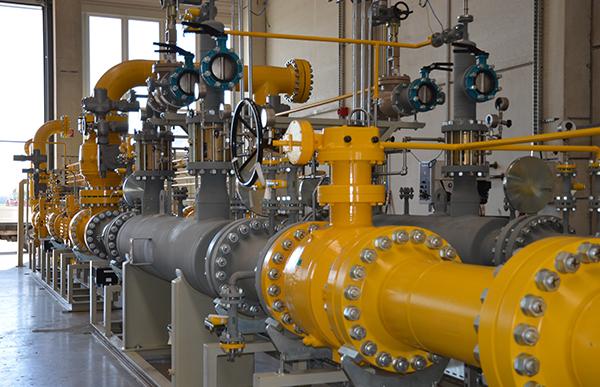
BERG Industries designs and manufactures GIS containers that start from the GIS equipment's requirements and engineer the building outward — HVAC systems sized for UAE climate conditions at the specific installation location, positive pressure ventilation designed to exclude dust at the actual dust loading of the site, and structural sealing systems verified to maintain performance through decades of thermal cycling.
The UAE Climate Challenge for GIS Container Environmental Control
GIS manufacturers typically specify maximum and minimum operating temperatures, maximum relative humidity, and minimum air quality standards for the equipment's internal environment. The challenge in UAE service is that the UAE climate is more demanding than the standard conditions these specifications were developed against.
Peak summer ambient temperatures exceeding 50°C at some UAE inland locations, combined with solar heat gain through the container roof, create cooling loads that overwhelm HVAC systems sized for standard ambient conditions of 35°C or 40°C. The consequence is internal temperatures that exceed the GIS manufacturer's maximum during summer peaks — causing accelerated aging of electronic control components, secondary wiring insulation, and SF6 sealing systems that determines the GIS equipment's long-term reliability.
Our thermal modeling for GIS containers starts from the GIS equipment manufacturer's actual heat generation data — obtained from their technical documentation — adds the external heat gain calculated for UAE peak summer conditions at the specific installation location and orientation, and sizes the HVAC system to maintain internal temperature within the GIS manufacturer's specified range with N+1 redundancy. One HVAC unit can fail completely without internal conditions exceeding limits before maintenance can respond.
Modular Technical Buildings: GIS Containers in the Broader Modular Buildings Family
Moudular Technical Buildings (E HOUSE) manufacturing capability at BERG Industries positions GIS containers as the most technically demanding variant within a broader family of factory-built technical buildings — E-Houses, control rooms, generator enclosures, and combined power facilities. The engineering disciplines applied to GIS container design — thermal modeling, structural analysis, sealing system specification, and Factory Acceptance Testing — are the same disciplines applied across our full modular buildings range, at the technical level appropriate for each application.
Electrical Houses: Integrated Substation Control Infrastructure
Major GIS substations require protection and control infrastructure alongside the primary GIS equipment — relay rooms, SCADA rooms, battery and UPS rooms, and telecommunications rooms. Electrical Houses Manufacturer capability at BERG Industries delivers these facilities as factory-assembled, factory-tested units, with comprehensive Factory Acceptance Testing covering every protection function, control element, and auxiliary system before delivery to the substation site.
Technical and Modular Solutions: Non-Standard GIS Container Requirements
Technical & Modular Solutions capability addresses GIS container applications that fall outside standard configurations — unusual voltage levels, extreme environmental conditions beyond standard specifications, or multi-manufacturer GIS installations in configurations that standard container templates cannot accommodate. For these non-standard requirements, our engineering team develops solutions from the technical requirements rather than adapting standard products that do not fully address them.
Switchgear Enclosures: Distribution Infrastructure for Substation Sites
GIS substations also require switchgear enclosures for the medium voltage and low voltage distribution infrastructure surrounding the primary GIS installation. Switchgear Enclosure Manufacturer UAE capability at BERG Industries provides these distribution enclosures with the same engineering discipline as our GIS containers — thermal analysis, ingress protection specification, and cable management design for the specific equipment and installation conditions.
Conclusion: GIS Container Quality Is Grid Asset Management
The investment in a correctly engineered GIS container — sized for UAE climate extremes, fabricated with precision, and tested comprehensively — is a small fraction of the GIS equipment's capital cost and protects it throughout its 30 to 40-year service life. Inadequately engineered containers compromise the performance of the expensive equipment they house, creating maintenance demands and operational risks that are disproportionate to the procurement savings.
BERG Industries' GIS container manufacturing capability — thermal engineering, structural design, sealing system specification, and Factory Acceptance Testing — delivers containers that protect grid-critical assets throughout their full operational life.
Frequently Asked Questions
Q1. How does BERG Industries determine the correct HVAC redundancy level for a GIS container?
We determine HVAC redundancy through a failure mode analysis — calculating how long before internal conditions reach critical limits after a single HVAC unit failure on the worst-case ambient day. For GIS containers at critical transmission substations where forced outage has significant economic and social consequences, N+1 redundancy is our standard recommendation: one unit can fail without conditions exceeding limits before maintenance can respond. For very critical assets — major transmission nodes serving large cities — N+2 redundancy provides resilience against simultaneous failure of two units. The failure mode analysis is documented and provided to the client as part of the design documentation, giving the asset owner the information needed to confirm that the redundancy level is consistent with their maintenance response capability.
Q2. How is the positive pressure ventilation system for a GIS container specified and tested?
The positive pressure ventilation system maintains a small positive pressure differential — typically 10 to 30 Pascals — between the container interior and the external atmosphere, preventing dust infiltration through door seals, cable gland entries, and structural joints. The system specification covers the supply fan capacity for the required pressure differential, the filter specification for the local dust loading conditions, the control logic for maintaining positive pressure under varying conditions, and the monitoring alarm for loss of positive pressure. During Factory Acceptance Testing, we verify that the system achieves the specified differential pressure with all doors closed and sealed, that the alarm activates when pressure drops below the minimum threshold, and that the system re-establishes the required differential pressure within the specified time after the alarm condition is cleared.
Q3. What maintenance does BERG Industries recommend for GIS container HVAC systems in UAE service?
Monthly: visual inspection of HVAC units for unusual noise, vibration, or refrigerant leaks; verification that positive pressure indication is within the normal range. Quarterly: HVAC filter inspection and replacement if contamination reduces airflow below the design value — replacement intervals may be as short as six weeks at UAE desert sites with high dust loading. Annual: HVAC unit full service covering refrigerant level verification, condenser and evaporator coil cleaning, fan belt and bearing inspection, and control calibration verification; door seal compression measurement with replacement of any seals showing hardening or compression set exceeding 30 percent; cable gland integrity inspection; external coating condition survey with remedial treatment of any damage. Five-year: comprehensive structural assessment including coating condition survey and fastener integrity verification. All maintenance records should be retained as part of the container's operational record.
Q4. How does BERG Industries manage the interface between GIS container design and GIS equipment procurement?
Effective interface management between GIS container and GIS equipment requires early engagement — we need the GIS equipment manufacturer's installation requirements before the container design is advanced, not after. These requirements specify the environmental conditions to be maintained, the floor loading distribution from each GIS bay, the cable entry locations and minimum dimensions, the access requirements for maintenance activities, and if applicable, any special requirements for the specific GIS technology (SF6 gas handling provisions, dry air system connections, etc.). Our container design is developed to meet all of these requirements simultaneously with the client's requirements for the installation location. Where the GIS equipment procurement is not completed when container design begins, we design to the parameters of the shortlisted GIS manufacturers and confirm compliance with the selected manufacturer's requirements when procurement is finalized.
Q5. Can a BERG Industries GIS container be designed for a future GIS bay addition?
Yes. Designing GIS containers for future bay additions is standard practice in substations with phased capacity programs. The container is designed at its ultimate buildout dimensions, with the structural system and HVAC sized for the complete equipment complement. Spaces for future bays are provided with temporary end walls at the future bay location, pre-installed cable management provisions and HVAC ductwork extended to the future bay spaces, and structural connection points designed for the future bay's equipment loads. When the future bay is added, the installation requires only removal of the temporary end wall, setting the new GIS bay in position, and connecting to the pre-installed services — without structural modification to the existing installed section. We document the future expansion provisions in the container's design documentation, providing the asset owner with a clear reference for the expansion work when it is required.