Gas-Insulated Switchgear at UAE transmission voltage levels — 33kV through 400kV and above — is among the most technically sophisticated and capital-intensive equipment installed in the region's power network. A single GIS bay represents a multi-million dirham investment. A major GIS substation installation may represent hundreds of millions. These assets are designed for service lives of 30 to 40 years — protecting, controlling, and routing the power flows that determine grid reliability for cities, industrial zones, hospitals, and data centers across the UAE.
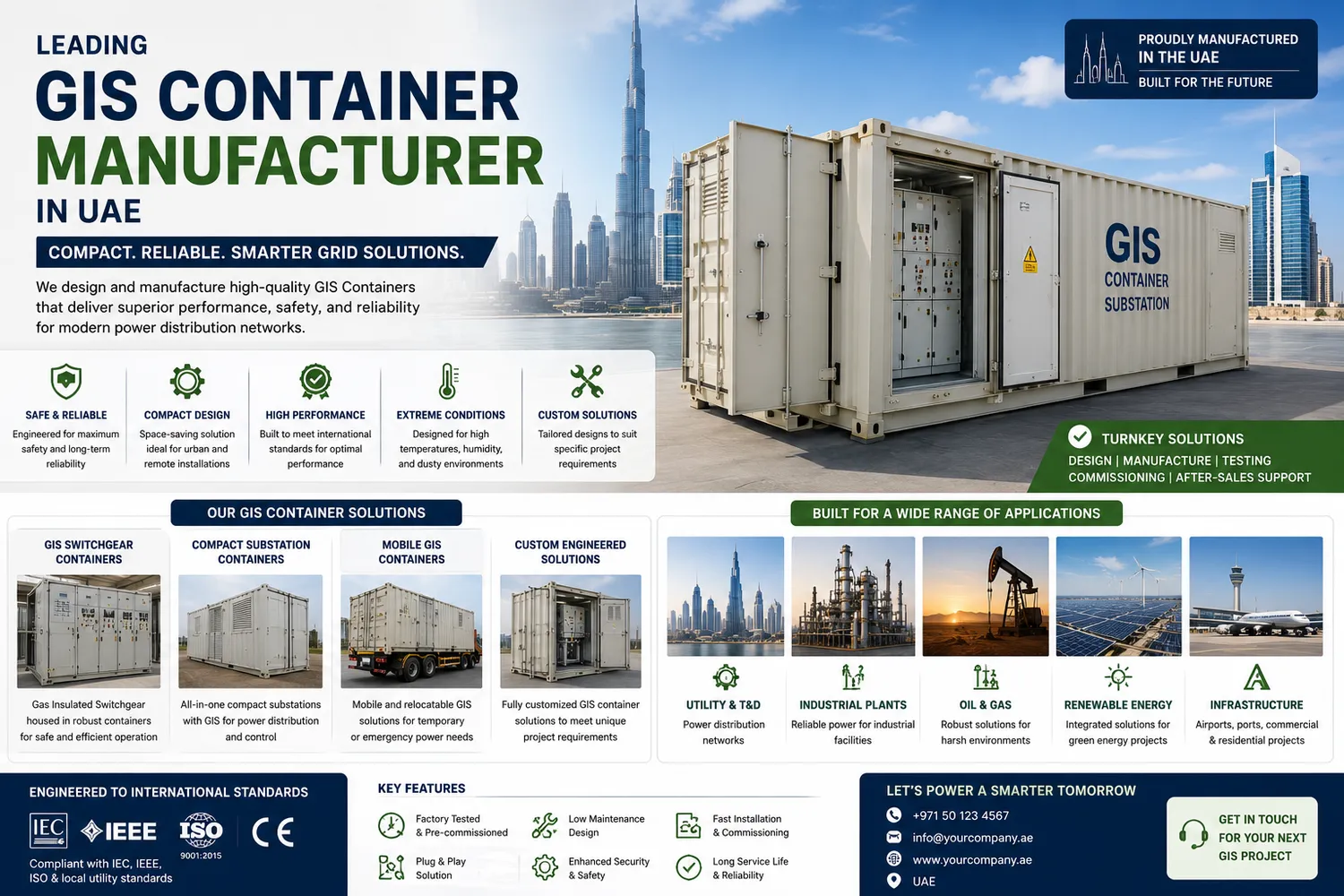
The container housing GIS equipment must maintain the internal environmental conditions — temperature, humidity, and particulate contamination — within the limits that the GIS manufacturer specifies for correct and safe operation. Throughout the UAE's extreme climate: peak summer ambient temperatures exceeding 50°C at inland locations, humidity approaching saturation at coastal sites during humid summer months, and dust loading from frequent desert sand storms.
BERG Industries is an established GIS Container Manufacturer UAE, designing and manufacturing GIS containers from the GIS equipment's specific environmental requirements — not from a standard prefabricated building template adapted for GIS use. Every container we deliver is engineered from the equipment's needs outward, verified through comprehensive Factory Acceptance Testing, and designed to protect the GIS investment throughout its full operational life.
UAE Climate: The Engineering Challenge That Defines GIS Container Design
Standard GIS manufacturer specifications for container environmental control are typically written for moderate climate conditions. UAE conditions are substantially more demanding:
Summer cooling: At UAE peak ambient temperatures exceeding 50°C with solar heat gain through the container roof and walls, the combined cooling load overwhelms HVAC systems sized for standard international ambient conditions of 35°C or 40°C. Our thermal modeling calculates the actual combined load — GIS equipment heat generation plus external heat gain at UAE peak summer conditions — and sizes HVAC to maintain the GIS manufacturer's specified maximum temperature with N+1 redundancy.
Winter heating: At some UAE inland locations, overnight winter temperatures can fall below 10°C — below the minimum operating temperature specified by some GIS manufacturers. Our HVAC design includes heating capability sufficient to maintain the minimum temperature throughout cold winter nights at the specific installation location.
Humidity control: Coastal UAE locations experience near-saturation external humidity during humid summer months. Brief door openings during maintenance access introduce substantial moisture that active dehumidification must remove before internal surfaces reach dew point — the temperature at which condensation forms on live GIS insulating surfaces, creating partial discharge paths that can progress to insulation failure.
Electrical Houses: Integrated Control and Protection Infrastructure
Major GIS substations require protection and control infrastructure alongside the primary GIS equipment — relay rooms, SCADA rooms, battery and UPS rooms. Electrical Houses Manufacturer capability at BERG Industries delivers these facilities as factory-assembled, factory-tested units — with every protection function, control element, and auxiliary system verified during Factory Acceptance Testing before the building is delivered to the substation site.
Designing the GIS container and the associated control building as a coordinated scope provides integration benefits: earthing provisions coordinated across both buildings, cable management between GIS container and control building designed as a system, and a single Factory Acceptance Testing event that verifies all interfaces.
Modular Technical Buildings: GIS Containers in the Broader Modular Range
Moudular Technical Buildings (E HOUSE) manufacturing capability at BERG Industries positions GIS containers as the technically most demanding variant within a broader range of factory-built technical buildings. The engineering disciplines applied to GIS container design — thermal modeling, structural analysis, sealing system specification, positive pressure ventilation design, and Factory Acceptance Testing — are the same disciplines applied across our full modular buildings range, at the technical level appropriate for each application.
Switchgear Enclosures: Distribution Infrastructure for Substation Sites
GIS substations also require switchgear enclosures for the medium voltage and low voltage distribution infrastructure at the substation — metering cubicles, protection relay panels, and auxiliary power distribution boards. Switchgear Enclosure Manufacturer UAE capability at BERG Industries provides these distribution enclosures with consistent engineering standards — thermal analysis, ingress protection specification, cable management design — integrated with the GIS container scope into a coherent substation electrical housing package.
Technical and Modular Solutions: Engineering for Non-Standard GIS Applications
Technical & Modular Solutions capability at BERG Industries addresses GIS container applications that fall outside standard configurations — unusual voltage levels, multi-manufacturer GIS equipment combinations, or sites with environmental conditions beyond standard specifications. For these applications, our engineering team develops solutions from the specific technical requirements rather than adapting standard products that do not fully address them.
Conclusion: The GIS Container Determines Whether the Asset Investment Is Protected
The engineering investment in a correctly specified GIS container — designed for UAE climate conditions, fabricated with precision, and tested comprehensively before delivery — is a small fraction of the GIS asset's capital cost. Inadequate containers compromise the performance of the expensive equipment they house, creating operational problems and maintenance demands that are disproportionate to the procurement savings that drove the inadequate specification.
BERG Industries' GIS container manufacturing — thermal engineering, structural design, sealing specification, and Factory Acceptance Testing — delivers containers that genuinely protect grid-critical assets throughout their 30 to 40-year operational lives.
Frequently Asked Questions
Q1. How does BERG Industries verify HVAC performance during Factory Acceptance Testing for a GIS container?
HVAC performance verification during FAT involves measuring internal temperature stability under controlled conditions that represent the GIS container's thermal load. We energize representative electrical loads within the container — or use resistive heaters calibrated to the GIS equipment's specified heat generation if the GIS equipment itself is not present during FAT — and measure internal temperature over a sufficient period to confirm that steady-state conditions are reached within the GIS manufacturer's specified maximum temperature. Ambient conditions during the test are recorded, and the measured performance is projected to UAE peak ambient conditions using the HVAC manufacturer's verified performance curves to confirm that the system will maintain acceptable internal temperatures at UAE summer peaks. The test results, ambient conditions, and performance projection are documented in the FAT record.
Q2. What SF6 gas monitoring provisions should BERG Industries include in a GIS container?
SF6 gas monitoring provisions should address both routine operational monitoring and emergency scenarios. For routine monitoring: gas density monitoring connection points for each GIS gas zone, accessible from outside the high-voltage area; local indication of gas density or pressure for each zone; and alarm outputs from each monitoring point to the substation control system, with local alarm devices. For emergency scenarios: fixed SF6 gas detectors at floor level — where SF6 accumulates due to its higher density than air — with alarm outputs to the building control system and facility emergency response systems; forced ventilation that activates automatically on gas detection to dilute SF6 concentration and prevent oxygen depletion; and emergency escape provisions that allow rapid exit from the container without requiring access to potentially SF6-contaminated areas. SF6 recovery connection points for maintenance activities that require gas removal before bay opening are also incorporated into our standard GIS container design.
Q3. Can BERG Industries design GIS containers for phased installation where future GIS bays will be added?
Yes. Designing for future GIS bay additions is standard practice for substations with phased capacity development plans. The container is designed at its ultimate buildout dimensions — covering the complete number of GIS bays planned for all phases — with temporary partitions, sealed openings, and HVAC provisions extending into the future bay spaces. Structural connection points for future bay equipment are pre-installed. Cable management provisions are extended into future bay areas. HVAC ductwork runs to future bay spaces with balancing dampers that can be opened when equipment is installed. When a future phase is implemented, the work involves removing the temporary partition, installing the new GIS bay, and connecting to pre-installed services — without structural modification to the existing installation or disruption to the energized portions of the existing GIS.
Q4. What structural design loads must BERG Industries account for in a GIS container for a UAE onshore substation?
Structural design for a UAE onshore substation GIS container must account for: equipment loads — the static weight of each GIS bay distributed to its specific support locations, with dynamic factors for equipment operation; transport loads — the accelerations experienced during road transport from BERG Industries' facility to the installation site, typically the most demanding structural loading scenario; crane lifting loads — dynamic loading during the crane-lift installation sequence, applied at the lifting points with appropriate dynamic factors; wind loads — calculated for the specific installation location using the UAE National Building Code wind speed map, applied as a static equivalent pressure on the container's external surfaces; thermal loads — the stresses resulting from differential thermal expansion between structural elements at UAE temperature extremes; and where the installation location requires it, seismic loads — calculated in accordance with the UAE National Building Code seismic provisions for the specific seismic zone.
Q5. How long has BERG Industries been manufacturing GIS containers, and what voltage levels have been served?
BERG Industries has been manufacturing GIS containers for UAE power transmission clients for over a decade, delivering containers for GIS installations at 33kV, 132kV, and 220kV voltage levels across multiple substations in Dubai, Abu Dhabi, and other UAE emirates. Our engineering team's GIS container experience covers both conventional SF6 GIS equipment from major international GIS manufacturers and, more recently, containers designed for eco-efficient GIS technologies using alternative insulating gases. We maintain relationships with the major GIS equipment manufacturers — ABB, Siemens, Schneider Electric, GE Grid, and others — allowing us to access the specific installation requirements documents for each manufacturer's equipment and ensure that our container designs address those requirements correctly. Our project references for GIS container installations are available for review during supplier pre-qualification.