When Pressure Spikes, the Right Equipment Saves Everything
Every pressurized pipeline system carries a hidden risk that most operators never think about until something goes wrong. When a pump trips unexpectedly, when a control valve closes faster than it should, or when an emergency shutdown sequence activates across a large network, the resulting pressure wave — commonly known as water hammer — travels through the system at the speed of sound in the fluid. It does not pause at bends, flanges, or fittings. It hits everything in its path with the full force of the transient pressure it carries.
The consequences are well documented across the industry: burst pipes, failed pump casings, cracked valve bodies, ruptured heat exchanger tubes, and structural damage to pipework supports. In large-scale industrial networks, a single uncontrolled pressure transient can cause damage that takes weeks to repair and millions of dirhams to rectify — not counting lost production revenue during that period.
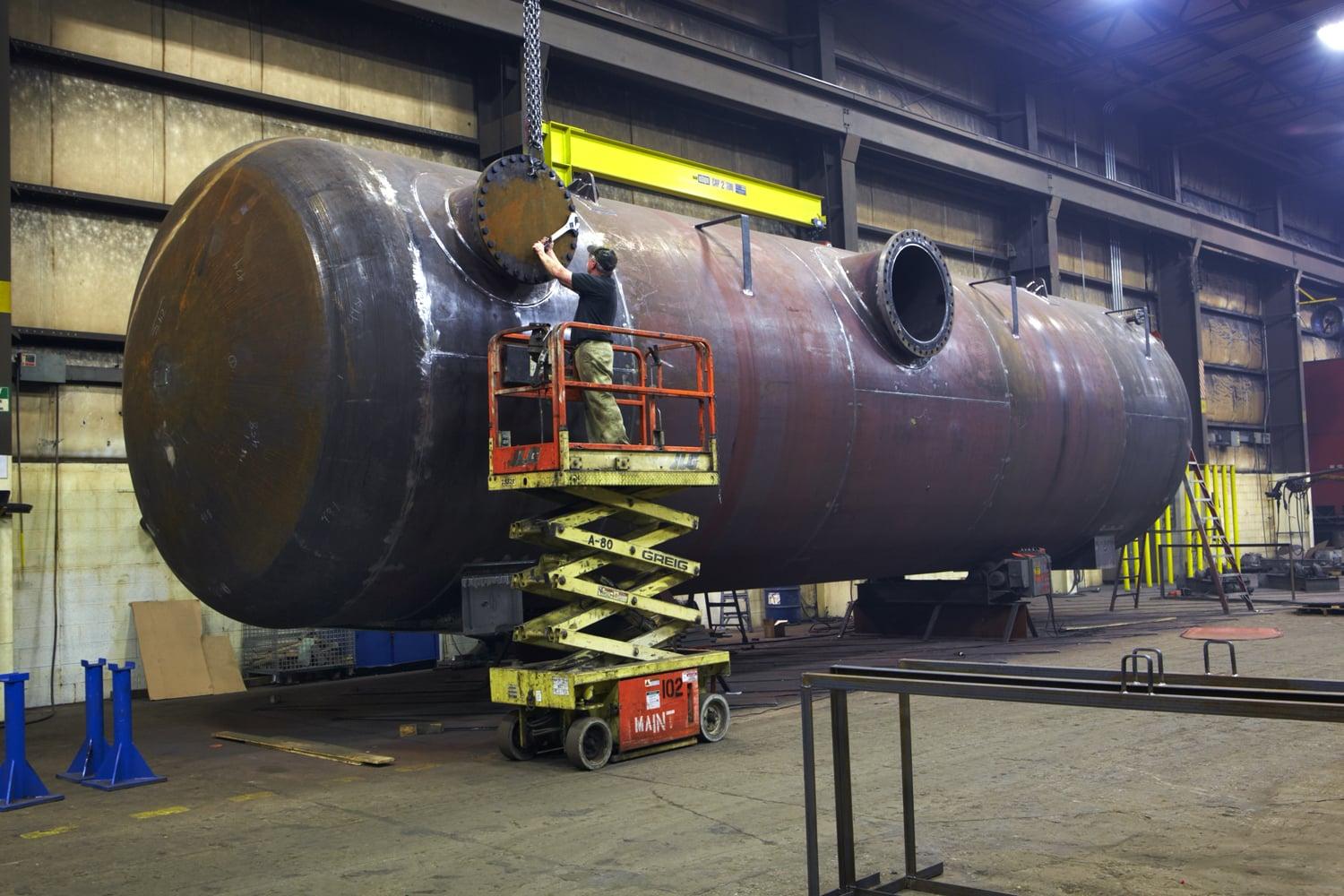
This is precisely why surge vessels manufacturing companies in UAE play such a fundamental role in the region's industrial infrastructure. A correctly designed and installed surge vessel absorbs hydraulic shocks before they can propagate destructively through a pipeline system, acting as a pressure buffer that protects every connected component downstream. In the UAE's booming oil and gas sector, expanding municipal water networks, and rapidly growing district cooling infrastructure, this technology is not optional — it is a core safety and reliability requirement.
Understanding what goes into a quality surge vessel, how they work under real operating conditions, and what separates capable manufacturers from commodity fabricators is essential knowledge for any plant engineer, infrastructure developer, or procurement manager working on UAE-based projects.
How Surge Vessels Work Under Real Industrial Conditions
A surge vessel is a pressure-containing tank, partially filled with liquid and partially with a compressed gas cushion — typically nitrogen. The gas and liquid interface is maintained either directly (in a gas-over-liquid configuration) or through a bladder or diaphragm that physically separates the two phases.
When a sudden pressure rise occurs in the connected pipeline, excess fluid enters the vessel, compressing the gas cushion and absorbing the energy of the pressure transient. When the pressure wave passes and system pressure drops, the compressed gas pushes the fluid back into the pipeline, restoring normal operating conditions and preventing the secondary low-pressure transient that often follows the initial spike.
This entire cycle happens in fractions of a second. The vessel must be correctly sized to handle the maximum transient volume without the gas cushion being completely compressed — which would cause the vessel to behave as a rigid element and transmit rather than absorb the transient. Proper sizing requires hydraulic transient analysis using specialized simulation software, a capability that the best UAE manufacturers maintain in-house as part of their standard engineering service.
Where Surge Vessels Are Deployed Across UAE Projects
Municipal Water Transmission Networks: Water authorities across Abu Dhabi, Dubai, Sharjah, and the Northern Emirates install surge vessels at pump stations on major transmission mains. These networks handle enormous flow volumes at high pressures, and water hammer events without adequate protection can generate pressure spikes several times the normal operating pressure — well beyond the design limits of standard pipework.
Offshore and Onshore Oil and Gas Pipelines: Production and export pipeline systems use surge vessels at pump and compressor stations to protect against pressure transients caused by emergency shutdowns, control valve operations, and pigging activities. In subsea pipeline applications, surge protection is particularly critical because access for repairs is complex and costly.
District Cooling Plants: Dubai and Abu Dhabi operate some of the world's largest district cooling networks, serving commercial districts, government facilities, and residential developments through centralized chilled water systems. These systems are vulnerable to pressure surges when large circulation pumps trip, making surge vessels a standard protection component in plant room design.
Desalination Plants: The UAE's desalination infrastructure — critical for national water security — operates complex high-pressure membrane and thermal systems where pressure transient protection is essential for protecting expensive membranes and heat transfer surfaces.
Pressure Vessels: Designed to Code, Built for Service Life
Surge vessels are a specialized category within the broader pressure vessel family. Pressure vessels cover the full range of process applications — reactors, separators, accumulators, flash drums, slug catchers, filter vessels, and storage tanks — each designed for specific operating pressures, temperatures, fluid characteristics, and service lives.
Every pressure vessel operating in the UAE must be designed and fabricated to an internationally recognized code. The most commonly applied standards are ASME Section VIII Division 1 (used widely in oil and gas and petrochemical applications), PED 2014/68/EU (required for European-supplied projects), and BS PD 5500 (specified by some UK-linked clients). The choice of code is driven by the client's specification and the regulatory framework of the jurisdiction where the vessel will operate.
A qualified Pressure Vessels manufacturer in UAE brings genuine engineering capability to this work. Their engineering team performs pressure design calculations in accordance with the applicable code, selects appropriate corrosion allowances based on the fluid service and material selection, specifies correct material grades with the right heat treatment conditions, and produces a comprehensive documentation package that includes material test reports, weld records, non-destructive examination results, inspection certificates, and the pressure vessel data book.
This documentation package is not simply a compliance requirement — it is the foundation of the vessel's maintenance history and provides the data needed for future fitness-for-service assessments, repair scope definition, and re-rating if operating conditions change.
Third-Party Inspection: Non-Negotiable for Critical Service
For pressure vessels destined for oil and gas, petrochemical, utility, or public infrastructure service, third-party inspection by an approved body — Lloyd's Register, Bureau Veritas, TÜV Rheinland, DNV, or SGS — is industry standard practice. Inspection at defined hold points ensures that critical welds are examined before subsequent operations cover them, and that the final hydrostatic test is witnessed by an independent authority who can certify the vessel's compliance with the design code.
Manufacturers who facilitate this process smoothly — with pre-notified hold points, organized documentation presented at each stage, clean weld records that are current and accurately reflect production status — demonstrate the quality discipline that distinguishes professional fabricators from suppliers who treat inspection as an administrative burden rather than a quality tool.
Pig Launchers and Receivers: Maintaining Pipeline System Integrity
Surge vessel installations on oil, gas, and product pipeline systems are frequently accompanied by pigging facilities. Regular pigging is essential for maintaining pipeline cleanliness, managing internal corrosion, detecting wall thickness loss, and verifying pipeline integrity between major inspection intervals.
A trusted Pig Launcher & Receiver Manufacturer provides complete pigging station assemblies — barrel assemblies rated to pipeline operating pressure, closure door mechanisms that allow safe pig loading and retrieval, kicker and drain connection arrangements, and pressure equalization systems that enable safe pig handling without depressurizing the main pipeline.
In the UAE's extensive oil, gas, and NGL pipeline network, regular pigging is not a discretionary maintenance activity — it is a regulatory and insurance requirement on many major lines. Pig launchers and receivers must be designed to the pipeline's full operating pressure and temperature range, and their integration with the pipeline's valve arrangement and isolation philosophy must be carefully coordinated during the engineering phase.
Static Equipment: The Broader Process Asset Family
Both surge vessels and pressure vessels belong to the larger category of static equipment — process assets that contain or process fluids without rotating elements. This family encompasses heat exchangers, distillation columns, absorption towers, reaction vessels, filter housings, separators, and storage tanks of all types and sizes.
For large UAE projects with extensive static equipment requirements, working with a single Static Equipment Manufacturer for the complete equipment list delivers significant practical benefits. Procurement is simplified because a single contract covers multiple equipment items. Inspection coordination is streamlined because one manufacturer's documentation process applies across the full scope. Material procurement is consolidated, which can deliver schedule and cost benefits on large orders. And there is a single accountable party for code compliance across all items — eliminating the finger-pointing between multiple vendors that sometimes arises when design or documentation issues are discovered.
BERG Industries' static equipment capability covers the full range — from small instrument knockout pots to large separator vessels and storage tanks — all fabricated under the same quality management system and code compliance framework.
Piping Fabrication: Where System Reliability Is Determined
Every surge vessel, pressure vessel, pig launcher, and static equipment item connects to the broader plant through fabricated pipework. The quality of that pipework — how accurately it is dimensioned, how well its welds are executed, how thoroughly it is inspected — directly determines the reliability of the complete system in service.
Piping fabrication at genuine industrial quality standard involves far more than cutting pipe and welding it together. It requires isometric drawing interpretation with attention to dimensional callouts and weld joint identification. It requires strict material identification and segregation to prevent incorrect material being installed in the wrong service. It requires fit-up to dimensional tolerances that ensure completed spools connect correctly to adjacent pipework without forced alignment. And it requires welding by qualified welders using qualified procedures, followed by post-weld examination appropriate to the service — visual inspection at minimum, radiographic or ultrasonic testing for high-criticality welds.
BERG Industries' in-house piping fabrication capability ensures that the pipework connecting their vessels and static equipment is fabricated to the same quality standard as the equipment itself. There are no quality gaps between the vessel fabrication scope and the piping scope — because both are executed under the same quality management system, with consistent material documentation and inspection standards throughout.
Conclusion: One Qualified Manufacturer, Complete System Reliability
For procurement teams assembling the vendor list for a UAE industrial project, the ability to source surge vessels, pressure vessels, pig launchers, static equipment, and piping fabrication from a single qualified manufacturer is not just a convenience — it is a meaningful project risk reduction strategy.
Fewer vendor interfaces mean cleaner documentation packages, simpler inspection coordination, less potential for conflicting design assumptions at equipment boundaries, and a single accountable party when questions arise after installation. In a project environment where schedule pressure is constant and quality requirements are exacting, these advantages translate directly into better project outcomes.
BERG Industries' integrated manufacturing capability across all of these equipment categories, backed by engineering competence, internationally aligned quality systems, and a growing track record on UAE and regional projects, makes them a logical partner for clients who need technical depth and local accountability on their most critical equipment requirements.