The structural steel in a UAE industrial facility — pipe racks carrying process piping loads, equipment platforms supporting rotating machinery, access structures enabling safe maintenance, and modular frames integrating process and electrical systems — will carry those loads every day for 25 to 30 years. The quality of the fabrication determines how reliably it does so: whether structural connections assemble correctly at installation, whether welds maintain their integrity through decades of thermal cycling and operational loading, and whether protective coatings survive the UAE's aggressive coastal and desert environments without requiring major maintenance intervention within the first few years of service.
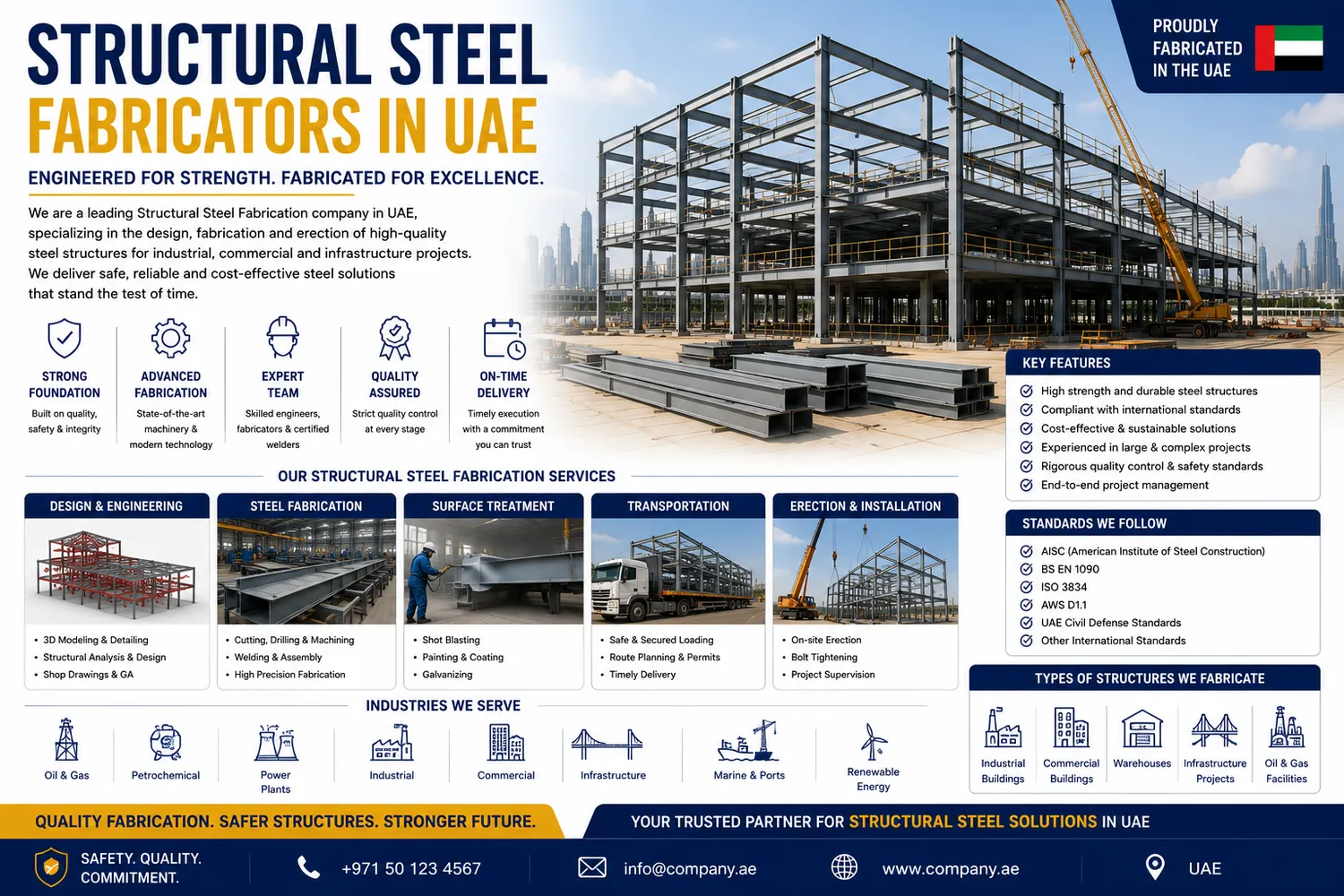
BERG Industries is among the most experienced Structural Steel fabricators in UAE, with a fabrication capability that spans standard structural work through to complex process code fabrication for oil and gas, petrochemical, power generation, and infrastructure clients across the UAE and the wider GCC region.
This article explains what distinguishes genuinely capable structural steel fabricators from the rest of the UAE market, and how BERG Industries' workshop capability, quality systems, and project track record deliver the performance that industrial projects require.
Workshop Capability: The Foundation of Structural Fabrication Quality
A structural steel fabrication workshop capable of industrial work requires specific equipment, organization, and quality management that separates it from general construction trade fabricators.
CNC drilling and cutting: Connection plates, base plates, and structural sections that require dimensional accuracy and positional consistency need CNC processing — manual marking and drilling introduces positional errors that accumulate across large structural assemblies, creating fit-up problems during site erection. Our workshop operates CNC processing for plates and connection components, ensuring consistent hole positions and cut geometry across the production run.
Assembly fixtures and fit-up tables: Large structural assemblies built on the floor without proper fixtures accumulate twist, sweep, and out-of-square conditions during welding — conditions that prevent correct assembly on site and require field modification. We use assembly fixtures that control geometry during fit-up, ensuring that completed assemblies match drawing dimensions within the specified tolerances.
In-house blast cleaning and coating: Surface preparation to Sa 2.5 or Sa 3 standard before protective coating application is essential for industrial structural steelwork. We maintain in-house blasting capability, eliminating the handling damage and schedule uncertainty of sending steelwork to external blasting facilities.
Welding procedure and welder qualifications: Every structural weld in industrial work must be made using a qualified welding procedure, and every welder must hold current certification for the joint types and positions they perform. Our welding procedure library covers the joint configurations encountered in typical industrial structural scopes under AWS D1.1, and our welder qualification records are current and available for client review.
Steel Fabrication Companies UAE: Process Code Capability
Steel fabrication companies UAE serving the oil and gas and petrochemical sectors must demonstrate process code fabrication capability alongside structural competence — the ability to fabricate pressure-containing components to ASME, EN, or BS standards with full material traceability, qualified welding procedures, and systematic NDE.
BERG Industries' fabrication capability spans both disciplines. Our quality management system covers structural fabrication to AWS D1.1 and process code fabrication to ASME Section VIII and ASME B31.3, with consistent documentation standards across both scopes. For projects that require both structural steelwork and pressure-containing equipment, single-source supply from BERG Industries provides consistent quality management and simplified documentation.
Fabrication Companies in UAE: Local Advantage for UAE Projects
Fabrication companies in UAE with genuine local manufacturing operations provide practical advantages that international suppliers cannot match. Engineering queries are resolved same-day in the same time zone. Site visits during manufacture are practical and cost-effective, without international travel costs. Delivery schedules are shorter, more reliable, and more responsive to project changes. Additional scope items can be added within realistic lead times.
For UAE industrial projects — where schedule changes are frequent and engineering decisions need rapid resolution — these local manufacturing advantages translate directly into project delivery performance that offshore procurement cannot replicate.
Piping Fabrication: Coordinated with Structural Work
Piping fabrication combined with structural fabrication under a single supplier provides a coordination advantage that consistently reduces one of the most common and most expensive field problems in industrial construction: dimensional conflicts between structural pipe supports and piping isometric dimensions.
When both scopes are at BERG Industries, structural support positions are checked against piping isometric dimensions in our factory — identifying and resolving conflicts before either scope is shipped to site. This in-factory coordination eliminates the site modification work that separate-supplier fabrication consistently produces when dimensional interpretations diverge.
Heat Exchangers: Fabrication Excellence Extended to Thermal Equipment
Heat Exchangers Manufacturer in UAE capability at BERG Industries extends our fabrication scope to thermal process equipment. Shell and tube heat exchangers, air cooled fin-fan coolers, and plate heat exchangers are fabricated under the same quality management framework as our structural and pressure vessel scopes — with thermal design verification confirming that fabricated equipment meets its process duty before delivery.
For projects with both structural steel and heat exchanger requirements, combined supply from BERG Industries provides coordinated documentation, consistent quality standards, and simplified inspection management.
Conclusion: BERG Industries Delivers Structural Steel Quality That Industrial Projects Require
UAE industrial projects need structural steel fabricators who combine workshop capability, quality systems, and engineering competence to deliver steelwork that assembles correctly on site, performs reliably through decades of service, and maintains its structural integrity in the UAE's challenging environmental conditions. BERG Industries' structural fabrication track record across UAE oil and gas, infrastructure, and industrial projects demonstrates this combination consistently.
Frequently Asked Questions
Q1. What welding standard does BERG Industries apply to structural steel fabrication for UAE oil and gas projects?
We apply AWS D1.1 (Structural Welding Code — Steel) as our baseline standard for structural steel fabrication, which is the most widely specified standard in UAE oil and gas projects procured by US-based operators and EPC contractors. For projects specified by European-based clients or for facilities requiring CE marking, we apply EN 1090 execution class requirements. Our welding procedure library covers the joint configurations, material groups, and welding positions encountered in typical industrial structural scopes under both standards, with current procedure qualification records available for client review during pre-qualification.
Q2. How does BERG Industries control dimensional accuracy for large structural assemblies such as pipe rack bents?
Dimensional control for large structural assemblies starts with CNC-processed components — connection plates and column base plates drilled to confirmed positions, and structural sections cut to confirmed lengths with square ends — providing a dimensionally accurate starting point for assembly. Assemblies are then built on alignment fixtures that control the geometric relationship between components during fit-up, preventing the accumulated distortion that floor assembly without fixtures produces. During welding, we apply weld sequence controls — backstepping, symmetrical welding, and progressive tack welding — to minimize distortion from weld shrinkage. Final dimensional inspection of completed assemblies against drawing dimensions at defined checkpoints provides the verification record that confirms conformance before dispatch.
Q3. What protective coating systems does BERG Industries apply to structural steelwork for UAE offshore and coastal environments?
For UAE offshore and coastal structural steelwork in ISO 12944 corrosivity category C5-M, our standard coating system comprises: surface preparation to Sa 2.5 blast standard with a surface profile of 50 to 85 micrometers; a zinc-rich epoxy primer at 60 to 80 micrometers dry film thickness (DFT); an epoxy intermediate coat at 80 to 100 micrometers DFT; and a polyurethane or epoxy topcoat at 60 to 80 micrometers DFT, providing total system DFT of 200 to 260 micrometers. For splash zone and submerged sections, we apply heavier-duty systems with higher total DFT and additional cathodic protection compatibility requirements. All coating applications are performed under controlled ambient conditions with DFT measurement at defined intervals and full application records retained.