Pipeline systems in the UAE's oil and gas, water transmission, district cooling, and desalination sectors share a vulnerability that most operators do not think about until an incident makes it impossible to ignore: the hydraulic transient. When a pump trips, a valve closes faster than intended, or an emergency shutdown sequence activates simultaneously across multiple stations, a pressure wave propagates through the pipeline system at the speed of sound in the fluid.
This wave does not dissipate quickly. It reflects off closed valves, travels back through the system, and interacts with other transients generated by the same event. The combined effect can produce pressure spikes two to three times the normal operating pressure at specific locations in the pipeline — pressures that exceed the design limits of standard pipework, pump casings, valve bodies, and heat exchanger connections.
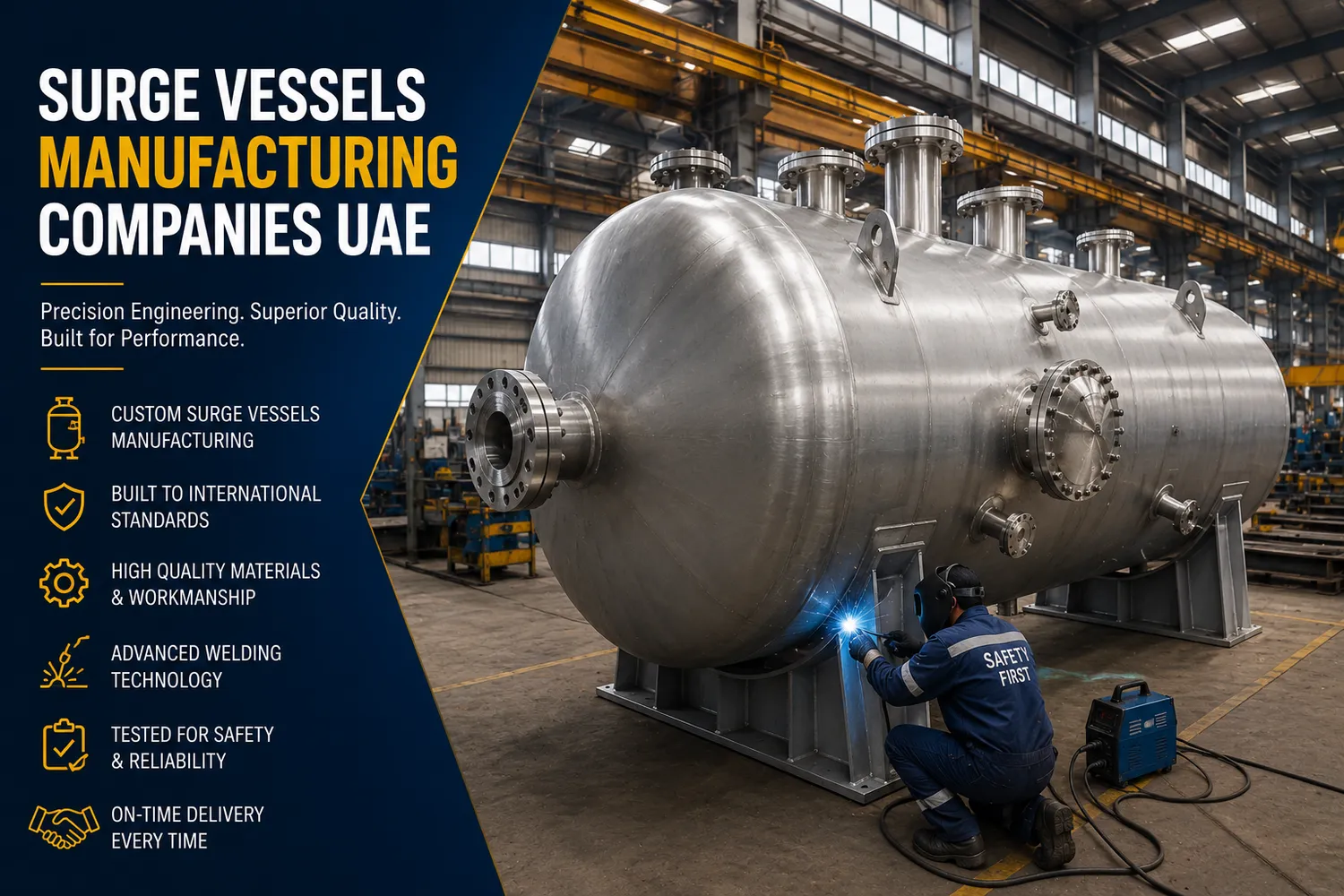
Among surge vessels manufacturing companies in UAE, BERG Industries brings both hydraulic engineering competence — the ability to analyze transient conditions and size vessels correctly — and ASME pressure vessel fabrication expertise — the ability to build a code-compliant vessel that will absorb those transients reliably for its 25 to 30-year design life.
The Engineering Difference Between Adequate and Inadequate Surge Protection
Surge vessels are sized from hydraulic transient analysis — a computational simulation of the specific pipeline system that models the pressure waves generated by worst-case operational events and calculates the volume and pressure range within which the surge vessel must operate to limit peak pressures to acceptable levels.
A surge vessel sized without this analysis — from rules of thumb, from similarity to other installations, or from vendor recommendations unsupported by pipeline-specific calculations — may provide some protection against moderate transients. It provides no engineered assurance against the worst-case transients the pipeline will actually experience. And in a high-consequence pipeline — a water transmission main serving a city, an offshore production pipeline, a refinery product export line — the worst-case transient is precisely the event that must be protected against.
BERG Industries performs or reviews hydraulic transient analysis for every surge vessel project, ensuring that the vessel size, pre-charge pressure, and connection arrangement are based on the specific hydraulic requirements of the pipeline system rather than on assumptions that may not match the actual pipeline characteristics.
Pressure Vessels: The ASME Code Foundation
Pressure Vessels manufacturer in UAE capability at BERG Industries provides the pressure vessel engineering and fabrication that every surge vessel requires. Surge vessels are ASME Section VIII pressure vessels — designed with appropriate pressure ratings, corrosion allowances, and nozzle reinforcement for the pipeline operating conditions; fabricated with qualified welding procedures and certified welders; inspected at defined hold points by an authorized inspection agency; and hydrostatic tested at 1.3 times MAWP before release.
Static Equipment: Complete Pipeline Infrastructure
Static Equipment Manufacturer capability at BERG Industries extends to the complete static equipment scope for pipeline pump stations — slug catchers, separator vessels, filter vessels, and storage bullets — all fabricated under the same quality management framework as surge vessels, with coordinated documentation and inspection across the complete equipment list.
Heat Exchangers: Protecting Thermally Connected Pipeline Systems
Heat Exchangers Manufacturer in UAE capability provides a link between surge vessel and heat exchanger supply — where heat exchanger feed and return circuits are connected to the same pipeline system requiring surge protection, BERG Industries can supply both the surge protection and the thermal equipment, with the surge vessel sizing coordinated to protect the heat exchanger nozzle connections from transient loads that could cause mechanical damage or long-term fatigue.
Pig Launchers: Pipeline Maintenance Infrastructure at Surge-Protected Stations
Pig Launcher & Receiver Manufacturer capability at BERG Industries allows pipeline pump stations to be equipped with both surge protection and pigging infrastructure from a single supplier — coordinated in design, consistent in documentation, and simplified in procurement management.
Conclusion: Surge Protection Saves More Than It Costs — Every Time
The cost of a properly engineered surge vessel installation is a small fraction of the cost of the first incident it prevents. Pipe replacement after a water hammer burst, pump casing repair after hydraulic shock damage, heat exchanger shell repair after nozzle fatigue failure — each of these incident responses costs multiple times the surge protection investment that would have prevented it.
BERG Industries' combination of hydraulic engineering competence and pressure vessel fabrication expertise provides UAE pipeline operators with surge protection that is designed correctly for the specific pipeline, built to ASME quality standards, and documented completely for the asset's operational life.
Frequently Asked Questions
Q1. What information does BERG Industries need to perform a hydraulic transient analysis for a surge vessel sizing project?
We need the following pipeline information for hydraulic transient analysis: pipe diameter and wall thickness, or pipe schedule, for all sections of the pipeline; pipe material (for wave speed calculation); pipeline length and elevation profile (for static head calculations); fluid properties — density and bulk modulus at operating temperature (for wave speed calculation); pump characteristics — head-flow curve and moment of inertia (for pump trip simulation); valve types and estimated closure times for all significant valves in the system; and initial steady-state operating conditions — flow rate, pressure, and temperature. Where this information is not all available at inquiry stage, we can perform a preliminary analysis with conservative assumptions for missing parameters and refine the analysis as the missing data becomes available. The preliminary analysis is often sufficient to confirm whether surge protection is required and to establish the approximate vessel size range.
Q2. How does BERG Industries determine the pre-charge pressure for a surge vessel?
The pre-charge pressure is the nitrogen gas pressure in the surge vessel before any pipeline flow enters. It is set at the minimum static pressure that occurs in the pipeline at the vessel connection point — the pressure during normal operation when the system is at rest but not operating. Setting pre-charge at this value ensures that the gas cushion has its maximum volume at the moment when it needs to absorb the maximum transient volume from the initial positive pressure spike, and also ensures that during the subsequent low-pressure phase of the transient — when pipeline pressure drops below static pressure — the gas cushion expands to push fluid back into the pipeline, preventing sub-atmospheric pressures that could cause pipe collapse in thin-walled systems. The pre-charge pressure value is specified in the hydraulic transient analysis output and documented in the vessel design record.
Q3. Can surge vessels be designed for installation in ATEX Zone 1 classified pipeline pump stations?
Yes. Surge vessels for ATEX Zone 1 locations are designed as standard pressure vessels for the pipeline operating conditions, with the ATEX classification affecting the specification of any ancillary equipment — pressure gauges, level instruments, isolation valves — that is installed on the vessel or in its immediate vicinity. In ATEX Zone 1, all electrical instruments and equipment must be selected with ATEX certification appropriate for Zone 1 and the gas group of the hazardous atmosphere. The vessel itself — as a passive pressure-containing vessel — does not require ATEX certification, but the instrument connections, the nitrogen recharge valve specification, and the drain valve specification must all be reviewed in the context of the Zone 1 classification to ensure that no ignition sources are created during normal or abnormal operation.
Q4. How should a surge vessel be maintained over its operational life?
Surge vessel maintenance requirements depend on the vessel design type. For bladder or diaphragm vessels — where the gas and liquid are physically separated — maintenance includes: annual pre-charge pressure check with nitrogen recharge if required; periodic bladder or diaphragm condition inspection — accessible through the gas-side connection — with replacement when the elastomer shows signs of hardening, cracking, or perforation; annual inspection of all instrument connections, pressure gauges, and safety devices; and inspection of the vessel external surface and corrosion protection condition. For gas-over-liquid vessels — where gas and liquid are in direct contact — maintenance is simpler: annual pre-charge pressure check; annual inspection of the gas-liquid interface level to confirm that excessive gas absorption has not occurred; and annual inspection of the vessel external surface. Internal inspection intervals follow the API 510 risk-based inspection schedule for the specific service.