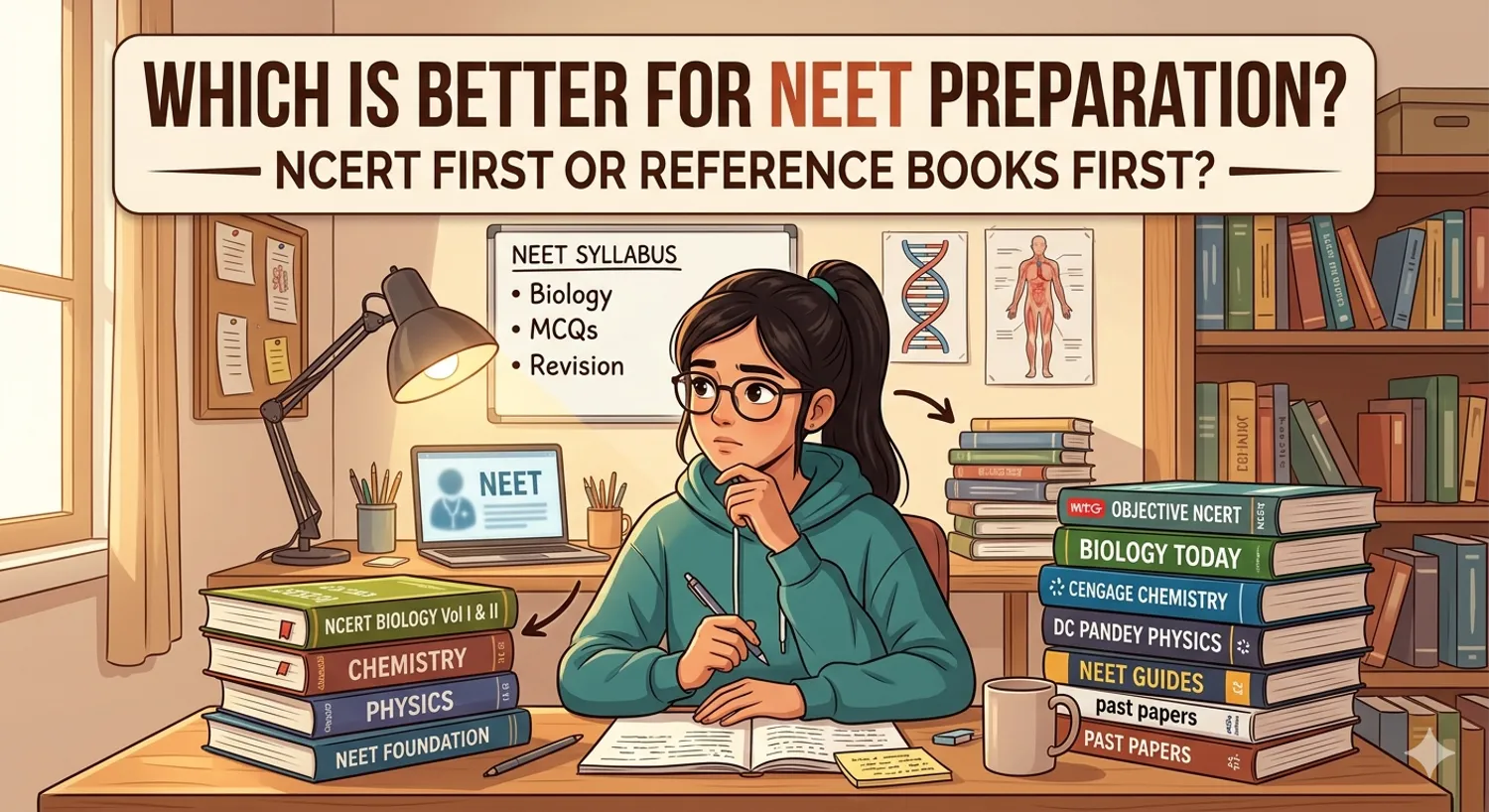
Every NEET aspirant hits this wall at some point. You've got your NCERT textbooks stacked on one side and a shelf full of HC Verma, DC Pandey, and Errorless on the other — and nobody around you seems to agree on where to start. Ask ten students, and you'll get ten different answers. Ask a teacher at the best NEET coaching in Bhopal, though, and most of them will tell you the same thing: the question isn't really which book — it's in what order, and for what purpose.
Why This Debate Exists in the First Place
The confusion is understandable. NEET is an exam that tests both conceptual clarity and problem-solving ability. NCERTs are the gold standard for clarity. Reference books are the training ground for application. Students often assume they have to pick one over the other, when the real answer is far more nuanced.
The truth is, most students who struggle in NEET do so not because they read the wrong book, but because they never truly understood what each type of book is meant to do.
What NCERT Actually Does for You
NCERT textbooks are written specifically to align with the syllabus prescribed by the National Testing Agency. Every single topic that appears in NEET — whether it's the cell cycle in Biology, thermodynamics in Chemistry, or laws of motion in Physics — has its roots in NCERT content.
Here's what most students underestimate: a significant chunk of NEET questions, especially in Biology, are lifted almost directly from NCERT lines. Not paraphrased. Not adapted. Word for word. If you haven't read NCERT carefully, you will lose marks that were essentially handed to you.
NCERT also builds your mental framework. Before you can solve a numerically intensive problem from a reference book, you need to understand why the formula works. NCERT explains that. Reference books often assume you already know it.
Where Reference Books Come In
Reference books are not replacements — they're extensions. Once you've built a solid conceptual base through NCERT, reference books help you do a few things NCERT simply can't:
Drill problem-solving patterns. NEET Physics and Physical Chemistry require you to handle a variety of numericals under time pressure. NCERT gives you maybe 10–15 practice questions per chapter. DC Pandey or VK Jaiswal will give you 200, across multiple difficulty levels.
Handle tricky, application-based questions.NEET has been getting progressively more application-heavy over the years. Reference books prepare you for questions that take a concept and twist it in a direction you haven't seen before.
Fill in gaps NCERT glosses over. Organic Chemistry in NCERT, for instance, is clear but thin. MS Chauhan fills those gaps with reaction mechanisms and practice sets that bring the chapter to life.
Also Read: NEET Institute in Bhopal
The Order That Actually Works
So, which comes first? The answer is almost always NCERT — but with a condition.
You can't just read NCERT passively. You need to read it actively — underlining key lines, noting definitions, understanding diagrams, and answering the back exercises seriously. Do this for a chapter, then move to the relevant reference book section to practice and deepen your understanding.
Think of it like building a house. NCERT is your foundation. Reference books are the walls, the windows, and the reinforcements. You don't start with the roof.
A practical approach that many toppers follow looks like this:
1. Read the NCERT chapter thoroughly — once slowly, once more quickly.
2. Make short notes or highlight key points.
3. Solve NCERT exercises and previous year NEET questions from that chapter.
4. Now open the reference book for the same chapter to practise additional problems.
5. Revisit NCERT once more after completing the reference book section — this step is often skipped, but it cements everything.
Subject-Wise Breakdown
Biology: NCERT is everything. Seriously. Spend 70–80% of your Biology time on NCERT, and use reference books like Trueman's or MTG only for MCQ practice, not theory.
Chemistry: Split it by type. For Physical Chemistry, reference books are essential for numericals. For Organic, balance both. For Inorganic, stick almost entirely to NCERT — it's precise and exam-aligned.
Physics: This is where reference books earn their place the most. NCERT Physics is clear but light on problem variety. HC Verma builds intuition, and DC Pandey builds speed. But neither makes sense if you haven't read the NCERT theory first.
The Mistake Most Repeaters Make
Students who appear for NEET a second or third time often make the same error — they abandon NCERT entirely in their second attempt, assuming they've already covered it, and go deep into advanced reference material. Then they lose easy marks in Biology and Inorganic Chemistry because they've forgotten exact NCERT phrasing.
Don't let familiarity trick you into skipping what matters most.
Final Word
If you're just starting your NEET preparation, begin with NCERT — no debate. If you're in your second year and already strong on theory, use reference books to sharpen your edge, but keep returning to NCERT for revision. And if you're ever unsure about how to balance both, seek guidance from experienced mentors. The faculty at the best NEET coaching in Bhopal will consistently tell you that toppers aren't the ones who read the most books — they're the ones who read the right books, in the right order, more times than everyone else.
The books were never the problem. The strategy was.