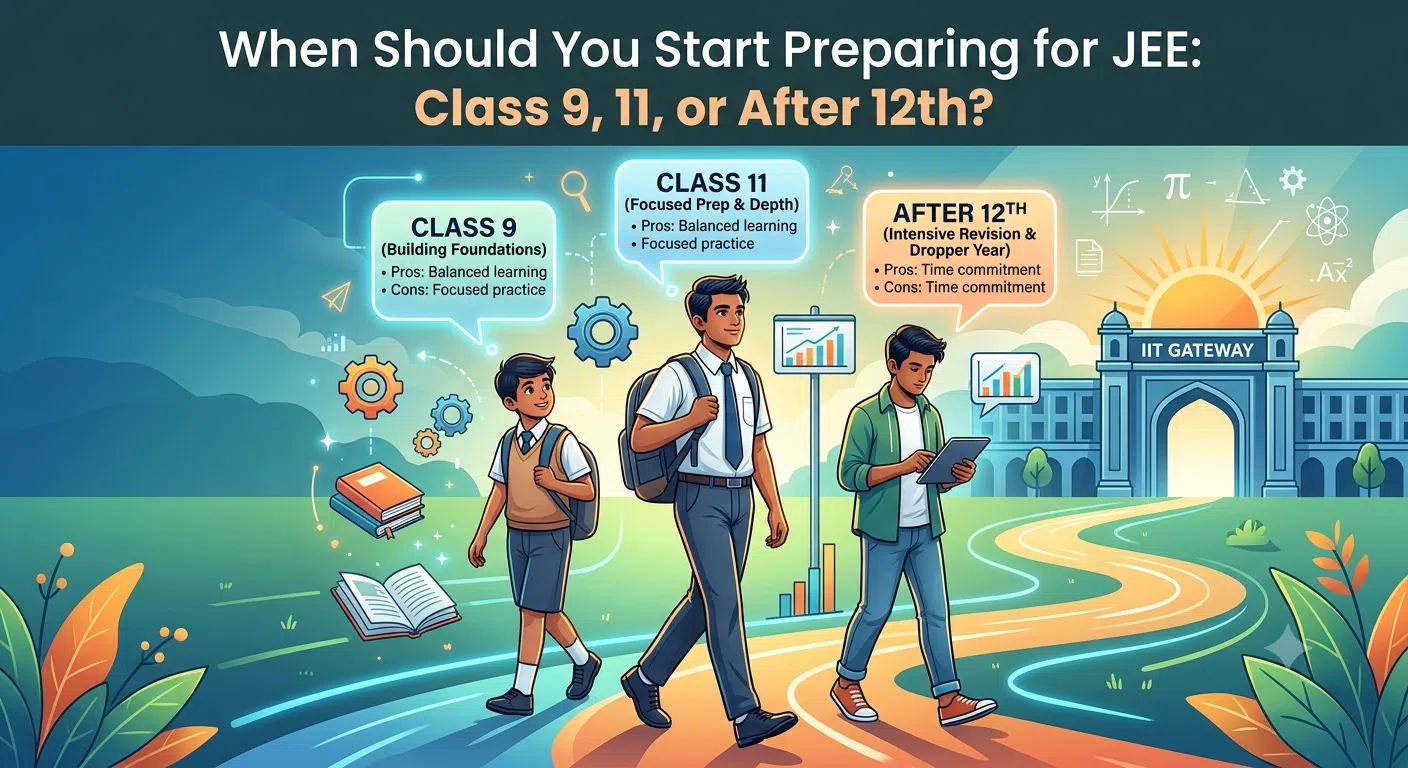
Every year, the same question lands in parents' WhatsApp groups and in the minds of anxious teenagers: "Are we too early? Are we too late?" The honest answer is that there's no single perfect starting line. But there are three common ones, and each comes with its own trade-offs.
Starting in Class 9: The Long Game
Some families begin in Class 9, and it's not as extreme as it sounds. Nobody is asking a 14-year-old to solve rotational mechanics problems at this stage. The idea is to build a base: strong arithmetic, comfort with algebra, and curiosity about why things work the way they do. Students who start early tend to find Class 11 less of a shock, because the jump to JEE-level thinking happens gradually rather than overnight.
The risk is burnout. A child who grinds for four years may lose interest long before the exam. If you go this route, keep it light: two or three focused hours a week, with plenty of room for cricket, reading, and just being a kid. Many parents exploring IIT coaching in Bhopal choose foundation batches for exactly this reason, since they offer gentle, concept-first teaching without the pressure of ranks.
Starting in Class 11: The Sweet Spot for Most
For most students, Class 11 is the natural starting point, and it's where the real battle begins. The JEE syllabus is built on Class 11 and 12 topics, and roughly half of it sits in Class 11 alone. Mechanics, basic organic chemistry, calculus, and coordinate geometry are the foundation blocks, and if they're shaky, everything built on top wobbles.
Two years is enough time to cover the syllabus, revise it, and take a healthy number of mock tests, provided you stay consistent. A student who studies four to five focused hours a day beyond school and reviews mistakes every week can do very well. This is where guidance matters. Choosing the right JEE coaching in Bhopal can save you from wasted months, because good teachers know which topics carry weight and which don't deserve your midnight hours.
Starting After Class 12: The Drop-Year Route
Then there's the third path: starting seriously after boards, often as a dropper. This isn't a failure story, whatever relatives might whisper. Plenty of students who end up in IITs took a year to figure out how to study properly. The advantage is complete focus, with no school and no board-exam distractions, just JEE.
But be realistic. Starting from scratch in this window is hard, because you're squeezing two years of learning into about twelve months. It works best for students who already have some exposure to the syllabus and need to sharpen it. Those who join IIT JEE coaching classes in Bhopal as droppers often benefit from the structure of daily schedules, regular tests, and peers who are equally serious.
So, Which One Should You Pick?
Ask three questions. First, how does the student feel about Maths and Physics? Interest matters more than any timetable. Second, how much pressure can they handle without losing their spark? Third, what does the rest of life look like, including board exams, hobbies, and family expectations?
If the answers are "curious, calm, and supported," an early start can pay off. If the student is average but hardworking, Class 11 is just right. And if things didn't go as planned the first time, a drop year with a clear plan is still a legitimate shot.
One more thing worth saying: starting early doesn't guarantee success, and starting late doesn't doom you. What separates rankers from everyone else is rarely the calendar. It's consistency, honest self-assessment, and the willingness to sit with a problem for forty minutes instead of peeking at the solution after five.
So don't panic about the date. Pick a starting point that fits your child, build a routine that can survive a bad week, and keep going. The best time to start is when you can commit to showing up, day after day.