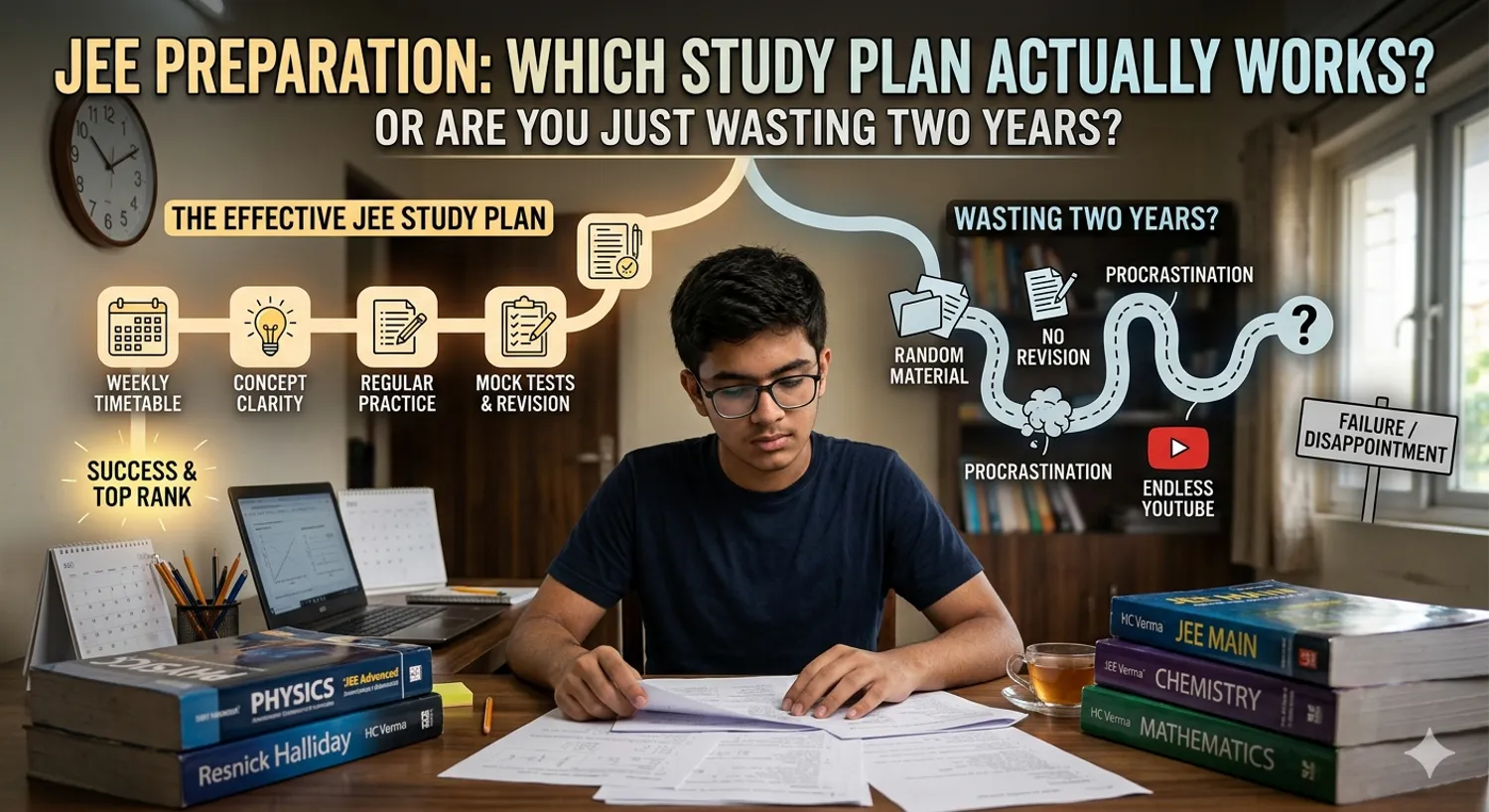
Somewhere in Bhopal right now, a student is redrawing a timetable that wasn't working. Different colors this time. Maybe a new app. Same chapters, same problem, different font.
This happens every few weeks during JEE preparation. The schedule gets blamed, replaced, and rebuilt — while the actual issue sits quietly in the background, completely unaddressed.
The issue is almost never the timetable.
Busy and Productive Are Not the Same Thing
JEE preparation has a strange way of rewarding the appearance of effort. Thick notebooks, highlighted textbooks, back-to-back study hours — all of it looks serious from the outside. Some of it genuinely is. But a large chunk of what passes as "studying" during these two years is really just controlled avoidance.
Students naturally drift toward chapters they're already decent at. Finishing thirty problems on a familiar topic feels like progress. Sitting with a derivation that refuses to make sense for an hour feels like failure. So the comfortable chapter gets revised again, and the difficult one gets pushed to tomorrow.
Tomorrow has been doing a lot of heavy lifting in JEE preparation history.
The students who actually crack it aren't doing ten things differently. They've mostly just stopped running from the chapters that make them feel stupid.
What Actually Changes Results
Talk to students who cleared JEE through any serious IIT institute in Bhopal — not the ones who'll give a rehearsed answer about discipline and sacrifice, but the ones who'll be honest — and a different picture emerges.
Most of them had messy, imperfect routines. Some skipped topics entirely. Several had patches of weeks where motivation disappeared completely. What they didn't do was treat mock tests like exams to be passed. They treated them like conversations — each wrong answer asking a specific question back at them. Was the concept unclear? Was the formula applied incorrectly under pressure? Was it a reading error?
Those are three different problems. They need three different solutions. Circling a wrong answer and moving on solves none of them.
The Coaching Question
Bhopal has developed a legitimate JEE preparation culture over the years. IIT coaching in Bhopal today offers something that pure self-study quietly struggles to replicate — not the lectures, but the friction. The moment a faculty member stops a student mid-explanation and says "that logic is wrong, here's why" is worth more than three hours of solo reading.
Good coaching creates productive discomfort. The problem is that a lot of students sit in those classrooms waiting to receive knowledge rather than actively hunting for their own gaps. The environment is useful only if it's being used that way.
The Actual Plan Worth Following
No fixed timetable survives contact with a genuinely hard chapter. The students who do well build something more flexible — a clear sense of where they're weak, a habit of returning to those weaknesses repeatedly, and an almost obsessive relationship with why they got something wrong rather than simply that they got it wrong.
That's it. That's the plan that actually works.
Not inspirational. Not particularly shareable. But two years from now, when results come out, that's the difference that tends to show up on the list.
Also Read: Best NEET Coaching in Bhopal