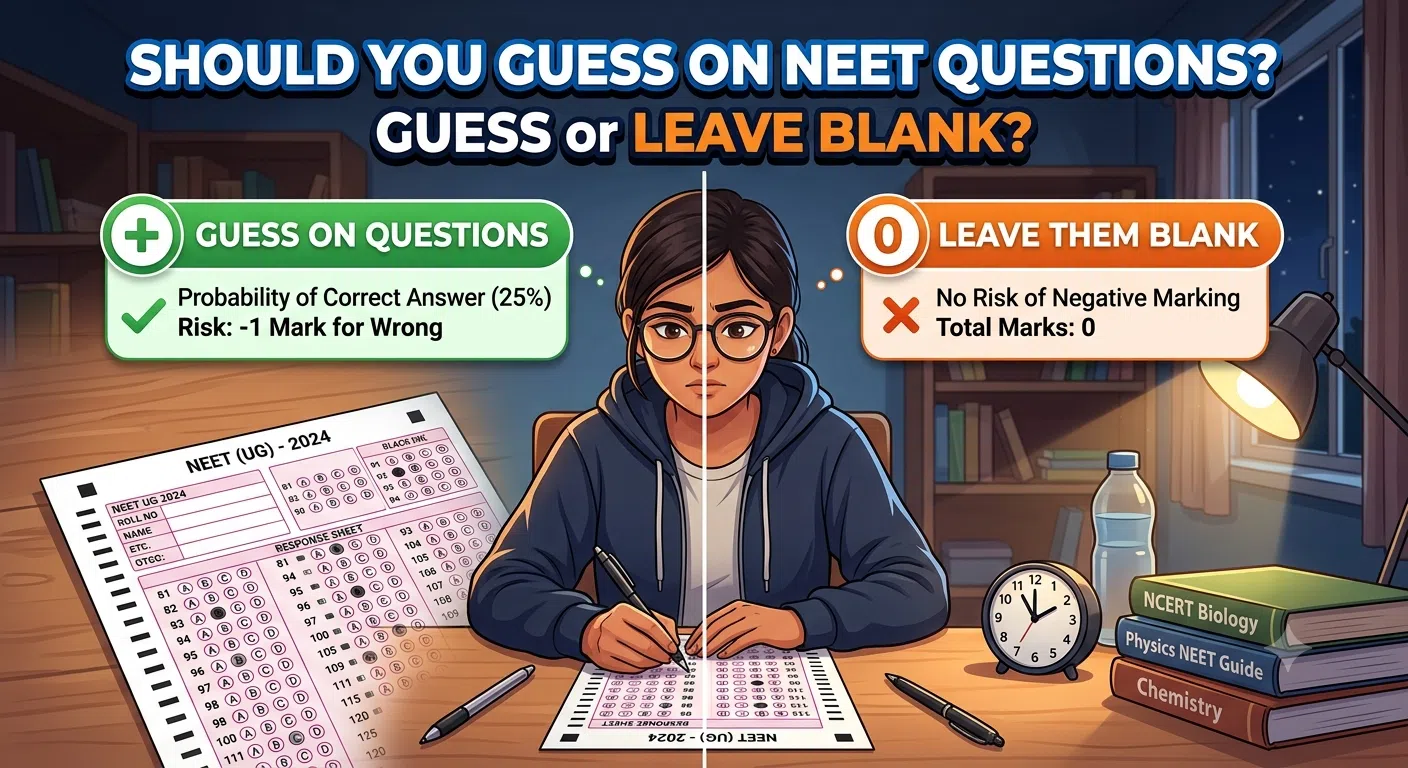
Every NEET aspirant hits this wall at some point during a mock test — you're staring at a question, and you've narrowed it down to two options, but you're just not sure. Do you go with your gut, or do you play it safe and move on? It's one of those decisions that seems small in the moment but can quietly shape your final score.
Let's break down what actually happens with NEET's marking scheme first, because that's the real starting point for this decision. NEET awards +4 for a correct answer and deducts -1 for a wrong one. Unanswered questions carry no penalty at all. So on paper, it looks like a simple math problem — and in some ways, it is. But the honest answer to "should I guess?" isn't a flat yes or no. It depends on how much you actually know.
When Guessing Makes Sense
If you can eliminate even one or two options out of four, the odds start tilting in your favor. Say you're down to two choices — that's a 50% shot at gaining 4 marks, against a 50% chance of losing 1. Run that math over ten similar situations, and you'll likely come out ahead. This is what teachers at coaching institutes call an "educated guess," and it's a completely different animal from a random shot in the dark.
Where students go wrong is treating every guess the same way. Eliminating wrong options using basic concept knowledge — even shaky, half-remembered knowledge — is still a mathematical edge. Total blind guessing, where all four options feel equally plausible, is where the math turns against you. In that case, you're looking at a 25% chance of gaining marks versus a 75% chance of losing them. That's not a gamble worth taking, especially in an exam where every mark decides your rank among lakhs of candidates.
Why Leaving It Blank Isn't "Giving Up"
There's a strange guilt that creeps in when students leave a question blank — like they're admitting defeat. But that mindset needs to go. Leaving a genuinely unknown question blank isn't weakness; it's damage control. Protecting your score from unnecessary negative marking is just as strategic as answering correctly. Many toppers will tell you their success wasn't about knowing everything — it was about knowing exactly where to hold back.
The Real Skill Is Self-Assessment
This is honestly where most students struggle, and it's rarely talked about enough. The ability to guess wisely isn't really about guessing at all — it's about accurately judging your own confidence level in real time, under pressure, with the clock ticking. That kind of judgment doesn't come naturally. It's built through repeated exposure to mock tests, reviewing your mistakes, and noticing patterns in where your confidence tends to mislead you.
This is exactly the kind of skill that structured mock-test analysis and mentorship can sharpen far faster than solo practice. Some of the top NEET coaching classes in Bhopal have started building dedicated modules around this — teaching students not just content, but decision-making under exam conditions. It sounds like a small addition to a syllabus, but for borderline scorers, this single skill can be the difference between a decent rank and a great one.
A Simple Rule of Thumb
If you had to walk away with one practical takeaway, it's this: guess only when you can eliminate at least one option. If a question feels completely unfamiliar — like you're seeing the concept for the first time — skip it without hesitation and move forward. Don't let one tough question eat into the time you need for questions you actually know well.
Final Thought
NEET isn't only a test of what you've memorized; it's also a test of how well you manage uncertainty under time pressure. Smart guessing, paired with disciplined skipping, is a strategy in itself — one that separates students who panic through the paper from those who move through it with a clear head. Practice this decision-making as seriously as you practice biology diagrams or chemistry equations, and it'll pay off on exam day.